

Kenya Entry Requirements 2027: The eTA, Passport, Health and Customs Checklist
Kenya swapped the visa for an online eTA in 2024, added compulsory health insurance in October 2026 and tightened airport health screening, so plenty of the guides you'll find are already out of date.

Departure lounge seats looking out at a passenger aircraft at the gate, the moment before check-in when Kenya entry requirements and eTA approval decide whether you board.
Heathrow. 8:50pm. Our phone buzzes with a message from a guest standing at a check-in desk. The agent has typed her passport number three times and the screen still shows no Kenya authorization. She’d read the Kenya entry requirements twice and ticked every box. She applied for her eTA in May. She renewed her passport in July.
The fix took eleven minutes. A fresh application on her phone, the expedited option at an extra USD 100 and an approval email before the agent had finished with the next passenger. She boarded. That’s the good version of this story. The usual version ends with a missed flight.
We’re a Nairobi-based safari operator. We’ve watched this paperwork change faster than any camp rate or park fee. The eTA replaced the visa in January 2024. Most of Africa was exempted from it in 2025. In In the first week of October 2026 the application grew a mandatory health-insurance step. Ebola screening added a health checkpoint to arrivals at Jomo Kenyatta International Airport. Plenty of pages that rank for this topic still quote fees from 2024.
Here’s our view. Kenya’s entry rules aren’t hard. They’re specific. They punish the traveller who checks once and trusts it. What follows is the checklist as it stands today, written by people who meet guests at the other end of it, with the Kenyan figures checked against government sources and dated so you can tell when they go stale.
| QUICK ANSWER | Do I need a visa to enter Kenya? No visa is needed, but the Kenya entry requirements now include an approved eTA for nearly every foreign visitor. Kenya replaced its visa system with the online Electronic Travel Authorization on 1st January 2024. Apply at etakenya.go.ke. Citizens of East African Community states and most African countries are exempt. |
AT A GLANCE:
- Entry document: an approved Kenya eTA for every traveller whose passport isn’t exempt, infants included. It isn’t a visa and it doesn’t guarantee entry.
- Where to apply: etakenya.go.ke or the Kenya Travel Authorization app, both run by the Directorate of Immigration Services.
- Cost: USD 30 for a standard single-entry eTA. Expedited processing adds USD 100. Mandatory travel health insurance is bought on top (USD 44 premium, about USD 52 at checkout).
- Processing: up to 3 working days as standard. Immigration recommends applying at least 2 weeks before you fly.
- Validity: 90 days from the issue date to enter Kenya. The immigration officer sets your length of stay on arrival.
- Passport: valid for at least 6 months after you arrive. The portal asks for 1 blank page and UK FCDO advice says 2, so carry 2.
- Yellow fever: a certificate is needed only if you arrive from a risk country or spend 12 hours or more in transit through one.
- Customs: declare cash above USD 10,000 and goods worth USD 500 or more that stay in Kenya. Drones need Kenya Civil Aviation Authority approval before you fly.
What are the Kenya entry requirements for 2027?
It’s a short list with a long tail of exceptions. Most travellers need the first four items below. The last two depend on your route and your luggage.
- A passport valid for at least six months after your arrival date. Carry two blank pages.
- An approved eTA for every traveller, infants included, unless your passport is on Kenya’s exemption list.
- Proof of Kenya’s mandatory travel health insurance, which the eTA application now checks before you can pay.
- Your arrival and departure itinerary plus confirmed accommodation, both of which the eTA form asks for.
- A yellow fever certificate, but only if your route triggers the rule.
- A completed customs declaration and nothing in your bag that needs a permit.
Everything below expands one of those lines. Where the Kenyan portal and other governments’ advice disagree, we say so and tell you which way to lean.
Do you need a visa or an eTA to enter Kenya in 2027?
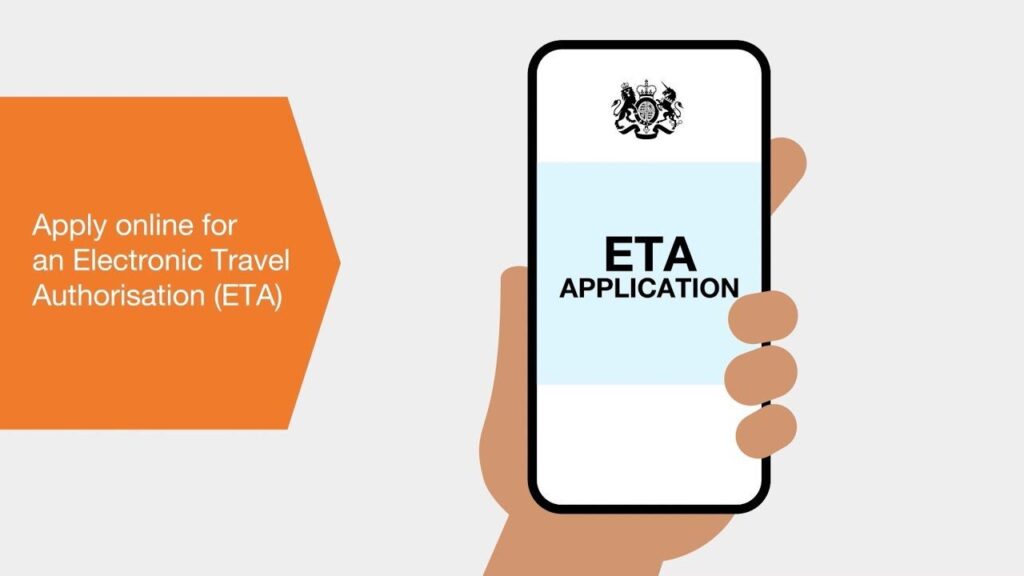
You don’t need a visa. You do need an eTA unless your passport is exempt. Kenya announced visa-free entry from 1st January 2024 and attached an online Electronic Travel Authorization to it, which is why you’ll see the country described as both visa-free and permit-required. Both descriptions are true.
Is an eTA the same as a visa?
No. A visa is permission to enter. The eTA is permission to travel, issued by the Directorate of Immigration Services after a check of the details you submit. The Kenyan portal is blunt about the difference: holding an eTA isn’t the final authority to enter. Admissibility is decided at the point of entry.
An eTA is permission to board. Immigration at the airport still decides whether you walk in.
In practice the officer at passport control is looking at three things: an approved eTA, a passport that matches it and an itinerary that makes sense. Give them those and the conversation is short.
Can you fly to Kenya without a visa?
Yes, because there’s no visa to buy. What you can’t do is fly without an approved eTA. Airlines check authorization at the departure desk and can refuse to board you, which is exactly what the Kenyan portal warns about.
What happens if you arrive in Kenya without an eTA?
Don’t plan on fixing it on arrival. Visas on arrival ended when the eTA launched. The portal’s own wording for non-compliance is denied boarding, a penalty fee on arrival or deportation. If you discover the gap at a check-in desk, apply on the spot and choose the expedited option, which the portal says is processed immediately for an extra USD 100. Approval still depends on your application passing the checks, so don’t treat it as a purchase.
Which countries can enter Kenya without a visa or an eTA?
Kenya publishes a long exemption list under the Citizenship and Immigration (Amendment) Rules, 2025. The short version:
- East African Community partner states. Citizens of Burundi, the Democratic Republic of Congo, Rwanda, South Sudan, Tanzania and Uganda can stay up to 180 days.
- Africa. In practice every African country except Libya and Somalia is exempt, for up to 90 days (Botswana, Ethiopia, Ghana, Mauritius, South Africa, Zambia and Zimbabwe are among them) or up to 60 days (Egypt, Morocco, Nigeria, Senegal and Tunisia are among them).
- Other countries. A defined list for up to 90 days, including Barbados, Belize, Brunei, Cyprus, Fiji, Jamaica, Malaysia, the Maldives, Singapore and Trinidad and Tobago.
- Residents and transit. Holders of Kenyan permanent residence or valid work permits and passes. Airside transit passengers who never leave the airport precincts.
UK, US, Canadian, Australian and most EU passport holders aren’t on any exemption list, so all of them need the eTA. The lists change. Check yours on the portal’s How to Apply page before you rely on this paragraph.
Kenya eTA requirements for US and UK citizens

US and UK citizens apply for the same eTA as everyone else, at the same fee, through the same portal. The differences are in the small print.
- British citizens. UK FCDO advice, current as of 14th October 2026, asks for a passport that expires at least six months after you arrive with at least two blank pages. It also says the Kenyan authorities recommend applying at least two weeks before departure.
- American citizens. The standard eTA is single entry. The portal also lists a one-year multiple-entry eTA at USD 300 and a five-year multiple-entry eTA at USD 185 for American nationals, which only makes sense if you’re planning repeat trips.
- Both. Both groups meet the insurance step described in the cost section below. Both also need a departure plan on the form.
For a first safari the standard eTA is the right one. Skip the multiple-entry options unless a second trip is already on the calendar. Our Kenya eTA visa guide for UK, US and EU travellers walks through the application screens for each passport.
How do you apply for the Kenya eTA, step by step?


Use the official portal at etakenya.go.ke or the Kenya Travel Authorization mobile app and nothing else. The Kenyan embassy in Vienna warns about websites imitating the portal. A lookalike site can take your money and your passport details.
- Gather your documents. Passport bio page, a selfie or passport-style photo, email address, phone number, arrival and departure itinerary, accommodation confirmations and a payment card. Business and family visits need an invitation letter.
- Start the application. Choose Apply Now. Families and groups should choose Apply as a Group, because every passenger still needs their own eTA.
- Enter your details exactly as they appear in your passport. Check the passport number, the spelling of every name and every date before you submit.
- Complete the insurance step. The portal looks for valid cover and prompts you to buy it if it finds none. You can also buy it in advance on the eCitizen portal.
- Pay by card. Keep both confirmation emails: one for receipt of the application and one for payment.
- Wait for the decision. An approval or refusal email follows the immigration officer’s review. Download the PDF attached to the approval.
- Save it twice. Keep the PDF on your phone or in the app and carry one paper copy. The portal says the eTA must be shown at every departure and arrival point.
- Check the status. Use your reference number on the portal’s status page whenever you want to see where the application stands.
Four mistakes that cost people a second fee
The Kenyan terms are plain. The fee is non-refundable. If you apply with mistakes you might need to submit a new application and pay again. These are the four we’d watch.
- Typing details from memory. Read the passport. Don’t recall it.
- Applying on a lookalike site. Only etakenya.go.ke and the official app count.
- Renewing your passport after you apply. The eTA was issued against the details you submitted, so treat a new passport as a reason to apply again.
- Applying once for a family. Every passenger needs their own eTA, children included.
The eTA belongs to the passport you typed in, not to you.
| EXPERT NOTE | Order of operations Do the dull things in this order: check the passport expiry against your arrival date, book flights and the first night’s accommodation, buy the insurance, then open the eTA form. The form asks for your itinerary and accommodation. Applying with placeholder details is how typos creep in. Keep the eTA PDF, the insurance reference and a passport scan in one phone folder and a printed set in your carry-on. Hellen Asiko, Director & Guest Experience Curator |
How long does the eTA take and how much does it cost?
| QUICK ANSWER | How long does the Kenya eTA take? The official processing time is three working days, though some applications take longer. Expedited processing is available for an extra USD 100. Kenya’s immigration directorate recommends applying at least two weeks before you fly. Treat three days as the minimum rather than the average. |
| QUICK ANSWER | How much does the Kenya eTA cost? A standard single-entry eTA costs USD 30 per person, children and infants included. Expedited processing adds USD 100. Since early October 2026 the application also requires Kenya’s mandatory travel health insurance, a USD 44 premium that came to about USD 52 at checkout. The eTA fee is non-refundable. |
The Kenya eTA fee table
| Type | Fee (USD) | What it covers |
| Standard eTA | 30 | One entry into Kenya, valid for 90 days from the issue date |
| Expedited processing | 100 on top | Immediate processing instead of up to 72 hours |
| Transit eTA | 20 | Transit flights through Kenya (airside transit with no airport exit needs no eTA) |
| One-year multiple-entry eTA | 300 | Multiple entries over one year |
| Five-year multiple-entry eTA | 185 | Multiple entries over five years, listed for American nationals |
| East African Tourist eTA | Not yet | Listed on the portal as coming soon |
Source: Kenya eTA portal eligibility page, checked 14th October 2026.
The portal says applications are generally processed within three business days but may take longer while details are verified. Expedited applications are processed immediately. We’d pay the extra USD 100 only if you’re inside two weeks or fixing a mistake.
Once issued, the eTA is valid for 90 days. You must enter Kenya inside that window or it lapses. Your length of stay is set by the immigration officer at the point of entry, not by the eTA. A standard eTA is single entry, with one exception for East African itineraries that we explain in the Tanzania, Uganda and Rwanda section below.
The new travel health insurance step
Since the first week of October 2026 Kenya’s Ministry of Health has required foreign visitors staying less than 12 months to hold travel health insurance. The eTA application won’t complete until the system finds valid cover. UK FCDO advice confirms the requirement. The premium shown on the government’s eCitizen portal was USD 44 in the first days of enforcement. You can buy it inside the eTA form or ahead of time on eCitizen.
What the cover has to include, whether the policy you already hold counts, how long Kenya’s policy runs and what happened in the court challenge are all still shifting week to week. We keep that detail in one place so it doesn’t contradict itself: our Kenya safari travel insurance guide.
What passport validity and documents do you need?
Passport validity required for Kenya
Your passport must be valid for at least six months after the day you arrive. Count from your arrival date, not your departure date and not today. A passport that expires five months after you land will fail at the eTA form and at the airline desk.
Blank pages are where the sources disagree. The Kenyan portal asks for one. UK FCDO advice asks for two. Carry two and the question never comes up.
What to carry in your hand luggage
- Your passport, the original.
- The approved eTA, printed and saved on your phone.
- Proof of your Kenyan travel health insurance, including the reference number.
- Your arrival and departure itinerary, which doubles as proof of onward travel.
- Accommodation confirmations for every night you’ve booked.
- Your yellow fever certificate if your route triggers the rule.
- An invitation letter if you’re visiting family or travelling for business.
- Medical paperwork for any controlled or injectable medicine.
Immigration may ask for any of these. Keep them in one folder, because fumbling through a day bag at passport control is how a two-minute stop turns into a long one.
Do you need a yellow fever certificate or other health documents?
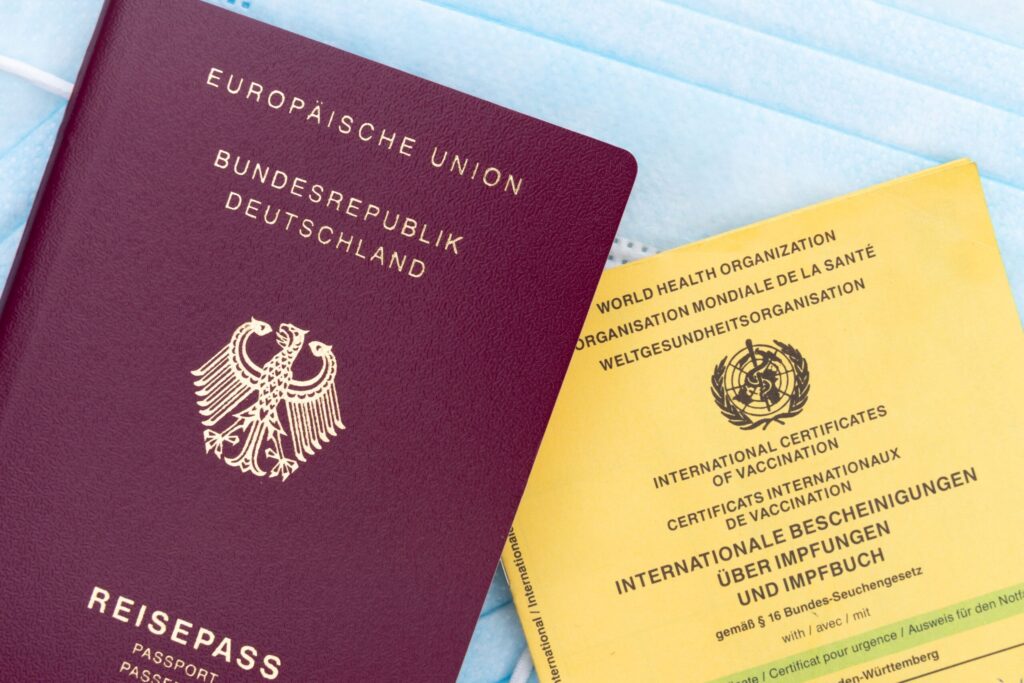
| QUICK ANSWER | Do I need a yellow fever certificate for Kenya? Not usually: you need one only if you arrive from a yellow fever risk country or spend 12 hours or more in transit through one. Arriving from the UK or US does not trigger it. Travellers under one year are exempt. Vaccinate at least ten days ahead. |
Kenya asks about the route you flew, not the destination you’re heading to. The Ministry of Health says travellers arriving from countries where yellow fever is endemic should present a valid certificate. The World Health Organization’s list of risk countries draws the boundary. The Kenya Airports Authority states that airport transits of 12 hours or more count.
Who needs the certificate
- You flew in from a risk country such as Ethiopia, Uganda, the Democratic Republic of Congo or South Sudan.
- You spent 12 hours or more in transit through one, even without leaving the airport. A shorter connection through Addis Ababa doesn’t trigger it.
Medical exemptions exist, according to the Ministry of Health: infants younger than nine months, pregnant women outside an outbreak, people with a severe egg-protein allergy and people with severe immunodeficiency. If one applies to you, speak to your doctor before you travel and carry their documentation.
Timing and validity
Vaccinate at least ten days before you travel, which is Kenya’s Port Health guidance. After that a certificate is valid for life. The World Health Organization removed the ten-year expiry in July 2016. A valid certificate can’t be rejected because ten years have passed. Carry the original yellow card, not a photo of it. Port Health clinics at Kenyan airports do offer the vaccine, but the ten-day rule means they can’t rescue a flight that leaves in two days.
Kenya asks where you flew from, not where you’re going.
| EXPERT NOTE | Required is not the same as recommended Kenya’s entry rule is a question about your route. The health advice is a question about your itinerary. The two don’t match. UK health advisers recommend yellow fever vaccination from nine months for most Kenyan itineraries, including the Masai Mara, Tsavo and Lake Nakuru. They generally advise against it for trips limited to Nairobi, Mombasa and parts of the coast. Malaria is a separate decision again: TravelHealthPro rates the risk as high across most of Kenya and very low only in Nairobi and the highlands above 2,500 metres. None of that is checked at the border. All of it matters on the ground. Kibara Mugo, Safari Writer and East Africa Specialist |
Our safari vaccinations and health guide covers the recommendations in full.
COVID-19, health forms and Port Health
Kenya no longer asks arriving travellers for proof of COVID-19 vaccination or a pre-departure test. Port Health officers can still screen anyone for symptoms and ask for a health declaration. The Ministry of Health’s traveller page lists a locator form for air passengers and a surveillance form for land crossings. The extra Ebola-related requirements are in the next section.
What are the current travel restrictions in Kenya?
No entry ban applies to tourists. Kenya has kept its airports and borders open. What has changed is the health screening at the door and the paperwork behind it.
Ebola screening at JKIA and the border posts
Kenya confirmed its first imported case of Bundibugyo virus disease, a form of Ebola, on 6th October 2026. The patient had travelled from the Democratic Republic of Congo and died in isolation. The Ministry of Health says Kenya isn’t experiencing an outbreak and, as of 14th October, no further case had been reported. The World Health Organization has declared the wider outbreak centred on the Democratic Republic of Congo a public health emergency of international concern.
At Jomo Kenyatta International Airport screening has been intensified at a dedicated gate for arrivals from the Democratic Republic of Congo, Uganda, Tanzania, Ethiopia, Angola, Zambia, Rwanda, Burundi, the Central African Republic and South Sudan. Travellers from the Democratic Republic of Congo or Uganda must complete the online Electronic Traveller Surveillance Form before landing. On 12th October the government gazetted the Public Health (Ebola Disease) Rules, 2026, which give health officers legal powers over entry screening, isolation and quarantine.
UK FCDO advice says travellers arriving in Kenya, particularly from Uganda, Ethiopia and the Democratic Republic of Congo, may face enhanced health screening. If you haven’t been near those countries, expect a temperature check and a few questions. If you have, allow extra time and answer honestly.
Government travel advisories
UK FCDO advises against all travel to Mandera County, to parts of Wajir and Garissa counties and to Lamu County except Lamu Island and Manda Island. It advises against all but essential travel to Garissa Town, parts of Tana River County and the strip within 15 kilometres of the east coast between the Tana and Galana rivers. The main safari areas (the Masai Mara, Amboseli, Laikipia, Samburu, Tsavo and the Rift Valley lakes) sit outside those zones.
The US State Department rates Kenya Level 2, exercise increased caution, in an advisory issued on 28th July 2026. It lists the Nairobi neighborhoods of Eastleigh and Kibera at Level 4, do not travel. It also strongly recommends travel insurance. Neither advisory restricts where tourists on a standard safari route can go.
What can you bring in and what must you declare at customs?

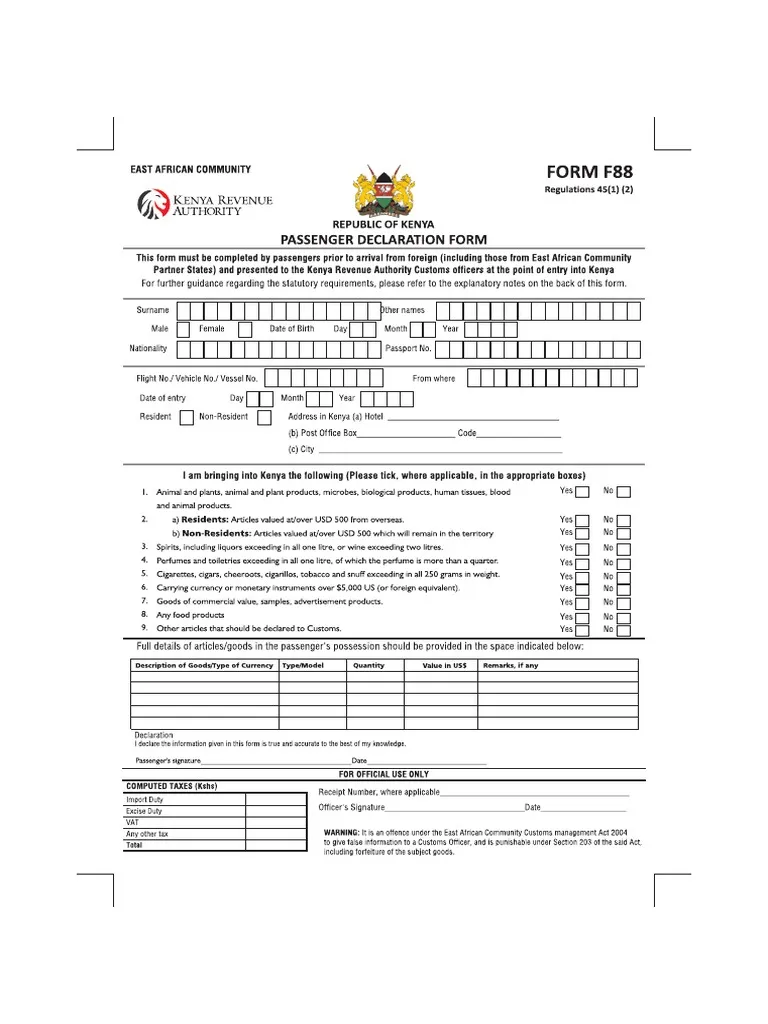
Kenya runs a two-channel customs system. Green is for passengers with nothing to declare and red is for everyone else. Every arriving passenger completes the Kenya Revenue Authority’s Passenger Declaration Form (Form F88). Bags from international flights are scanned on arrival.
Duty-free allowances and declaration limits
| Item | Limit or rule |
| Spirits or wine | 1 litre of spirits or 2 litres of wine per adult aged 18 and over |
| Cigarettes, cigars and tobacco | 250 grams in total per adult |
| Goods that stay in Kenya | Declare items worth USD 500 or more (non-residents) |
| Cash and monetary instruments | Declare anything above USD 10,000 or its equivalent on arrival and again before departure |
Source: Kenya Revenue Authority passenger declaration form and customs FAQs. Check kra.go.ke before you fly.
What to leave at home or sort out first
- Drones. It’s illegal to import or export a drone without prior approval from the Kenya Civil Aviation Authority, according to UK FCDO advice. Apply well before you fly. Even with approval, drone flights are restricted in most national parks and reserves, so ask before you pack one.
- Plastic carrier bags. Kenya has banned them since 2017. The National Environment Management Authority says duty-free carrier bags must be left at the point of entry. Reusable zip-lock pouches for toiletries are widely accepted. Supermarket-style carrier bags aren’t.
- Camouflage clothing. Leave it at home. Kenya reserves military-style dress for its security forces. Wearing camouflage can get you stopped and questioned or asked to hand the garment over. Khaki, olive and neutral tones are fine.
- Medicines. Personal prescription medicines are fine in sensible quantities when carried in original packaging with a copy of the prescription and a doctor’s letter. Controlled medicines such as codeine, other opioids and ADHD stimulants can need permission from the Pharmacy and Poisons Board. Declare them and carry the paperwork.
- Prohibited items. Narcotic drugs, counterfeit currency and counterfeit goods are prohibited outright.
Our African safari packing list covers the rest of what goes in the bag.
What changes if you travel on to Tanzania, Uganda or Rwanda?
Kenya’s rules stop at the border. Your eTA doesn’t carry you through the next country’s immigration desk. Three things change: the entry document, the yellow card and the re-entry rule.
| Tanzania | Uganda | Rwanda | |
| Entry document | Visa: USD 50 single entry. US citizens pay USD 100 for a multiple-entry visa. | e-Visa applied for online: USD 50 for a single-entry tourist visa valid 90 days. | Visa on arrival or online: USD 50 for 30 days. Multiple entry costs USD 70. |
| Yellow fever certificate | Asked for if you arrive from Kenya or another risk country. | Uganda announced on 2nd October 2026 that it’s no longer a mandatory entry requirement. Confirm before you fly. | Asked for if you arrive from a risk country. Kenya is on the list. |
| Watch for | Zanzibar charges its own compulsory USD 44 visitor insurance. | Ebola advisories were raised in May 2026. Uganda has since declared its outbreak over. | Advisories were raised in May 2026. Check your government’s current level. |
Sources: Tanzania fees as listed by operators and the Immigration Services portal; Uganda immigration notice of 2nd October 2026; US State Department Rwanda guidance. Confirm each on the government’s own portal.
The East Africa Tourist Visa
The East Africa Tourist Visa costs USD 100, lasts 90 days and allows multiple entries across Kenya, Uganda and Rwanda. It doesn’t cover Tanzania. It must be issued by the country where you first enter the region, according to Uganda’s immigration service. On paper it saves about USD 30 against three separate permits.
Kenya’s own portal lists an East African Tourist eTA as coming soon. As of 14th October 2026 it isn’t available there. So if Nairobi is your first stop, apply for the Kenya eTA and buy your Uganda and Rwanda permits separately. If Entebbe or Kigali comes first the East Africa Tourist Visa can work, but confirm Kenya will accept it before you pay.
Coming back into Kenya on the same eTA
A standard eTA is single entry, with one exception. It stays valid for a return to Kenya if, inside its 90 days, you visit only an East African Community partner state (Burundi, the Democratic Republic of Congo, Rwanda, South Sudan, Tanzania or Uganda) and no other country. A Kenya, Tanzania and Kenya loop works on one eTA. Add a stopover in Dubai or Addis Ababa and you should apply for a second eTA instead of testing the rule at the desk.
| EXPERT NOTE | Land borders At a land border every passenger presents in person, so keep passports, eTA printouts, yellow cards and insurance proof in one folder in your day bag. Don’t leave them in luggage strapped to the roof or stacked in the back of the vehicle. Your guide can walk you to the right window but can’t present on your behalf. Nicholas Wangithi, Director & Founder |
One more check before you add Uganda or Rwanda. Several governments raised their advisories for both countries in May 2026. Some restricted entry for certain travellers who’d recently been in Uganda or the Democratic Republic of Congo. Those rules were adjusted at different times, so check your own government’s current guidance for the journey home as well as the journey out.
When should you apply before a safari trip?

| QUICK ANSWER | How early should I apply for the Kenya eTA? Apply at least two weeks before you fly, as Kenya’s immigration directorate recommends. Three days is the stated minimum, but processing can run longer. The eTA is valid for 90 days from issue, so avoid applying more than two months ahead. Book flights and accommodation first. |
Our own rule is three to four weeks out. That’s late enough that the 90-day validity won’t lapse before you land and early enough to absorb a slow approval or a typo.
| When | What to do |
| 10 to 12 weeks out | Check your passport expiry against six months after your arrival date. Renew now if it fails. Book flights and accommodation. |
| 6 to 8 weeks out | Book a yellow fever appointment if your route needs one. UK health advisers suggest a travel health appointment four to six weeks before you go. Ask your doctor about malaria tablets. |
| 3 to 4 weeks out | Buy Kenya’s travel health insurance and apply for the eTA. This is our recommended window. |
| 2 weeks out | The latest date Kenya’s immigration directorate recommends. If you’re inside it, consider the expedited option. |
| 3 days out | The stated minimum. Don’t plan around it. |
| 48 hours out | Download the eTA PDF, print one copy, save the insurance reference and check every detail against your passport. Put the yellow card in your carry-on. |
| Travel day | Show the eTA at check-in. Complete any health form you are handed at arrivals. Declare cash and goods that need declaring. |
If this is your first trip, our first safari guide puts this timeline next to everything else you need to book.
What could change before you fly?
Four things are still moving as we write this. Any of them could change the checklist by the time you travel.
- The East African Tourist eTA. The portal lists it as coming soon.
- The insurance rule. As of early October 2026, the authorities hadn’t said whether one policy covers several entries or how foreign policies are treated.
- Ebola screening. The new rules were gazetted on 12th October and the Ministry of Health hasn’t said how long they’ll stay in force.
- Neighbouring countries. Tanzania, Uganda and Rwanda each set their own entry and health rules and any of them can change without much warning.
We review this guide quarterly. The date at the top shows the last check.
Frequently asked questions about Kenya entry requirements
Do babies and children need their own Kenya eTA?
Yes. Every visitor needs an approved eTA before the journey starts, infants and children included. Each child’s eTA is a separate application with a separate USD 30 fee. A parent or guardian is responsible for the information submitted. Group applications are possible but each passenger still gets their own eTA.
How long can I stay in Kenya on an eTA?
The eTA is valid for 90 days to enter, but the immigration officer sets your length of stay at the point of entry. Many tourists are admitted for up to 90 days. Check the length of stay you’ve been given before you leave the desk.
Do I need a return ticket to enter Kenya?
In practice, yes. The eTA form asks for your arrival and departure itinerary and immigration can ask to see it. Book your departure flight before you apply and keep the itinerary in your hand luggage.
Do I need a yellow fever certificate if I connect through Addis Ababa?
Only if the connection lasts 12 hours or more. Ethiopia is on the World Health Organization’s list of yellow fever risk countries. The Kenya Airports Authority counts airport transits of 12 hours or more as arriving from a risk country. A shorter connection doesn’t trigger the rule. Carry your certificate anyway if you have one, because it costs nothing to have it.
Do I need to print my eTA?
Not strictly, but you should. The portal says you can print the approval PDF or save it on your phone or in the Kenya Travel Authorization app. It has to be shown at every departure and arrival point. Phones die at the worst moments. Carry one paper copy.
Is the Kenya eTA fee refundable if I am refused or my plans change?
No. The portal’s terms say the fee is non-refundable and can’t be transferred, even if your eTA is denied or something changes your journey. If you’re refused, the portal says you can’t travel for now and points you to the eTA helpdesk to find out why.
Can a travel agent or operator apply for my eTA?
Yes. The portal allows someone to apply on behalf of another traveller as long as the form says so and the traveler’s details are correct. Whoever submits it, check the confirmation against the passport yourself.
Can I bring a drone to Kenya?
Only with prior approval from the Kenya Civil Aviation Authority. UK FCDO advice calls it illegal to import or export a drone without that approval and says to contact the authority well before you travel. Even with approval, most national parks and reserves restrict drone flights.
Can I bring prescription medicine into Kenya?
Yes, in personal quantities. Keep medicines in their original packaging with your name on the label and carry a copy of the prescription and a doctor’s letter. Controlled medicines such as codeine, other opioids and ADHD stimulants can need permission from the Pharmacy and Poisons Board, so ask well before you fly and declare them on arrival.
Do I need an eTA if I am only transiting through Nairobi?
Not if you stay airside. Passengers who change aircraft or continue on the same aircraft without leaving the airport precincts are exempt. If you want to leave the airport during a long layover you need an eTA. The portal lists a Transit eTA at USD 20 for transit travellers.
Let us check your documents before you fly


Passport dates, eTA, insurance, yellow card and a customs bag. None of it is complicated and all of it is unforgiving at a check-in desk at 8:50pm. The woman at Heathrow made her flight because she had one thing to fix and eleven minutes to fix it. Most problems aren’t that obliging.
Afrikan Accent Adventures is a Nairobi-based safari operator, so we can hold your real documents up against your real route, which is where Kenya’s rules bite. Send us your passport expiry date, flight route and travel dates and our team will check them against everything in this guide. Hellen Asiko, our Director & Guest Experience Curator, handles guest planning and logistics and is the person to ask for. Our trips run across Kenya, Tanzania, Uganda and Rwanda, so we know where the rules change between them.
Ask our team to check your documents before you fly, so that check-in is seamless.
Let's plan your East African safari
Tell us when you'd love to travel and a local specialist will craft a tailor-made route around you.


