


Planning & Tips
Solo Safari in Kenya: What the Single Supplement Really Costs and How to Cut It
We priced eleven safaris for one traveller, from a USD 650 shared tent in the Siana Conservancy to…
Read more →
Explore Tsavo National Park: red dust elephants, volcanic lava flows, Mzima Springs, and luxury 4x4 safaris in Tsavo East & West.
Tsavo National Park is one of Kenya’s most remarkable safari destinations and one of the largest protected The road into Tsavo starts long before the gate. The red soil begins to show through the grass, baobabs appear against the horizon and the traffic thins as the landscape opens into something much larger than the coast you have just left behind. Then the first elephant appears, dust-red from head to tail, walking across the track as if the vehicle simply isn’t there. In Tsavo, moments like that are not unusual. They are the reason the journey south becomes part of the safari itself.
Tsavo National Park is one of Kenya’s defining wilderness destinations and one of the largest protected wildlife landscapes in East Africa. The name actually refers to two adjoining national parks, Tsavo East National Park and Tsavo West National Park, separated by the Nairobi–Mombasa highway and railway line. Together, they form the core of the vast Tsavo Conservation Area, a landscape of roughly 22,000 square kilometres that stretches across southeastern Kenya.
Tsavo National Park is different from the Masai Mara, Amboseli or Samburu. It is bigger, drier, more rugged and, in many areas, considerably less developed. The landscape changes constantly: red-earth plains in Tsavo East, volcanic hills and lava flows in Tsavo West, underground springs, baobab-dotted bushland, rocky outcrops and enormous stretches of wilderness where the next vehicle may be many kilometres away.
What makes Tsavo National Park especially compelling is the combination of scale and character. The park is famous for its large elephant herds, often coated in the distinctive red dust of Tsavo, as well as lion, leopard, buffalo, giraffe, zebra, antelope and hundreds of bird species. Tsavo West adds Mzima Springs, the Shetani Lava Flow, the Tsavo West Rhino Sanctuary and dramatic volcanic scenery, while Tsavo East is known for the Galana River, Yatta Plateau, Lugard’s Falls, Mudanda Rock and expansive wildlife plains.
We send guests to Tsavo National Park for a safari that feels genuinely wild without requiring a remote expedition. It is particularly practical for travellers staying on the Kenyan coast, because Tsavo East can be reached from Mombasa in a few hours and the parks can be combined with Diani, Mombasa, Watamu or Malindi. For travellers coming from Nairobi, Tsavo also works naturally as the southern beginning or final section of a longer Kenya safari.
Tsavo National Park is a vast protected wildlife area in southeastern Kenya made up of Tsavo East National Park and Tsavo West National Park. Tsavo East covers approximately 13,747 square kilometres, while Tsavo West covers approximately 9,065 square kilometres. Together with surrounding protected landscapes, they form part of the approximately 22,000-square-kilometre Tsavo Conservation Area. Tsavo National Park is famous for red elephants, large wilderness landscapes, diverse wildlife, volcanic scenery, Mzima Springs, Yatta Plateau and the historic man-eating lions of Tsavo.
Location: Southeastern Kenya, primarily in Taita-Taveta County and adjoining areas
Made up of: Tsavo East National Park and Tsavo West National Park
Tsavo East size: Approximately 13,747 square kilometres
Tsavo West size: Approximately 9,065 square kilometres
Combined Tsavo East and Tsavo West area: Approximately 22,812 square kilometres
Tsavo Conservation Area: Approximately 22,000 square kilometres according to Kenya Wildlife Service conservation-area planning
Established: 1948 as Tsavo National Park; divided administratively into Tsavo East and Tsavo West in 1949
Managed by: Kenya Wildlife Service
Known for: Red elephants, Big Five wildlife, Mzima Springs, Yatta Plateau, Lugard’s Falls, Shetani Lava Flow, Tsavo lions and dramatic volcanic landscapes
Major rivers and water sources: Tsavo River, Athi River, Galana River and Mzima Springs
Main access from Mombasa: Bachuma Gate, Voi Gate and other Tsavo East entrances
Main access from Nairobi: Mtito Andei and other Tsavo West approaches
Nearest major towns: Voi, Mtito Andei and Taveta
Nearest international tourism hubs: Nairobi and Mombasa
Best for: Big Five safaris, elephant photography, wilderness, road safaris, coastal safari combinations, geological landscapes and shorter Kenya safari extensions
Tsavo East and Tsavo West are administered as separate national parks, but wildlife moves across the wider ecosystem. The two parks therefore work best when treated as different parts of the same larger Tsavo landscape rather than as completely separate safari destinations.
Tsavo East is the larger and more open half of Tsavo National Park. Covering approximately 13,747 square kilometres, it is Kenya’s largest national park and one of the country’s great wilderness landscapes.
The first thing many visitors notice in Tsavo East is the colour. The soil is intensely red, and elephants that dust-bathe or walk through the dry earth can appear almost completely red from a distance. These are the famous red elephants of Tsavo, one of the visual signatures of the park.
Tsavo East is dominated by broad semi-arid plains, acacia scrub, rocky outcrops and riverine habitats. The Galana River cuts through the landscape, providing an important source of water, while the Tsavo and Athi rivers also contribute to the ecological character of the wider park.
The scale of Tsavo East changes the way a safari feels. In some areas you can drive for long periods without seeing another vehicle, and the wilderness seems to extend all the way to the horizon. Wildlife is still concentrated around water and productive habitats, but the sheer size of Tsavo East means that a game drive can feel more exploratory than a tightly concentrated wildlife circuit.
Tsavo East is particularly rewarding for elephants, buffalo, giraffe, zebra, antelope and large predators. The Kenya Wildlife Service also highlights attractions including Aruba Dam, Mudanda Rock, Lugard’s Falls and the park’s famous maneless lions. Tsavo East has recorded more than 500 bird species, making it a strong destination for birdwatchers as well as traditional game-drive travellers.
Tsavo West is the more mountainous and geologically dramatic side of Tsavo National Park. Covering approximately 9,065 square kilometres, it is Kenya’s second-largest national park and is characterized by volcanic hills, lava flows, springs, rocky landscapes and areas of dense bush.
Where Tsavo East often feels expansive and open, Tsavo West feels more enclosed and varied. A single game drive can move from open savannah to volcanic terrain, from dry bushland to lush springs and from rocky viewpoints to palm-fringed water.
The defining attraction is Mzima Springs, where clear groundwater emerges from beneath the volcanic landscape and forms a series of pools surrounded by green vegetation. Hippos, crocodiles and numerous bird species are associated with the springs, making the area one of the most distinctive stops in Tsavo National Park.
Tsavo West is also home to the Shetani Lava Flow, a dramatic expanse of black volcanic rock created by ancient lava activity. Nearby volcanic features such as Chaimu Hill and the Five Sisters add to the park’s unusual geological character.
The park is also historically important. Tsavo West is associated with the famous man-eating lions of Tsavo, whose attacks on workers constructing the Kenya–Uganda Railway in 1898 became one of the most famous wildlife stories in Africa. The park also contains landscapes associated with the East African Campaign of the First World War.
The red elephants are perhaps the most immediately recognizable wildlife symbol of Tsavo National Park.
Tsavo’s elephants are not naturally red. Their characteristic colour comes from the iron-rich red soil that covers much of the landscape. Elephants regularly dust themselves with earth to help protect their skin from insects, heat and the harsh conditions of the semi-arid environment.
A large herd moving across an open Tsavo East plain can be an extraordinary sight. The contrast between the red elephants, dry grass and blue horizon creates some of the most distinctive wildlife photography opportunities in Kenya.
Elephant sightings are possible in both Tsavo East and Tsavo West, although the open landscapes and water sources of Tsavo East often provide particularly dramatic viewing opportunities.
For photographers, the red elephants are one of the strongest reasons to include Tsavo National Park in a Kenya safari. The combination of elephant behaviour, red earth and low-angle morning or evening light produces images that look completely different from elephant photographs taken in Amboseli or the Mara.
Tsavo National Park supports a remarkable range of wildlife across its enormous landscape. The Big Five are present, including elephant, lion, leopard, buffalo and rhinoceros, although sightings are naturally influenced by season, habitat and the area of the park being visited.
Elephants are the signature species, and large herds can often be encountered around rivers, dams and other water sources.
Lions are another major attraction. Tsavo’s lions have a distinctive place in wildlife history because of the legendary man-eating lions associated with the railway construction of 1898. Modern Tsavo lions are wild predators like lions elsewhere in Kenya, and sightings can range from individual males to prides resting in shade or moving across open country.
Leopards are present but are naturally more elusive. They are most likely to be encountered in riverine habitats, thicker bush and areas where prey species are abundant.
Buffalo are widespread, while giraffe, zebra, hippo, crocodile, warthog, impala, waterbuck, lesser kudu and numerous other antelope species contribute to the diversity of the Tsavo ecosystem.
Tsavo National Park also has important populations of smaller mammals, reptiles and birdlife. Tsavo East alone has more than 500 recorded bird species, while Tsavo West has recorded more than 600 species according to Kenya Wildlife Service.
Tsavo National Park supports elephant, lion, leopard, buffalo and rhinoceros, alongside giraffe, zebra, hippo, crocodile, warthog, waterbuck, impala, lesser kudu and many other species. Tsavo East is particularly famous for its red elephants, while Tsavo West offers strong wildlife viewing around Mzima Springs, water sources and open savannah habitats. The two parks together support hundreds of bird species.
Tsavo National Park is one of the Kenyan destinations where travellers can realistically build a safari around the Big Five, although wildlife sightings are never guaranteed.
Elephant: The easiest of the iconic five to associate with Tsavo. Large herds are regularly seen, particularly around water and productive feeding areas.
Lion: Tsavo has a strong lion population and an extraordinary historical association with the species because of the famous man-eaters of Tsavo.
Leopard: More difficult to spot because of its solitary and secretive nature, but experienced guides know the riverine and bush habitats where sightings are possible.
Buffalo: Often encountered in herds and particularly impressive when large groups gather around water.
Rhinoceros: Tsavo West provides one of the strongest opportunities to learn about rhino conservation through the Tsavo West Rhino Sanctuary, while sightings of wild rhino remain much less predictable than elephant or buffalo sightings.
The Big Five should never be treated as a checklist. Tsavo National Park is large enough that the quality of the experience often comes from the landscape and smaller encounters as much as from ticking off individual species.
Few stories in African safari history are as famous as the man-eating lions of Tsavo.
In 1898, during construction of the Kenya–Uganda Railway, two male lions attacked railway workers in the Tsavo region. The attacks became notorious and eventually entered popular culture through books, museum collections and films.
The story has been retold many times, sometimes with considerable exaggeration, but its historical connection to Tsavo remains important. The lions became part of the mythology surrounding the park and contributed to Tsavo’s reputation as a place of untamed wilderness.
Today, visitors do not come to Tsavo National Park to encounter dangerous man-eaters. They come to observe modern wild lions in their natural environment while understanding the history that made Tsavo one of the world’s most recognizable wildlife landscapes.
Tsavo West’s connection to the story is particularly strong because of its proximity to the historic railway corridor and the landscapes through which the railway was constructed.
Game drives are the central experience in Tsavo National Park.
Morning game drives begin around sunrise, when temperatures are cooler and many animals are active. The soft light is also ideal for photography, particularly when elephants move through the red soil.
Afternoon game drives begin later in the day and continue toward sunset. As temperatures fall, wildlife often becomes more active and the changing light transforms the landscape.
In Tsavo East, game drives can focus on rivers, dams, open plains and rocky viewpoints. In Tsavo West, the route can include springs, volcanic hills, lava flows, woodland and open savannah.
The size of Tsavo National Park means that your guide’s knowledge of current wildlife movements is particularly valuable. Rather than simply following a fixed route, a good guide reads tracks, water availability, recent sightings and animal behaviour to decide where to go.
Photography is one of the strongest reasons to visit Tsavo National Park.
The red soil provides a natural visual identity that is difficult to reproduce elsewhere in Kenya. Elephants walking through the dust, giraffes against baobabs, lions resting in dry grass and buffalo silhouetted against the evening sky all benefit from the park’s strong colours and dramatic light.
Early morning and late afternoon are particularly rewarding for photographers because the low sun produces warmer tones and longer shadows.
Mzima Springs is one of the essential experiences in Tsavo West National Park.
The springs are fed by underground water moving through the volcanic landscape before emerging as clear pools. The surrounding vegetation creates an oasis of green in a landscape that can otherwise appear extremely dry.
Visitors can explore the springs on foot along designated routes, observing hippos, crocodiles, fish and birdlife. The springs have also historically been associated with an underwater viewing chamber, although facilities and access can change, so current conditions should always be confirmed before travelling.
Mzima Springs is particularly valuable for travellers who want something beyond a conventional game drive.
The Shetani Lava Flow is one of the most visually striking geological features in Tsavo West.
The name comes from the Swahili word for devil, reflecting local stories about the black lava field when it emerged from the ground. The hardened lava creates a stark contrast with the surrounding vegetation and demonstrates how volcanic activity has shaped the landscape.
For travellers interested in geology, photography or landscapes, the Shetani Lava Flow adds another dimension to a Tsavo National Park safari.
The Tsavo West Rhino Sanctuary was established to protect black rhinoceros within a secure area of the park.
Rhino conservation is one of the most important wildlife stories in Kenya, and the sanctuary provides an opportunity to understand the work involved in protecting one of Africa’s most threatened large mammals.
Rhino sightings are not guaranteed, but the conservation significance of the sanctuary makes it a valuable part of the Tsavo West experience. Kenya Wildlife Service identifies the sanctuary as one of the key attractions of Tsavo West.
Lugard’s Falls is one of Tsavo East’s most recognizable landscapes.
The name can be misleading because the feature is not a conventional waterfall. Instead, the Galana River has carved a series of rapids and sculpted channels through sandstone and rock, creating dramatic formations as the water moves downstream.
The surrounding landscape provides excellent opportunities for photography, especially when combined with wildlife sightings along the Galana River.
The Yatta Plateau is one of the geological highlights of Tsavo East.
Stretching across the northern side of Tsavo East, the plateau is associated with an ancient lava flow and is recognized as the world’s longest lava flow. Its enormous scale is difficult to appreciate from a single viewpoint, but its presence is one of the reasons Tsavo East feels so geologically different from Kenya’s more familiar savannah parks.
A game drive around Tsavo East therefore becomes more than wildlife viewing. The landscape itself tells the story of ancient volcanic activity, erosion and changing rivers.
Aruba Dam is an important water source and wildlife viewing area in Tsavo East.
During drier periods, water becomes increasingly valuable and wildlife may gather around permanent or semi-permanent sources. Aruba Dam can therefore provide productive game viewing, especially when conditions elsewhere are dry.
The Kenya Wildlife Service lists Aruba Dam Game Viewing Point among the key attractions of Tsavo East.
Mudanda Rock is a large geological formation overlooking a natural water catchment area in Tsavo East.
The elevated viewpoint provides an opportunity to look across the surrounding landscape while watching wildlife below, particularly during dry periods when animals are drawn toward water.
Mudanda Rock is also a good example of how Tsavo combines wildlife and geology. The rock itself is part of the attraction rather than simply a backdrop to a game drive.
Tsavo West contains several elevated viewpoints where visitors can appreciate the park’s rugged topography.
Poacher’s Lookout and Roaring Rocks provide panoramic views across the surrounding wilderness and are especially attractive for photographers and travellers who want to understand the scale of Tsavo West beyond the vehicle.
These viewpoints are also useful reminders that Tsavo is not simply a flat savannah park. Its volcanic hills, rocky ridges and lava formations give it a very different physical character.
Lake Jipe lies near the Kenya–Tanzania border and forms an important wetland habitat on the edge of Tsavo West.
The lake attracts waterbirds and other wildlife and provides a quieter alternative to some of the better-known Tsavo attractions.
For birdwatchers, Lake Jipe can add considerable value to a Tsavo National Park itinerary, particularly when combined with the other wetland and riverine habitats of the region.
Tsavo National Park is an excellent destination for birdwatchers.
Tsavo East has more than 500 recorded bird species, while Tsavo West has more than 600 recorded species. The combination of rivers, springs, open plains, woodland, volcanic terrain and seasonal water sources creates a broad range of habitats.
Migratory birds can add another layer to the birding experience during the appropriate season, while resident species can be observed throughout the year.
A dedicated birding safari in Tsavo benefits from slower game drives, longer stops and a guide who is comfortable identifying calls and smaller species rather than focusing only on large mammals.
Walking opportunities in Tsavo National Park are more restricted than in some private conservancies, but guided walking experiences can be arranged in designated areas and through certain camps or surrounding conservation properties.
Walking changes the way you experience Tsavo. Instead of scanning the horizon for large animals, you begin noticing tracks, insects, plants, droppings, bird calls and geological details.
Any walking activity must follow current Kenya Wildlife Service rules and the guidance of qualified guides or rangers. Visitors should never leave their vehicle independently in wildlife areas.
A bush breakfast or sundowner can turn a conventional game-drive day into a more memorable experience.
After an early morning game drive, some camps arrange breakfast in a designated safe location where guests can sit beneath the open sky and watch the landscape wake up.
In the evening, sundowners provide an opportunity to stop as the temperature drops and the light turns golden across the Tsavo plains.
In Tsavo National Park, the landscape itself is often the highlight. You do not need a spectacular animal sighting every minute when you are watching the sun disappear behind a baobab-covered horizon.
Tsavo National Park is particularly suited to wildlife photography because of its combination of wildlife, colour and scale.
The red elephants are an obvious subject, but photographers can also work with silhouettes, wide environmental portraits, volcanic landscapes, baobabs, birds and dramatic skies.
Tsavo East generally offers wider compositions, while Tsavo West provides more opportunities for layered images involving hills, springs, lava and wildlife.
The main activities in Tsavo National Park include morning and afternoon game drives, red elephant photography, visits to Mzima Springs, Shetani Lava Flow, Lugard’s Falls, Mudanda Rock and Aruba Dam, birdwatching, wildlife photography, selected guided walks, bush breakfasts and sundowners. Tsavo West also offers access to the Rhino Sanctuary and volcanic viewpoints, while Tsavo East is particularly strong for elephants, open landscapes and river-based game viewing.
The question of Tsavo East or Tsavo West is common, but the two parks offer different experiences.
Tsavo East is the larger, more open and more expansive park. It is particularly associated with red elephants, open plains, the Galana River, Lugard’s Falls, Yatta Plateau, Aruba Dam and Mudanda Rock.
Tsavo West is smaller but more geographically varied. It offers Mzima Springs, volcanic hills, Shetani Lava Flow, Lake Jipe, the Rhino Sanctuary and the historical landscapes associated with the man-eating lions.
For a first-time visitor with only two or three nights, the better choice depends heavily on the starting point and interests.
Travellers coming from Mombasa often find Tsavo East especially convenient.
Travellers coming from Nairobi may find Tsavo West easier to incorporate into a southern Kenya route, particularly when combining it with Amboseli.
Travellers with three or more nights can combine both sides and experience a much broader picture of Tsavo National Park.
We rarely recommend choosing between Tsavo East and Tsavo West based only on a list of animals. The route matters just as much. A traveller coming from Diani has a different logical itinerary from someone travelling from Nairobi to Amboseli, and the best Tsavo experience is usually the one that avoids unnecessary backtracking.
Nicholas Wangithi, Director & Founder
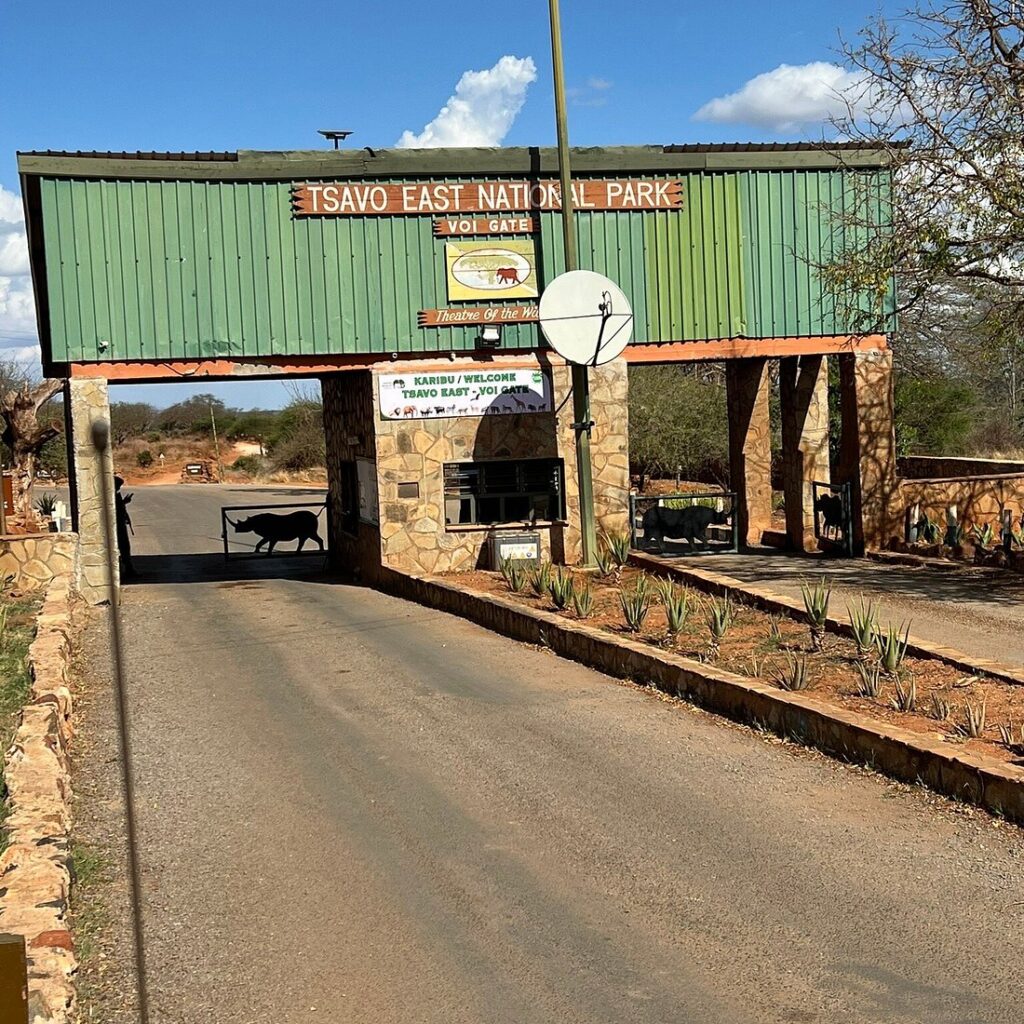
Tsavo National Park has numerous entry points because of its enormous size.
Voi Gate: One of the principal entrances into Tsavo East and a practical access point for travellers coming from Nairobi, Mombasa or Voi.
Bachuma Gate: A major entrance used by travellers approaching from the Mombasa side.
Manyani Gate: Another access point from the Nairobi–Mombasa corridor.
Sala Gate: Particularly useful for travellers approaching Tsavo East from the Malindi side.
Mudanda and other local access points: Used according to accommodation, route and current park access arrangements.
Mtito Andei Gate: One of the main access points into Tsavo West from the Nairobi–Mombasa corridor.
Tsavo River Gate: Provides access from the eastern side of Tsavo West.
Maktau Gate: Serves western approaches into the park.
Lake Jipe Gate: Useful for itineraries focused on the Lake Jipe area.
Ziwani Gate: Provides another access route into the western side of the park.
The correct gate depends on where you are staying and where you are coming from. Kenya Wildlife Service currently lists multiple road, air and rail access points for both parks.
Tsavo National Park is easily incorporated into a road safari from Nairobi.
The Nairobi–Mombasa highway runs along the northern and central sections of the Tsavo ecosystem, making access relatively straightforward compared with more remote Kenyan parks.
For Tsavo West, Mtito Andei is approximately 240 kilometres from Nairobi according to Kenya Wildlife Service. Tsavo East can be accessed through routes leading to Voi, Bachuma and other gates.
A road safari is particularly attractive for travellers who want to combine Tsavo with Amboseli, Taita Hills, the Kenyan coast or other destinations along the southern circuit.
Tsavo National Park is one of the easiest major Kenyan safari destinations to combine with a beach holiday.
From Mombasa, the journey to Tsavo East is relatively short, making the park a practical choice for a two- or three-night safari before or after time on the coast.
Travellers staying in Diani, Mombasa, Watamu or Malindi can also incorporate Tsavo into a longer coastal safari itinerary.
For guests travelling from Malindi, Kenya Wildlife Service identifies Sala Gate as an access point into Tsavo East.
Fly-in safaris are possible using the network of airstrips serving Tsavo National Park.
Tsavo East has airstrips including Voi, Ithumba, Aruba, Satao, Sala, Sangayaya, Thabagunji, Lugard and Bachuma.
Tsavo West has airstrips including Kilaguni and Finch Hattons, as well as Kamboyo, Ziwani, Tsavo River, Lake Jipe, Maktau and Kasigau.
Flying makes particular sense for travellers with limited time, guests staying in luxury camps and travellers combining Tsavo with distant destinations such as the Masai Mara.
The Standard Gauge Railway provides another practical option for reaching Tsavo National Park.
Travellers can take the SGR from Nairobi to Voi for Tsavo East or to Mtito Andei for access toward Tsavo West. Kenya Wildlife Service identifies both railway options among the park’s access routes.
This can be an excellent compromise for travellers who want to reduce driving time while still continuing their safari by road once they reach the Tsavo region.
A road safari is usually the better choice if Tsavo National Park forms part of a larger southern Kenya itinerary. It allows travellers to combine Tsavo with Amboseli, Taita Hills, Mombasa or the Kenyan coast without adding the cost and luggage restrictions of a light aircraft.
Flying makes more sense when time is limited or when the itinerary connects Tsavo with destinations that are too far apart to drive comfortably.
The road journey itself can also be part of the experience. Tsavo sits between very different environments, and travelling from Nairobi or the coast allows you to watch the landscape change from urban areas to farmland, dry bush, volcanic terrain and open wilderness.
Tsavo National Park has a warm to hot climate throughout most of the year.
Tsavo East is generally hotter and drier, while Tsavo West’s elevation and volcanic terrain can create slightly cooler conditions in some areas.
Daytime temperatures are often high, particularly during the dry season, while early mornings and evenings can feel surprisingly cool during game drives.
Tsavo experiences seasonal rainfall, broadly following Kenya’s two-rain pattern. The long rains generally occur between March and May, while shorter rains commonly occur around October and November or into December.
The exact timing and intensity of rainfall vary from year to year.
The rains transform Tsavo. Dry brown landscapes can become greener within a short period, water becomes more widely distributed and wildlife spreads out across the park.
During dry periods, animals concentrate more strongly around rivers, dams, springs and other permanent water sources, which can make wildlife viewing easier.
Kenya Wildlife Service notes that many Kenyan parks experience their strongest wildlife-viewing conditions during dry or relatively dry periods because vegetation is shorter and animals are easier to locate.
Tsavo National Park has a generally warm to hot climate with a semi-arid character, particularly in Tsavo East. The park experiences two broad rainy periods, the long rains around March to May and shorter rains later in the year. Dry periods often provide easier wildlife viewing because animals concentrate around reliable water sources and vegetation becomes less dense.
Tsavo East and Tsavo West are Kenya Wildlife Service-managed national parks and fall under the current KWS conservation-fee structure.
Under the KWS conservation fee schedule currently published for Tsavo East and Tsavo West, the non-resident rate is USD 80 per adult and USD 40 per child for the applicable 24-hour entry period. The same schedule lists lower rates for East African citizens, Kenya residents and African citizens.
KWS also publishes package rates covering combinations such as Tsavo West and Amboseli or Tsavo East, Tsavo West and Amboseli. The current published package for Tsavo East, Tsavo West and Amboseli is USD 215 for a non-resident adult and USD 115 for a non-resident child, subject to the applicable terms and fee schedule.
Because conservation fees can change, we recommend confirming the applicable KWS rate for your exact travel dates before finalizing a safari budget.
Most Afrikan Accent Adventures safari packages include applicable park entry fees within the overall safari quotation, so guests do not normally need to arrange these payments separately.
The current KWS conservation-fee schedule lists Tsavo East and Tsavo West at USD 80 per non-resident adult and USD 40 per non-resident child for the applicable 24-hour entry period. Lower rates apply to East African citizens, Kenya residents and African citizens. KWS also offers combination packages covering Tsavo and Amboseli.
Tsavo National Park is a year-round safari destination, but different months produce very different experiences.
January and February are generally hot and relatively dry. Wildlife viewing can be productive around water, although temperatures during the middle of the day can be intense.
March to May brings the long rains. The landscape becomes greener, bird activity increases and visitor numbers can fall. Some roads can become challenging after heavy rainfall, making a capable 4×4 particularly important.
June to October is one of the strongest periods for traditional game viewing. Vegetation is generally thinner, water becomes increasingly important and wildlife can be easier to locate. The weather is also generally favourable for road safaris.
November and December bring the short rains. The landscape becomes greener, migratory birds can add interest and the park can feel quieter than during the busiest dry-season periods.
For photographers, the best month depends on the desired look. Dry-season Tsavo produces strong contrast and famous red-earth scenes, while the rainy season creates greener landscapes and dramatic skies.
If your priority is elephants and predictable game viewing, I normally lean toward the drier months. If photography, birding and greener scenery matter more than ticking off every major animal, the shoulder and rainy seasons can be surprisingly rewarding.
Kibara Mugo, Safari Writer & East Africa Specialist
Two nights is enough for a focused introduction to Tsavo National Park.
For travellers staying on the coast, a two-night Tsavo East safari can provide several game drives without requiring a long absence from the beach.
This works particularly well for guests who want to experience elephants and the Big Five but have limited holiday time.
Three nights is our preferred starting point for a more complete Tsavo experience.
It allows time for multiple game drives, a slower pace and the possibility of experiencing different areas rather than spending the entire safari moving between destinations.
Three nights can also make it practical to combine Tsavo East and Tsavo West, depending on the route and accommodation.
Four nights or more allows Tsavo National Park to become the main destination rather than simply a stop on a larger circuit.
This gives travellers time to explore Tsavo East and Tsavo West separately, visit Mzima Springs, spend longer around wildlife hotspots and include additional experiences such as photography, birdwatching or a conservation visit.
For serious wildlife photographers, birders and repeat safari travellers, four nights or longer can be worthwhile because the sheer scale of Tsavo rewards patience.
Two nights works well for a short Tsavo East safari from the Kenyan coast. Three nights is a better introduction for travellers who want multiple game drives and time to explore more of the ecosystem. Four nights or longer is ideal for combining Tsavo East and Tsavo West or travelling at a slower pace.
Tsavo National Park offers something that many smaller Kenyan parks cannot: scale.
There is a sense of distance in Tsavo that is increasingly difficult to find in heavily visited safari destinations. You can spend an entire morning moving through the landscape, seeing elephants, giraffes, birds and antelope, while still feeling as though you have barely touched the wilderness.
The park is also one of the best destinations in Kenya for elephant lovers.
The red elephants of Tsavo are visually unforgettable, and their behaviour around rivers, dust-bathing sites and water sources provides excellent opportunities for observation and photography.
Then there is the geology.
Tsavo West’s volcanic landscape, Mzima Springs, Shetani Lava Flow and rocky hills make it one of the most visually varied safari destinations in Kenya.
Tsavo East offers another kind of drama through its huge open plains, Galana River, Yatta Plateau, red earth and enormous horizons.
For travellers staying at the Kenyan coast, Tsavo National Park is also one of the most practical ways to add a genuine wildlife safari to a beach holiday.
A guest can spend a few days beside the Indian Ocean and then, within hours, be watching elephants beneath baobabs.
The cost of a Tsavo National Park safari depends primarily on accommodation category, season, number of nights, transport and whether the safari covers Tsavo East, Tsavo West or both.
As a broad planning guide, budget Tsavo safaris using simple camps or basic lodges may start around USD 200 to 350 per person per day, depending on the number of travellers and season.
Mid-range Tsavo safari packages commonly fall around USD 300 to 500 per person per day, particularly when using comfortable lodges or tented camps, a private 4×4 safari vehicle, meals, guide services and park fees.
Luxury Tsavo safaris can range from approximately USD 500 to 900+ per person per day, with premium properties and exclusive-use camps reaching considerably higher rates during peak periods.
These are planning ranges rather than fixed prices. The final cost depends on the accommodation selected, travel dates, number of people, route and whether flights or private transfers are included.
Flying into Tsavo National Park normally increases the cost but can save several hours of road travel. Driving is generally more economical and works particularly well when Tsavo forms part of a southern Kenya circuit.
A Tsavo National Park safari can range broadly from around USD 200 to 350 per person per day for budget travel, approximately USD 300 to 500 for mid-range safaris and USD 500 upward for luxury experiences. The final price depends on accommodation, season, number of travellers, park fees, transport and whether the safari covers Tsavo East, Tsavo West or both.
We build Tsavo National Park safaris around the traveller’s starting point and the experience they want.
A short 2-day or 3-day Tsavo East safari works particularly well for travellers staying in Mombasa, Diani or other coastal destinations.
A 3-day Tsavo East and Tsavo West safari offers a stronger introduction to the complete Tsavo landscape, combining the red-earth plains of the east with the volcanic scenery and Mzima Springs of the west.
A 4-day Tsavo and Amboseli safari combines the wilderness of Tsavo with Amboseli’s famous Mount Kilimanjaro views and elephant herds.
A 5-day or longer southern Kenya safari can combine Tsavo East, Tsavo West, Amboseli and the Taita Hills or other conservation areas, depending on the route.
For guests arriving from Nairobi, Tsavo can also be combined with Amboseli before continuing toward the coast.
For guests arriving from the coast, Tsavo can be the first safari destination before travelling inland toward Amboseli, Nairobi or other parks.
Because Tsavo National Park is so large, we prefer to design the route around the accommodation and access gates rather than forcing every itinerary into the same sequence.
Accommodation in Tsavo National Park ranges from public campsites and special campsites to established safari lodges and luxury tented camps.
Tsavo East has accommodation options including Voi Safari Lodge, Ashnil Aruba Lodge, Sentrim Hotel, Impala Safari Lodge, Ngutuni Lodge, Satao Camp and Galdessa Tented Camp, alongside public and special campsites.
Tsavo West offers properties including Finch Hattons Luxury Safari Camp, Kilaguni Serena Safari Lodge, Severin Safari Camp and Ngulia Safari Lodge, as well as public and special campsites.
The best property depends on the safari style.
Riverside properties are attractive for guests who want wildlife close to camp.
Luxury tented camps work well for travellers who want privacy, high-quality guiding and a more intimate safari atmosphere.
Traditional lodges can offer excellent value for families and first-time safari travellers.
Private or semi-exclusive camps can be particularly attractive to photographers and repeat safari guests who prefer slower game drives.
The Masai Mara and Tsavo National Park provide very different safari experiences.
The Masai Mara is famous for high predator densities, open grasslands and the annual wildebeest migration.
Tsavo is much larger in physical scale and offers greater landscape diversity, particularly when Tsavo East and Tsavo West are combined.
The Mara is often the better choice for travellers whose main priority is dramatic predator action and the migration.
Tsavo is often the better choice for travellers who want elephants, red-earth landscapes, geological scenery, fewer vehicles in many areas and a more expansive wilderness atmosphere.
We frequently recommend doing both.
The Mara provides the classic East African grassland safari, while Tsavo introduces travellers to the dry southern wilderness of Kenya.
I would never tell a client that Tsavo is simply a quieter version of the Mara. It is a different ecosystem and a different safari. The Mara is about open grasslands and predator drama; Tsavo is about scale, elephants, geology, history and wilderness.
Kibara Mugo, Safari Writer & East Africa Specialist
Amboseli is best known for its enormous elephant herds and spectacular views of Mount Kilimanjaro.
Tsavo offers a much larger and more varied landscape.
If photography of elephants beneath Mount Kilimanjaro is the priority, Amboseli has the advantage.
If red elephants, volcanic landscapes, open wilderness and the combination of Tsavo East and Tsavo West are more appealing, Tsavo is the stronger choice.
The two parks work exceptionally well together.
A southern Kenya safari combining Amboseli and Tsavo creates a natural progression from Kilimanjaro’s mountain backdrop to the red-earth wilderness of Tsavo.
Samburu is smaller and more concentrated, with the Ewaso Nyiro River providing the ecological focus of the reserve. It is famous for the Samburu Special Five: Grevy’s zebra, reticulated giraffe, gerenuk, Beisa oryx and Somali ostrich.
Tsavo is dramatically larger and offers a different wildlife profile.
Samburu is particularly appealing for travellers looking for northern Kenya’s specialist species.
Tsavo is particularly appealing for elephant enthusiasts, Big Five travellers and guests who want a huge wilderness landscape.
Both are excellent additions to a longer Kenya itinerary.
If you only have two nights, choose the side that fits your route.
If you are coming from the coast and want the shortest practical safari, Tsavo East is usually the most logical.
If you are travelling from Nairobi toward the coast and want to combine Tsavo with Amboseli, Tsavo West can make more sense depending on the itinerary.
If you have three or more nights, combining both parks provides the most complete Tsavo National Park experience.
Tsavo East gives you red elephants, huge plains, Galana River, Yatta Plateau and Lugard’s Falls.
Tsavo West gives you Mzima Springs, volcanic hills, Shetani Lava Flow, Lake Jipe, the Rhino Sanctuary and the historical landscapes of the Tsavo lions.
Together they show why Tsavo National Park is much more than a single safari circuit.
Tsavo National Park is part of one of Kenya’s most important conservation landscapes.
The enormous Tsavo Conservation Area supports wildlife populations that require large connected habitats, particularly elephants and other wide-ranging species.
Conservation in Tsavo involves habitat protection, anti-poaching operations, wildlife monitoring, community engagement and management of human-wildlife interactions.
Visitors have an important role to play.
Stay on designated roads.
Do not approach wildlife too closely.
Never feed animals.
Keep noise to a minimum.
Do not leave the vehicle except in designated safe areas or during an officially guided activity.
Avoid single-use plastics.
Take all rubbish out of the park.
KWS currently requires visitors to remain at least 20 metres from wildlife, stay on established roads and trails, observe a maximum speed limit of 40 km/h and follow park entry and exit regulations.
Responsible tourism in Tsavo National Park is not only about protecting animals. It is about maintaining the wilderness character that makes the destination worth visiting.
The biggest mistake we see in Tsavo is treating the park like a checklist. Slow down. Give the elephant herd time. Stop for the unusual bird. Look at the lava. Watch the landscape change. Tsavo rewards travellers who allow the wilderness to set the pace.
Hellen Asiko, Director & Guest Experience Curator
The best Tsavo National Park safari is built around your route, not simply around the number of nights.
For a coastal traveller, we may recommend Tsavo East for two or three nights before returning to Mombasa, Diani, Watamu or Malindi.
For a traveller arriving from Nairobi, we may combine Tsavo West with Amboseli before continuing toward the coast.
For a repeat Kenya safari traveller, we may build a longer Tsavo itinerary that includes both parks and places greater emphasis on photography, birdwatching, geology and slower game drives.
For a first-time safari traveller, we may combine Tsavo with Amboseli or another major Kenyan destination so that the itinerary offers different landscapes rather than repeating the same experience.
The key is to allow enough time.
Tsavo National Park is too large to appreciate properly when treated as a rushed stop between destinations.
If your main goal is reliable wildlife viewing, the dry months are generally the strongest choice.
If your priority is photography and green scenery, the rainy periods can produce spectacular conditions.
If you want fewer visitors and are comfortable with the possibility of wet roads, the shoulder seasons can provide an excellent balance.
If you are travelling during April or May, we recommend using a reliable 4×4 vehicle and allowing additional travel time after heavy rainfall.
If you are travelling during the busiest dry-season periods, book accommodation early, especially if you have a specific lodge or luxury camp in mind.
Lightweight, breathable clothing is essential because Tsavo can become very hot during the day.
A fleece or light jacket is useful for early morning game drives.
Neutral-coloured clothing is practical for safari photography.
A wide-brimmed hat, sunglasses and sunscreen are strongly recommended.
Binoculars make a noticeable difference, particularly in Tsavo’s enormous landscapes.
A camera with a telephoto lens is useful for wildlife photography, while a wide-angle lens is valuable for the landscapes.
Insect repellent, personal medication, a reusable water bottle and comfortable walking shoes should also be included.
For fly-in safaris, confirm luggage restrictions with the airline before departure.
Tsavo National Park can work extremely well for families.
The variety of wildlife means that children can see elephants, giraffes, zebras, buffalo, birds and other animals without needing to spend every game drive searching for a single species.
The shorter travel time from the Kenyan coast also makes Tsavo East particularly practical for families staying in beach resorts.
A family safari should normally use comfortable accommodation, shorter game drives when necessary and a flexible itinerary that allows children to rest between activities.
Tsavo West can be especially interesting for older children because Mzima Springs and the volcanic landscape add geological and educational experiences beyond wildlife.
Tsavo is one of Kenya’s strongest destinations for environmental wildlife photography.
The red soil is a natural visual feature, while the enormous horizons of Tsavo East allow photographers to place animals within the landscape rather than always filling the frame with a close-up.
Tsavo West provides more opportunities for layered compositions involving hills, lava, springs and vegetation.
Elephants are particularly rewarding subjects because their dust-bathing behaviour interacts so strongly with the red earth.
The best photography light is generally early morning and late afternoon, when temperatures are cooler and shadows create more depth.
Birdwatchers can spend several days exploring Tsavo without becoming bored.
The combination of riverine forest, dry bush, open plains, volcanic terrain, springs and wetlands provides a remarkable range of habitats.
Tsavo East has recorded more than 500 bird species, while Tsavo West has recorded more than 600.
Lake Jipe and Mzima Springs are particularly interesting for water-associated species, while open areas and dry woodland provide opportunities for raptors, bustards, larks and other savannah birds.
A dedicated birding itinerary should be slower than a conventional Big Five safari, with more time spent listening, scanning vegetation and stopping for species that a general safari vehicle might pass without noticing.
One of the greatest strengths of Tsavo National Park is its proximity to Kenya’s Indian Ocean coast.
Travellers staying in Mombasa, Diani, Watamu or Malindi can add a wildlife safari without committing to a long inland journey.
A common arrangement is:
Beach holiday → Tsavo East → Tsavo West → Amboseli or Nairobi
Another option is:
Nairobi → Amboseli → Tsavo West → Tsavo East → Mombasa or Diani
For travellers arriving at the coast, Tsavo can provide the perfect transition from a relaxed beach holiday into an active wildlife experience.
For travellers finishing a safari at the coast, Tsavo can be the final wildlife destination before several days of rest beside the Indian Ocean.
We build Tsavo National Park safaris around the traveller rather than simply selling a fixed package.
We can arrange private 4×4 safari vehicles, experienced safari guides, accommodation ranging from comfortable mid-range lodges to luxury tented camps, park fees, meals, transfers and carefully planned game drives.
For travellers arriving from the coast, we can coordinate pick-up from Mombasa, Diani, Watamu or Malindi and build Tsavo into a wider Kenya itinerary.
For travellers flying into Kenya, we can arrange a road or fly-in safari depending on the available time and budget.
We also consider the practical details that make a difference on the ground: which gate to use, which side of the park to stay in, how long to spend on each side, when to schedule game drives and how to avoid unnecessary backtracking.
From the red elephants of Tsavo East to the clear waters of Mzima Springs in Tsavo West, Tsavo National Park offers one of the most varied safari experiences in Kenya.
It is a destination for travellers who want more than a checklist of animals.
It is for the person who wants to watch a herd of elephants cross a red-earth plain.
It is for the photographer looking for a landscape that does not resemble the Mara.
It is for the family wanting to combine a beach holiday with a genuine wildlife safari.
It is for the repeat Kenya traveller who has already seen the Mara and wants to explore a different side of the country.
It is for anyone fascinated by volcanic landscapes, ancient rivers, wildlife conservation and the long history of the Kenyan wilderness.
Tsavo National Park is enormous, rugged and sometimes unpredictable. That is precisely its appeal.
The next elephant may appear around the bend.
The next lion may be resting beneath a thorn tree.
The next horizon may reveal nothing but red earth, baobabs and sky.
And then, suddenly, the wilderness starts moving.
Speak to Afrikan Accent Adventures to build a Tsavo National Park safari around your travel dates, budget and preferred accommodation, whether you want a short Tsavo East safari from the coast, a combined Tsavo East and Tsavo West adventure, or a longer southern Kenya circuit including Amboseli.
Tsavo is not simply somewhere you pass through on the way to another park. For many travellers, it is where Kenya’s wilderness begins.
Explore Kenya's largest safari destination where giant elephant herds roam across endless plains, lions patrol volcanic landscapes and crystal-clear springs emerge from ancient lava fields. Tsavo offers one of Africa's last truly wild safari experiences.
Tsavo's elephants are among the most iconic wildlife spectacles in Africa. The elephants frequently dust themselves with the park's rich red volcanic…
Tsavo is forever linked to the famous "Man-Eaters of Tsavo," the lions that halted construction of the Kenya-Uganda railway in the late…
One of Kenya's most remarkable natural attractions, Mzima Springs produces millions of litres of crystal-clear water daily from underground streams originating on…
Created by volcanic eruptions only a few centuries ago, the black lava fields of Shetani provide a dramatic and almost lunar landscape…
Stretching for approximately 290 kilometres, Yatta Plateau is considered the world's longest lava flow. The plateau dominates the landscape of Tsavo East…
Located on the Galana River in Tsavo East, Lugard Falls consists of a series of white-water rapids and sculpted rock formations rather…
Situated within Tsavo West, the sanctuary protects one of Kenya's remaining populations of endangered black rhinos. Visitors have a chance to observe…
With over 600 recorded bird species, Tsavo is one of East Africa's premier birdwatching destinations. The varied habitats support hornbills, ostriches, kingfishers,…
From value camps to premium lodges — we match every stay to your style and budget.
Comfortable tented camps just outside the reserve gates. En-suite rooms with hot showers, full-board meals, and close proximity to the Mara.
Spacious canvas tents on raised platforms with private decks, often inside or adjacent to conservancies. Better access and fewer crowds.
World-class lodges and exclusive camps in private conservancies. Night drives, bush walks, spa, and personalized service — the ultimate safari experience.
Every season has its magic — here's what to expect when, so you can travel at your perfect time.
Everything you need to know before you go — and we’ll guide you through every step.
Most international visitors require a Kenyan Electronic Travel Authorisation (eTA) before entering Kenya. Applications are completed online and should ideally be submitted several days before travel. Passports should be valid for at least six months from the date of entry.
Due to Tsavo's lower altitude and warmer climate, malaria prevention is generally recommended, particularly during the rainy seasons. Visitors should consult their healthcare provider regarding vaccinations, travel medications, and general health advice before departure.
Tsavo can be reached by road from Nairobi or Mombasa via the Nairobi-Mombasa Highway. Scheduled flights operate daily from Nairobi Wilson Airport and coastal airports to several airstrips within both Tsavo East and Tsavo West National Parks.
The Kenyan Shilling (KES) is the official currency, although US Dollars are widely accepted for tourism services. Most lodges and camps accept Visa and Mastercard, while mobile payment systems such as M-Pesa are commonly used throughout Kenya.
Tsavo experiences a warm semi-arid climate with daytime temperatures typically ranging between 24°C and 33°C. Rainfall occurs mainly between March and May and again during November and December.
Kenya uses Type G electrical sockets operating at 240 volts and 50Hz frequency. Most safari lodges provide charging facilities and international adapters for guests.
Tsavo follows East Africa Time (EAT), which is UTC +3 throughout the year. Kenya does not observe daylight saving time.
Tsavo National Park is considered one of Kenya's safest safari destinations. Professional guides, rangers, and lodge staff ensure visitor safety while maintaining responsible wildlife viewing practices.
Absolutely. Tsavo is Kenya's largest protected wilderness and offers one of Africa's most authentic safari experiences. Unlike smaller parks, Tsavo provides vast landscapes, fewer crowds, exceptional wildlife diversity, and dramatic scenery ranging from volcanic lava flows to natural springs and endless savannah plains. It is particularly popular among repeat safari visitors, photographers and travellers seeking a true wilderness experience.
Tsavo is internationally famous for its red elephants, legendary lions, Mzima Springs, the Shetani Lava Flow and the historic "Man-Eaters of Tsavo" lions that famously disrupted railway construction in 1898. The park is also known for its enormous size and spectacular landscapes that differ significantly from Kenya's other safari destinations.
Yes. Tsavo East and Tsavo West together host all members of the Big Five: elephants, lions, leopards, buffaloes and black rhinos. Rhino sightings are best in the Ngulia Rhino Sanctuary within Tsavo West, while elephant and lion sightings are common throughout both parks.
Tsavo East is characterized by vast open plains, large elephant herds, the Galana River, Lugard Falls and the Yatta Plateau. Tsavo West offers more varied scenery including volcanic hills, lava fields, Mzima Springs, dense vegetation, and the Ngulia Rhino Sanctuary. Many visitors combine both parks to experience the full diversity of the Tsavo ecosystem.
A minimum of three days and two nights is recommended to explore either Tsavo East or Tsavo West comfortably. Visitors wishing to experience both parks should consider four to five nights to allow sufficient time for game drives and sightseeing without rushing.
Visitors regularly encounter elephants, lions, leopards, buffaloes, giraffes, zebras, hippos, crocodiles, hyenas, cheetahs, hartebeests, impalas, waterbucks and numerous antelope species. Tsavo is also one of Kenya's best birdwatching destinations, with more than 600 bird species recorded.
The best wildlife viewing occurs during the dry seasons between June and October and from January to February. During these months animals gather around rivers, springs, and waterholes, making sightings easier and more predictable. The green seasons offer beautiful landscapes and excellent birdwatching opportunities.
Yes. Tsavo offers family-friendly lodges, swimming pools, educational experiences and exciting wildlife viewing opportunities. Children particularly enjoy elephant sightings, visits to Mzima Springs, and learning about the history of the Man-Eaters of Tsavo.
No. One of Tsavo's greatest attractions is its sense of wilderness and space. Visitors often enjoy wildlife sightings without large numbers of vehicles, creating a more private and authentic safari experience.
Tsavo West lies approximately 240 kilometres from Nairobi and about 250 kilometres from Mombasa. Tsavo East is approximately 330 kilometres from Nairobi and around 150 kilometres from Mombasa, making it one of Kenya's most accessible safari destinations from both cities.
Yes. Tsavo is one of the most popular safari extensions for visitors staying in Mombasa, Diani Beach, Watamuand Malindi. Its proximity to the coast allows travellers to combine beach relaxation with wildlife experiences in a single holiday.
We priced eleven safaris for one traveller, from a USD 650 shared tent in the Siana Conservancy to…
Read more →
A 5:00am start, about eight hours inside the park and a late return to your hotel: who the…
Read more →
Kenya swapped the visa for an online eTA in 2024, added compulsory health insurance in October 2026 and…
Read more →Tell us what you’d love to see and a local specialist will design a tailor-made itinerary around you — no obligation, reply within 24 hours.