

Maasai Village Visits: How to Do One Respectfully
A village visit can be the best hour of a Kenya safari or the most awkward one, and the difference almost always comes down to who is actually running it.
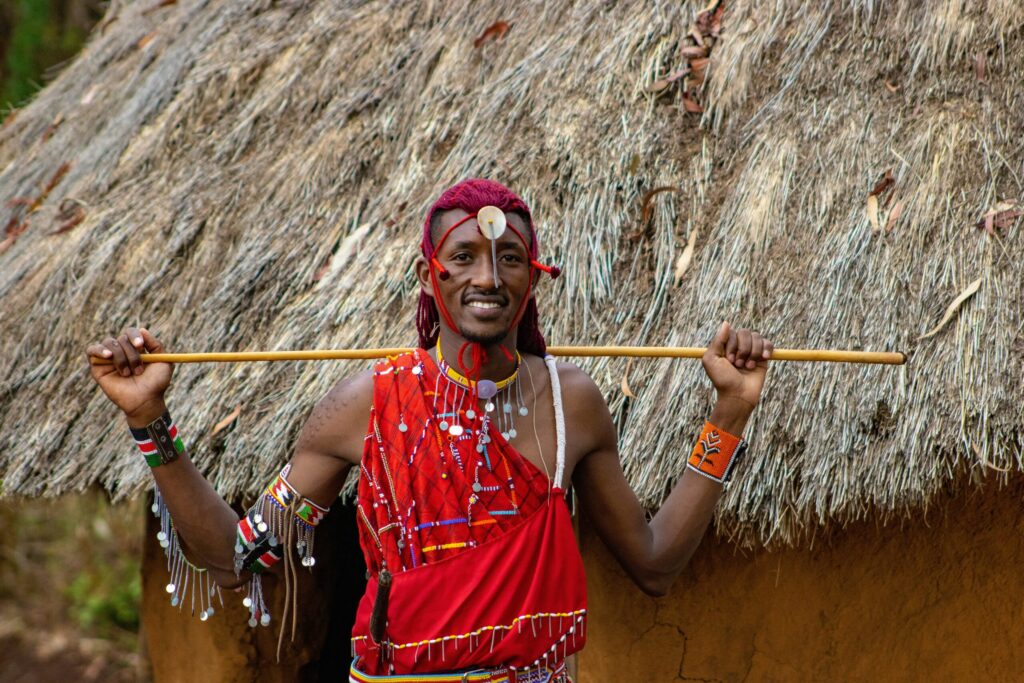
Smiling Maasai Moran host wearing traditional red attire and beaded jewelry outside a thatched boma homestead during a Maasai village visit Kenya.
Talek Gate, the Masai Mara. Just past nine in the morning, and four safari Land Cruiser vans are already queued nose to tail outside a boma, waiting their turn while the moran run through the welcome dance again for the group ahead of us. Nicholas, our founder and the guide who has driven this stretch of road longer than anyone else on our team, slows down, looks at the queue, and keeps driving.
“Not that one,” he says. “We know a family near Siana Conservancy who actually want us there.”
It sounds like a small decision. It is not. That boma will still take your money, still perform the jumping dance, still sell you beadwork at the end. Nothing about the visit will feel wrong in the moment. It is only later, comparing notes with other travellers, that people start to wonder whether they saw a Maasai village or a Maasai village-shaped show built for four safari vans a day.
We have taken guests to both kinds of stops over the years, and we have opinions about it. A well-run village visit is one of the most genuinely educational hours you can spend in Kenya. A badly run one is closer to a human zoo with a souvenir stand attached, and the fact that it is common does not make it acceptable. This guide is about telling the two apart, and about how to make sure your fee, your photographs and your fifty minutes actually respect the people hosting you.
| QUICK ANSWER | Is a Maasai Village Visit in Kenya Worth It? Yes, a Maasai village visit is worth it when it’s community-led rather than a staged roadside stop. Budget USD 20 to 50 per person for a Masai Mara boma, USD 20 to 40 for Samburu, or about USD 10 for Umoja Uaso. Ask who receives the fee first. |
At a Glance:
- Where you can visit: Masai Mara conservancies for Maasai bomas, the edge of Samburu National Reserve for Samburu manyattas, and Umoja Uaso near Archer’s Post for the women-only Samburu village
- Typical cost: USD 20 to 50 per person for a Maasai village, USD 20 to 40 for a Samburu village, around USD 10 for Umoja Uaso
- Typical duration: 45 minutes to 1.5 hours, longer at Umoja Uaso if you stay for tea and beadwork
- Not included in park fees: Village visits are a separate, optional add-on to Masai Mara or Samburu National Reserve entry, never part of the conservation fee itself
- Best paired with: A game drive morning or afternoon, not squeezed in before a flight departure
- Who should lead it: The boma or village itself, hosting on its own terms, not a driver reselling access to a stop it does not control
- Photography: Ask before every photograph, some visits bundle photography into the entry fee and others charge separately
- Good for: Travellers who want context beyond wildlife and are comfortable with direct, unscripted interaction
Why This Is a Sensitive Topic Worth Addressing Directly
We are not going to pretend this is a simple, feel-good add-on to a safari itinerary, because it is not. The criticism levelled at Maasai village tourism over the years is fair criticism, some of the time. Villages built purely for tour traffic, families paid a flat rate regardless of how many buses arrive, children posed for photographs they have no say in, rituals performed on a loop for people who will never come back. Call it what it is: exploitative, when it is run that way.
At the same time, tourism has become one of the more reliable income sources for Maasai and Samburu communities living on land where livestock keeping is harder every year, thanks to drought cycles, subdivided grazing land and the same climate pressure affecting pastoralists across East Africa. A well-negotiated village visit, where the community sets the fee and the terms, is not a compromise of Maasai culture. It is a Maasai family or a Samburu council choosing to monetize something they already have, on their own terms. The difference between those two outcomes is entirely in the setup, and that is what the rest of this article covers.
We think it is worth saying plainly: skip a village visit entirely if it makes you uncomfortable. You are not obligated to add one to your Masai Mara or Samburu itinerary. But if you do want to go, go somewhere that wants you there for the right reasons.
| EXPERT NOTE Almost every operator writes about “respecting Maasai culture” without ever naming who receives the money. That vagueness is the tell. If a company can’t tell you which family, boma or council you actually visited, the chances are they never checked either. Ask the question and see what you get back. Kibara Mugo, Safari Writer and East Africa Specialist |
What a Respectful Visit Actually Looks Like
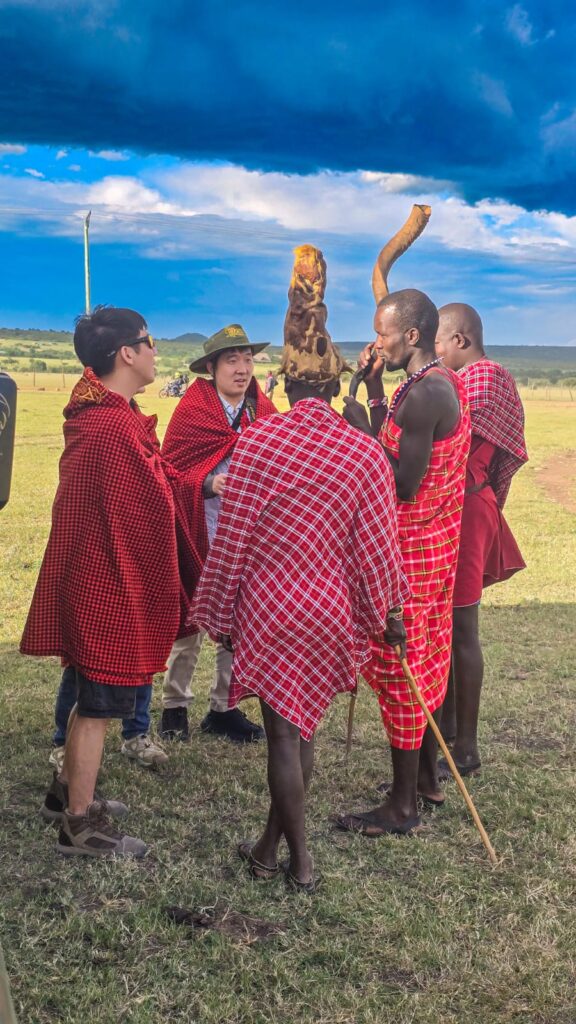
A good village visit feels closer to being invited into someone’s home than to buying a ticket for a show. There are specific things you can check for, both when booking and once you arrive.
Before you arrive
The fee should be clear before you get out of the vehicle, not negotiated at the gate. Your guide should be able to tell you who the fee goes to. You should not feel rushed, and you should not be told this is the only village visit option available in the area, because it usually is not.
Once you’re there
A respectful host explains what you are about to see rather than simply performing it. You get a chance to ask questions, and someone genuinely translates the answers rather than giving you a generic tourist script. Elders and mothers are treated as the authority on their own customs, not as background for a photograph. Nobody insists you buy beadwork, though buying something directly from the person who made it is a good way to put money straight into the household rather than into a resale chain.
| A respectful visit feels like a conversation. A staged one feels like a transaction dressed up as a performance. |
Staged Tourist Stops vs Community-Led Visits
Almost every village visit you’ll be offered in Kenya falls into one of two categories, and it is usually obvious within the first five minutes which one you are looking at.
Signs you’re at a staged stop
A crowded entrance with several other tour vehicles already queued for the same slot. A fixed schedule that moves one group through after another with barely a pause in between. A performance that starts the second your vehicle door opens, before anyone has said hello. A hard sell at the beadwork stand that only eases off once you buy something. Your guide receiving a visible commission from the person running the entrance.
Signs it’s community-led
The visit was arranged directly with a specific family or council, often one the operator has worked with for years. The fee is stated as a flat contribution to the household or the women’s group, not itemized per photograph or per activity. You are shown around by someone who lives there, not by a hired performer bussed in from elsewhere. There is no pressure to buy anything, and the people you meet are happy to talk about ordinary life, not just the version curated for visitors.
Neither category is exclusive to the Masai Mara. The same pattern repeats along the Nairobi to Samburu highway, where roadside Samburu manyattas do brisk business with tour vans that never repeat a visit to the same family twice.
What Actually Happens on a Maasai Village Visit
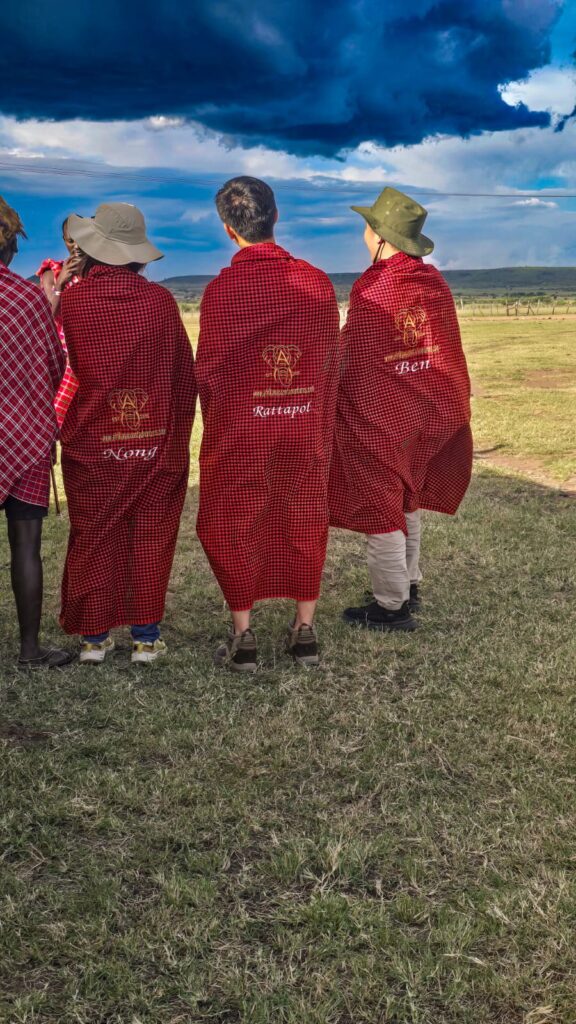
A typical Maasai boma visit runs through a fairly consistent sequence, whether it is staged or community-led. Knowing what to expect helps you tell a rushed version from an unrushed one.
The welcome and the jumping dance
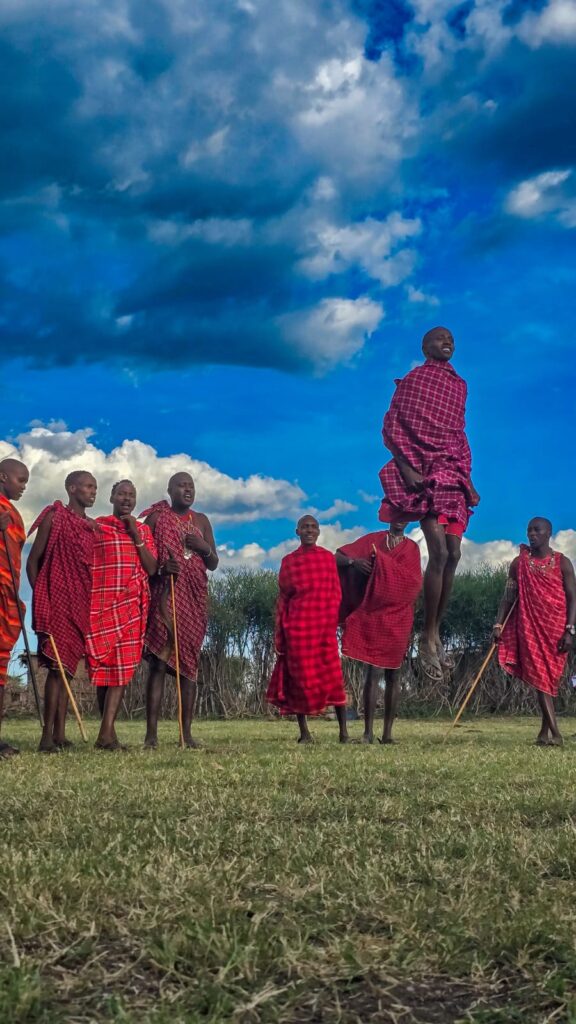
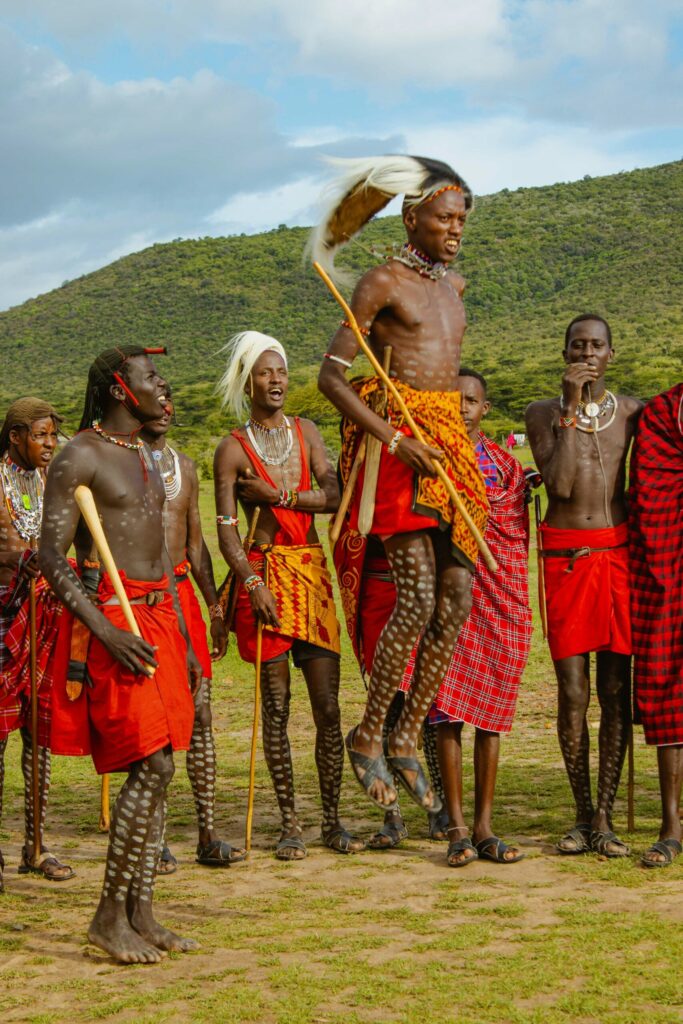
Moran, the young warriors, and the women of the boma greet arriving guests with singing, and the men perform the Adumu, the vertical jumping dance where each Moran takes a turn jumping as high as he can while the group chants around him. It is genuinely impressive athletically, and yes, visitors are usually invited to try it. Nobody expects you to jump as high as a Moran, and everybody will laugh kindly when you don’t.
Fire by friction
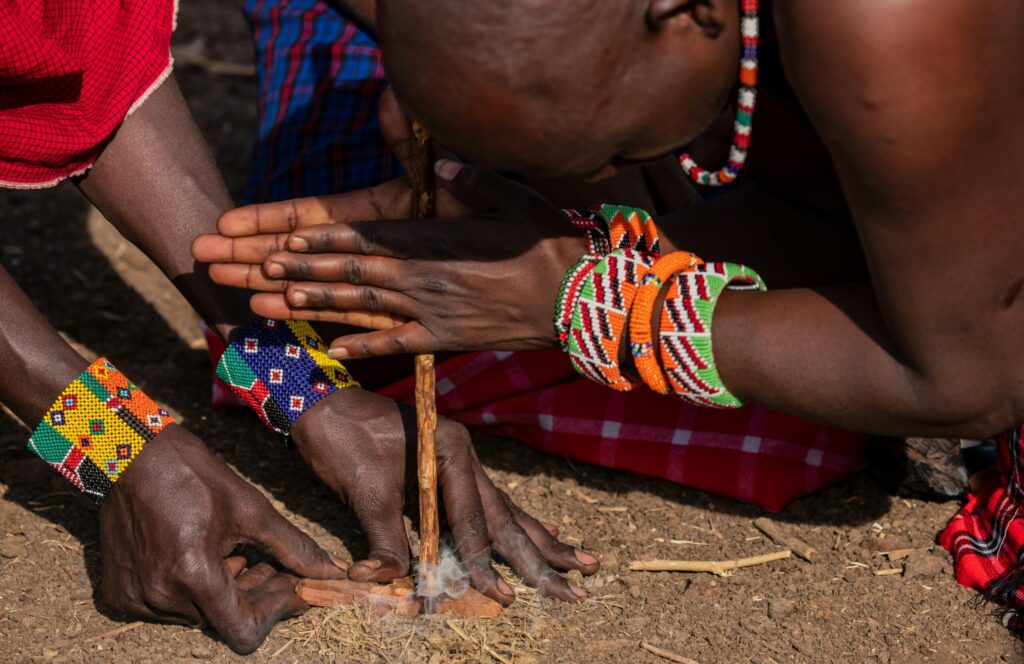
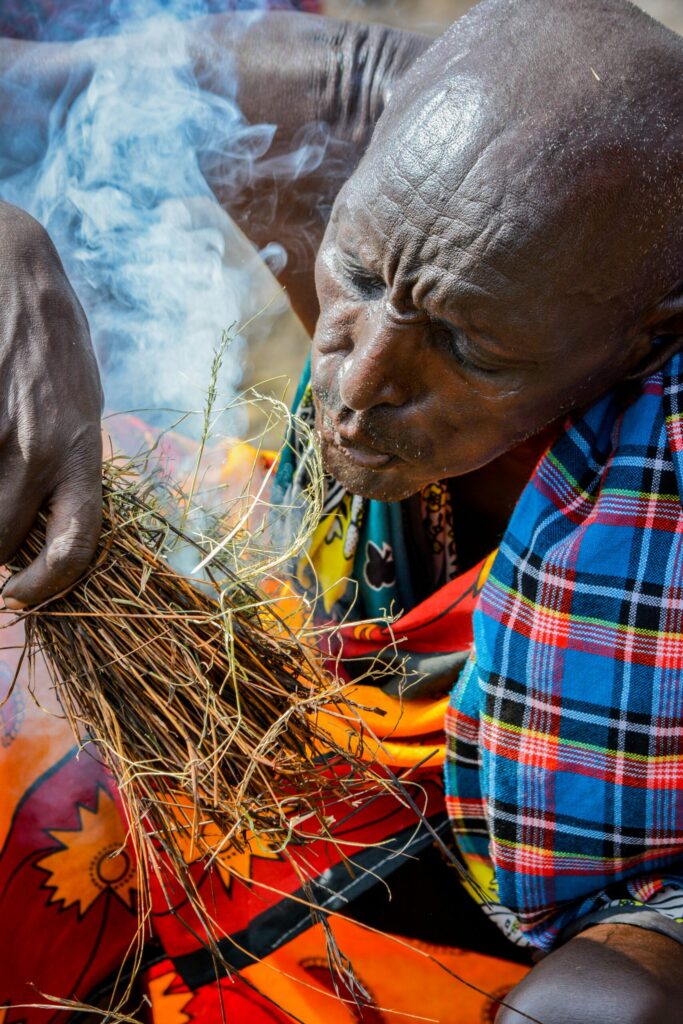
Two men demonstrate starting a fire using a wooden fireboard and a spinning stick, working the friction until an ember catches in a bed of dry dung and grass. It takes real skill and a steady hand, and it is one of the more genuinely impressive things you will see demonstrated on a safari.
Milking and the manyatta tour
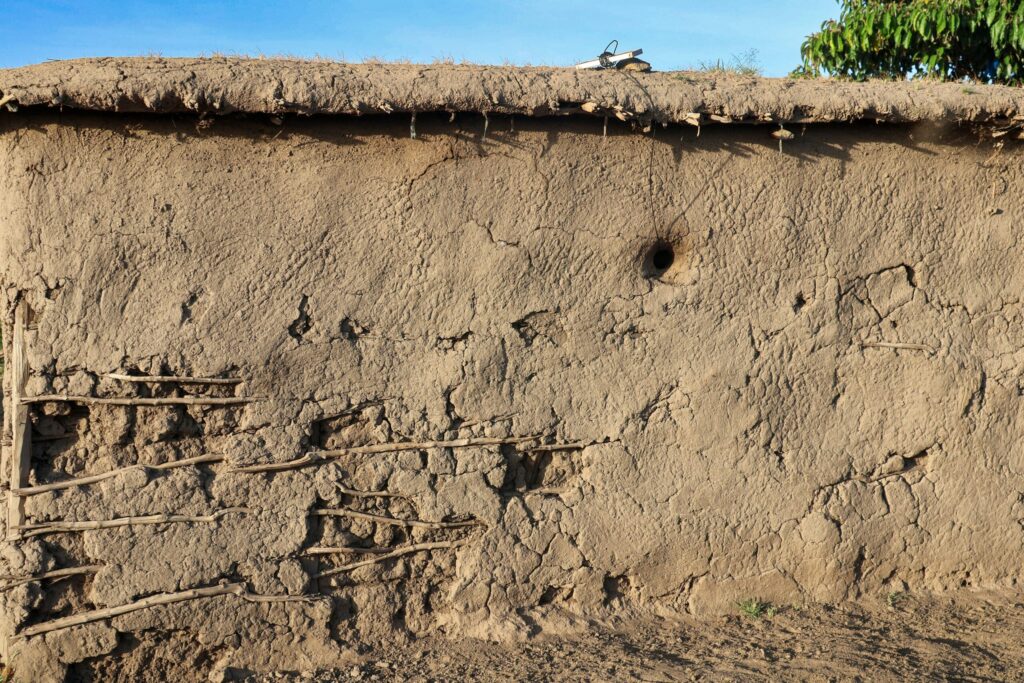
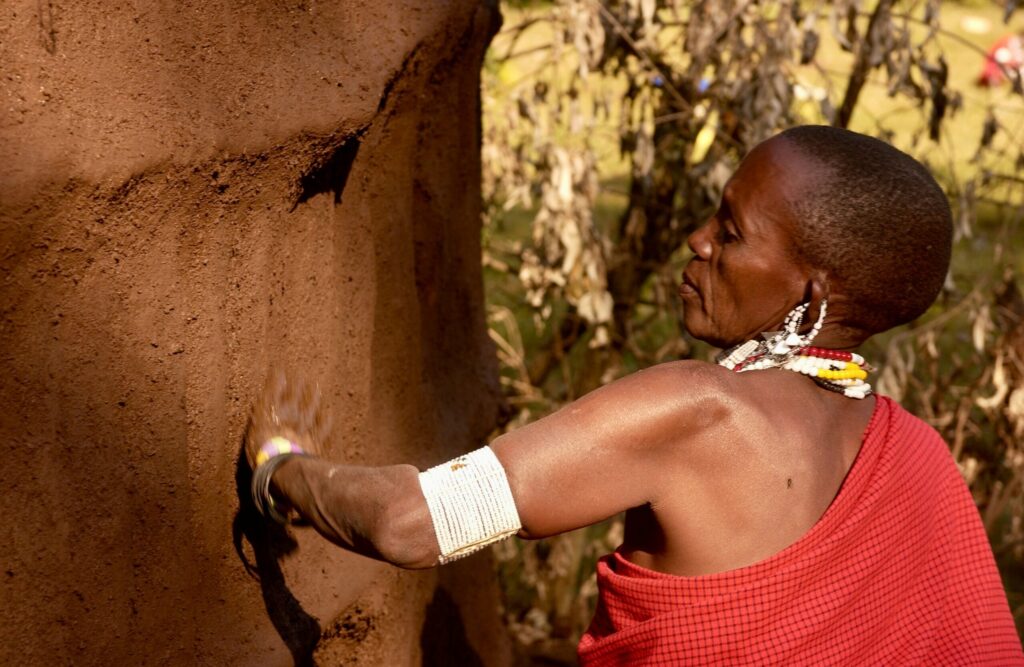
You may be shown cattle being milked, since livestock is still central to Maasai wealth and identity, and then walked through the low, dome-shaped huts that make up the boma, built by the women from a frame of branches plastered with a mix of mud, grass, cow dung and ash. Inside, a hut is dark, smoky and considerably smaller than it looks from outside, built that way deliberately for warmth and to conserve firewood.
The market
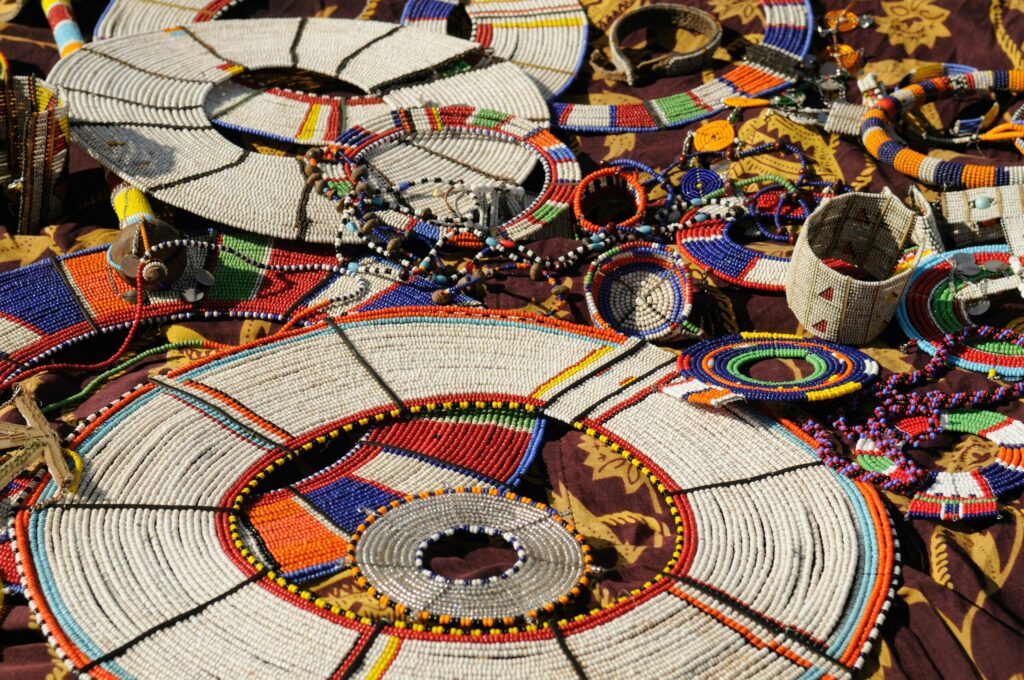
Most visits end at a beadwork display, usually laid out by the women of the boma on cloth or low tables. This is normal and it is one of the more direct ways your money reaches individual households rather than an operator’s margin. It becomes a problem only when refusing to buy triggers pressure or a change in mood.
Photography Etiquette
Ask before you photograph any individual, not just as a courtesy but because some Maasai and Samburu elders hold real reservations about photographs, tied to older beliefs some communities have about images and personal identity. Not everyone shares that view, which is exactly why asking matters more than assuming either way.
Some village visits include photography in the entry fee. Others, especially staged roadside stops, charge separately per photograph or per person photographed, and this should be explained to you before you start shooting, not after. If nobody mentions it upfront, ask.
Children need a parent’s or guardian’s consent, not just a nod from whoever happens to be standing nearby. If you are told a particular hut, ritual or area is off limits to cameras, treat that as final rather than a starting point for negotiation. Drones are a hard no near any village visit without direct, explicit permission from the community, since the noise and the intrusion are genuinely disruptive to a place people live in.
Where the Money You Pay Actually Goes
This is the question we think travellers should ask more often, and the honest answer is that it varies enormously depending on how the visit was set up. In a community-led visit, the fee is typically split between the hosting family or boma and a shared community fund used for things like school fees, water access or medical costs. In a staged roadside stop run through a middleman, a meaningful share can disappear into commissions before it ever reaches the people you actually met.
It helps to separate this from your Masai Mara or Samburu National Reserve Park entry fee, which is a completely different payment covering conservation and reserve management and has nothing to do with any individual village. A village visit fee is always a separate, optional charge on top of that.
| EXPERT NOTE Guests often assume the village visit fee is bundled into their safari package the same way park fees are. It usually isn’t. When we build an itinerary, we tell guests exactly what a village visit costs and exactly which family or council receives it, before they ever agree to add it on. If an operator can’t answer that question clearly, that’s worth noticing. Hellen Asiko, Director & Guest Experience Curator |
Samburu Village Visits: How They Differ
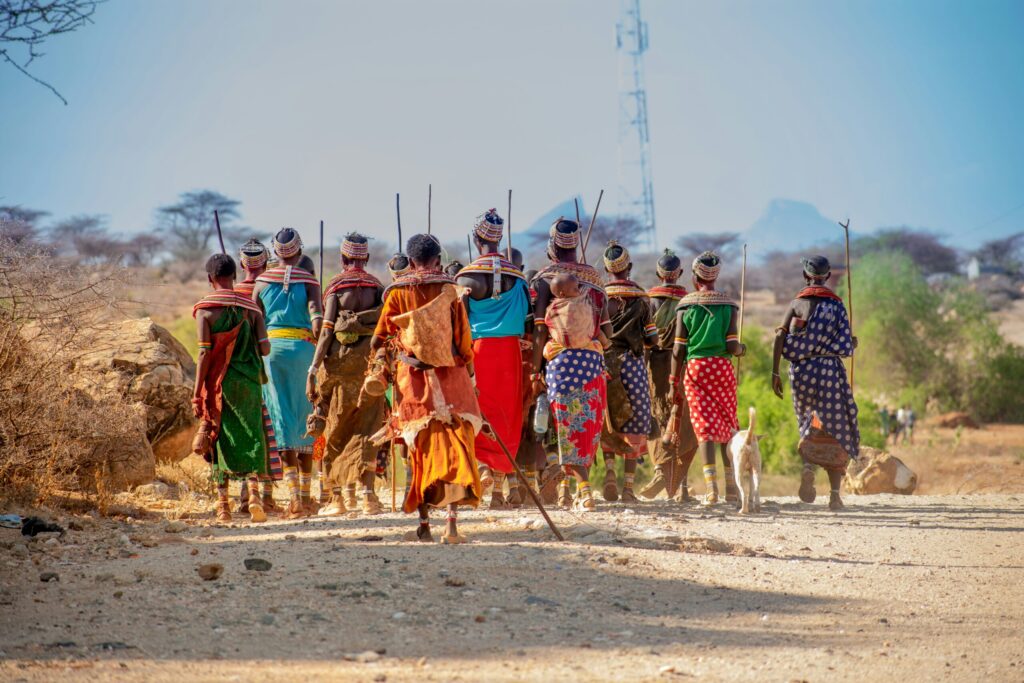
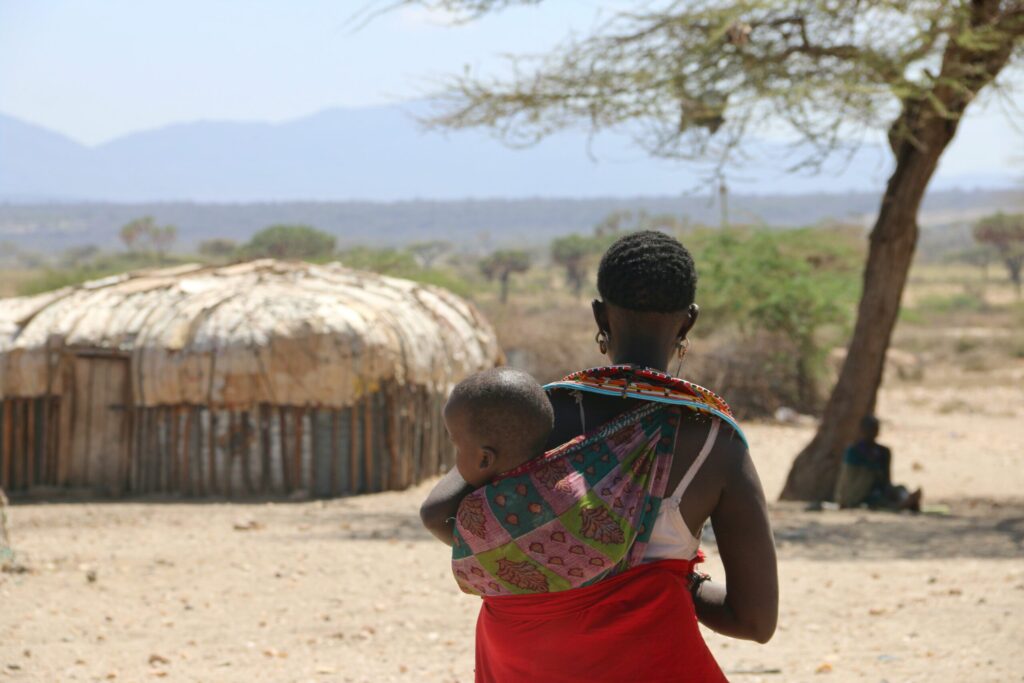
Samburu village visits work on the same basic model as Maasai village visits, and it is easy to see why the two get confused. The Samburu and the Maasai speak closely related Maa languages, share a similar age-set warrior system built around Moran, and both wear distinctive beaded ornamentation, but they are separate communities with their own customs, history and territory. The Samburu live in Samburu County in northern Kenya, centred on Samburu National Reserve, roughly five to six hours north of Nairobi by road.
A typical Samburu village visit sits right outside the reserve, often as a short add-on to a game drive, running about an hour and costing in the region of USD 20 to 40 per person. You’ll see many of the same elements as a Maasai boma visit, warrior dancing, hut interiors, beadwork, but set against the drier, rockier landscape of the north rather than the Mara’s open grassland. The same staged-versus-community-led distinction applies here too, and the same signs give it away: a fixed roadside stop working through a rotation of tour vehicles versus a specific manyatta your guide knows personally.
Umoja Uaso Village: A Different Kind of Visit
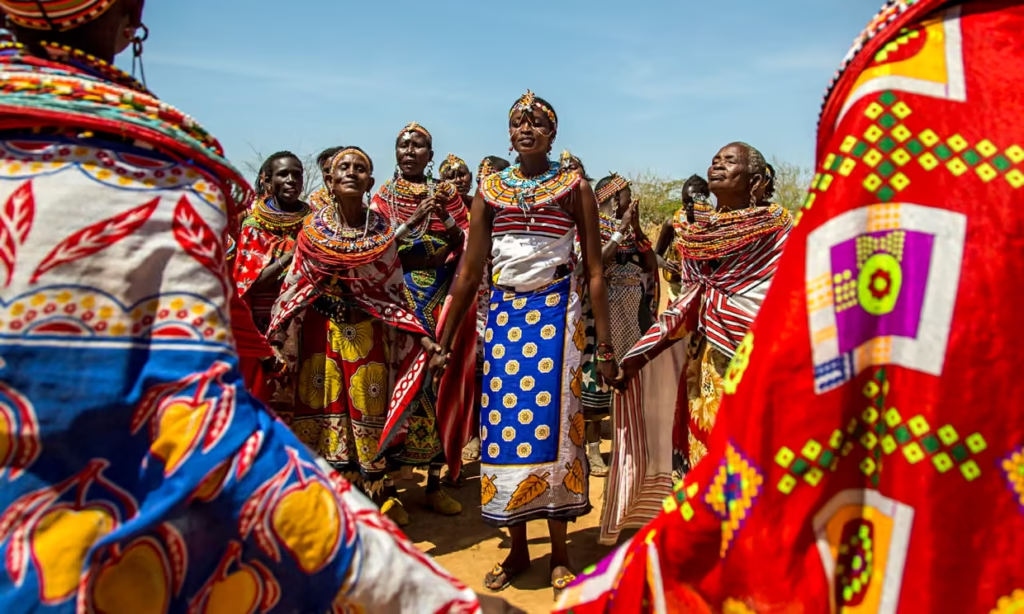
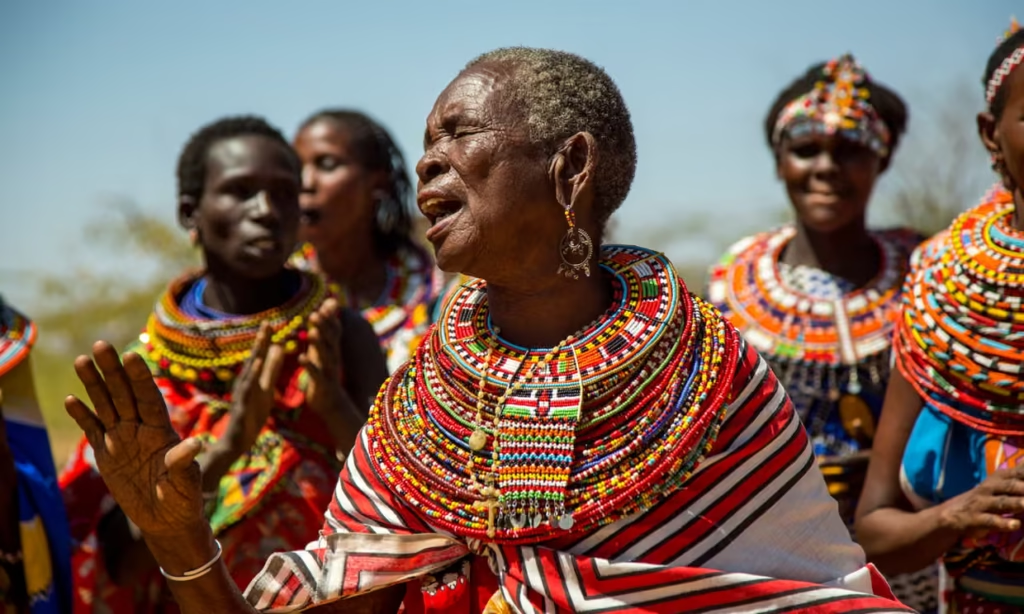
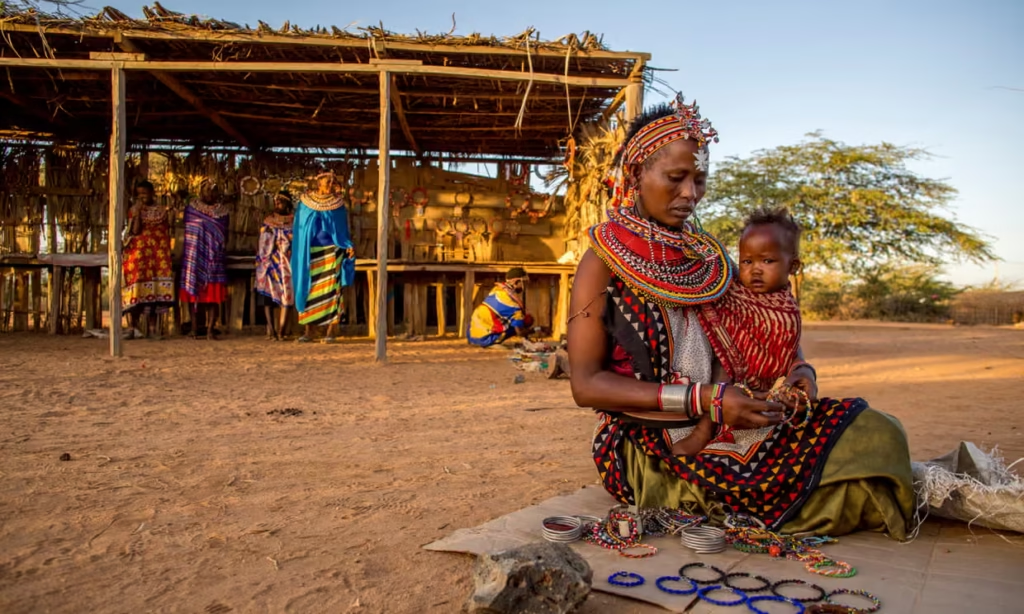
Umoja Uaso is not a typical village visit, and it deserves its own explanation rather than a footnote. Founded in 1990 by Rebecca Lolosoli and a group of Samburu women, Umoja, meaning unity in Swahili, began as a sanctuary for women who had survived rape, forced marriage and female genital mutilation, at a time when Samburu women could not own land or livestock in their own right. It sits near Archer’s Post in Samburu County, on the banks of the Ewaso Ng’iro River, close to Samburu National Reserve and roughly 380 kilometres from Nairobi.
Today, Umoja is an all-women community. Men do not live there, though they are welcome to join a tour. Visitors are shown around the huts, the pre-school and the napoo, the village’s own governing council, and hear directly from the women about how the village works, how decisions get made without a male head of household, and how the community sustains itself, largely through a beadwork cooperative that sells internationally as well as to visitors on site. There is a basic campsite on the property for anyone who wants to stay longer than an afternoon.
| Umoja is not a cultural performance built for tour traffic. It is a working, self-governed community that happens to welcome visitors, and that distinction matters. |
Because Umoja is genuinely community-owned rather than a stop resold by a tour operator, it is one of the clearer examples of what a community-led visit looks like in practice. If you are travelling through Samburu and want to see that model in action, it belongs on the itinerary alongside your game drives, not instead of one.
Maasai vs Samburu Village Visits: A Comparison
The two are often bundled together in itinerary language, so here is the practical breakdown side by side, with Umoja Uaso included as the third, distinct option.
| Maasai Village Visit | Samburu Village Visit | Umoja Uaso Village | |
| Location | Masai Mara conservancies and community land bordering the reserve | Edge of Samburu National Reserve, Isiolo County | Near Archer’s Post, Samburu County, on the Ewaso Ng’iro River |
| Typical cost | USD 20 to 50 per person | USD 20 to 40 per person | Around USD 10 per person |
| Duration | 45 minutes to 1.5 hours | About an hour | 30 to 60 minutes, longer if you stay for tea |
| Who hosts you | A boma (homestead) of an extended Maasai family | A Samburu manyatta near the reserve gate | An all-women council, the napoo, and resident families |
| What you’ll see | Adumu jumping dance, fire by friction, milking, hut interiors, beadwork market | Warrior dancing, hut interiors, beadwork, age-set customs | Women’s council meeting space, huts, school, beadwork cooperative |
| Best paired with | A Masai Mara game drive morning or afternoon | A Samburu National Reserve game drive | An overnight or lunch stop on the Nairobi to Samburu Road |
What It Costs, In Plain Terms
Pricing for village visits is rarely printed on an operator’s website the way park fees are, so here is what to expect and budget for, based on current rates across the Masai Mara and Samburu.
Maasai village visit cost
Expect USD 20 to 50 per person for a Maasai boma visit in or around the Masai Mara. The lower end covers a straightforward roadside stop, and the upper end is typical for a private arrangement through a lodge or operator with an established relationship with a specific boma. Some camps quote this inclusive of return transfer and guide time, while others quote it as the village contribution only, so ask which you’re being given.
Samburu village visit cost
Expect USD 20 to 40 per person for a Samburu village visit near the national reserve, for a visit lasting roughly an hour. This is usually a straightforward gate fee paid on arrival rather than something bundled into your safari package.
Umoja Uaso village visit cost
Expect around USD 10 per person, to visit Umoja Uaso. This is considerably lower than a typical Maasai or Samburu boma fee, and it reflects Umoja’s own pricing as a self-run community enterprise rather than a rate set by a tour operator or a middleman.
Questions to Ask Your Operator Before Booking
A short list of direct questions tends to sort a genuine, community-led visit from a resold roadside stop faster than any amount of research online.
- Who receives the fee, by name or by family, not just “the village”?
- Is this the same boma or manyatta every time, or does it rotate depending on who’s paying a commission that week?
- Is the visit optional, or is it built into the itinerary as a fixed stop?
- How is photography handled, and is it included in the fee or charged separately?
- Can we spend time asking questions, or is it strictly a fixed sequence of performances?
- Does our guide or driver take a commission from the visit, and is that disclosed to us?
| EXPERT NOTE I’ve been driving guests through the Mara long enough to know which bomas want us there and which ones just want the vehicle count. It’s not something you can always tell from a website. It’s built over years of actually showing up, paying fairly, and asking the family what they’d rather we did differently next time. Nicholas Wangithi, Director & Founder |
Frequently Asked Questions
Is a Maasai village visit worth visiting?
Yes, a Maasai village visit is worth it when it is arranged with a specific, community-led boma rather than a staged roadside stop. You’ll come away with a genuinely deeper understanding of pastoralist life, cattle culture and the Maa age-set system than any game drive can offer, but the quality of the experience depends entirely on who is hosting it and how the visit was set up.
Is visiting a Maasai village ethical?
It can be, but it isn’t automatically. A visit is ethical when the community controls the terms, sets its own fee and can decline visitors, and it becomes questionable when a middleman resells access to a family that sees little of the money. Ask who benefits before you book, and you’ll usually get your answer.
What should you expect on a Maasai village tour?
Expect a welcome song and the Adumu jumping dance, a fire by friction demonstration, a walk through the manyatta’s huts, and a beadwork market at the end. The whole visit typically runs 45 minutes to 1.5 hours, and a good host will also leave room for you to ask questions rather than running straight through a fixed sequence.
Is it okay to take photos in a Maasai village?
Yes, with permission asked individually before each photograph, rather than assumed. Some visits include photography in the entry fee and others charge separately, children need a guardian’s consent, and any area or ritual marked off limits to cameras should be respected without argument.
How much does it cost to visit a Maasai village?
A Maasai village visit typically costs USD 20 to 50 per person in and around the Masai Mara. The fee usually covers a guided walk through the boma, the cultural demonstrations and access to the beadwork market, though transfer and guide time may or may not be included depending on how the operator quotes it.
How much does it cost to visit a Samburu village?
A Samburu village visit typically costs USD 20 to 40 per person, for a visit lasting about an hour near Samburu National Reserve. It is usually paid as a straightforward entry fee at the gate rather than bundled into a wider safari package.
How much does it cost to visit Umoja Uaso village?
Umoja Uaso costs around USD 10 per person. That covers a guided walk through the women-only village near Archer’s Post, including its huts, school and the napoo council space, and it is one of the more affordable and directly community-run village visits in northern Kenya.
What’s the difference between a Maasai village visit and a Samburu village visit?
The main difference is which community is hosting you: Maasai villages sit in and around the Masai Mara in southern Kenya, while Samburu villages sit near Samburu National Reserve in the north. The two communities share related Maa languages and a similar warrior age-set system, but they are culturally distinct, and neither name should be used for the other.
Plan a Village Visit That’s Worth Your Time
This guide has covered what separates a staged roadside stop from a genuine, community-led village visit, what actually happens once you arrive, how photography and fees should be handled, and what a Maasai, Samburu or Umoja Uaso visit realistically costs. None of it is complicated once you know what to look for, but most travellers never get told any of it before they book.
At Afrikan Accent Adventures, we don’t add a village visit to your Masai Mara or Samburu itinerary as a default stop, and we won’t route you through a staged boma just because it’s convenient. Talk to Hellen Asiko, our Director & Guest Experience Curator, about arranging a community-led cultural visit with a family or council we already know and trust, on terms that are clear before you ever step out of the vehicle.
The best village visit is the one that wanted you there in the first place.
Let's plan your East African safari
Tell us when you'd love to travel and a local specialist will craft a tailor-made route around you.


