Giza Mrembo: The Black Leopard of Laikipia Who Changed the Way Kenya Does Safari
Giza Mrembo is a melanistic leopardess living in the Ewaso Narok River corridor of central Kenya, and she has made Laikipia County one of the most sought-after wildlife destinations on the continent. This is her story and what it takes to see her.
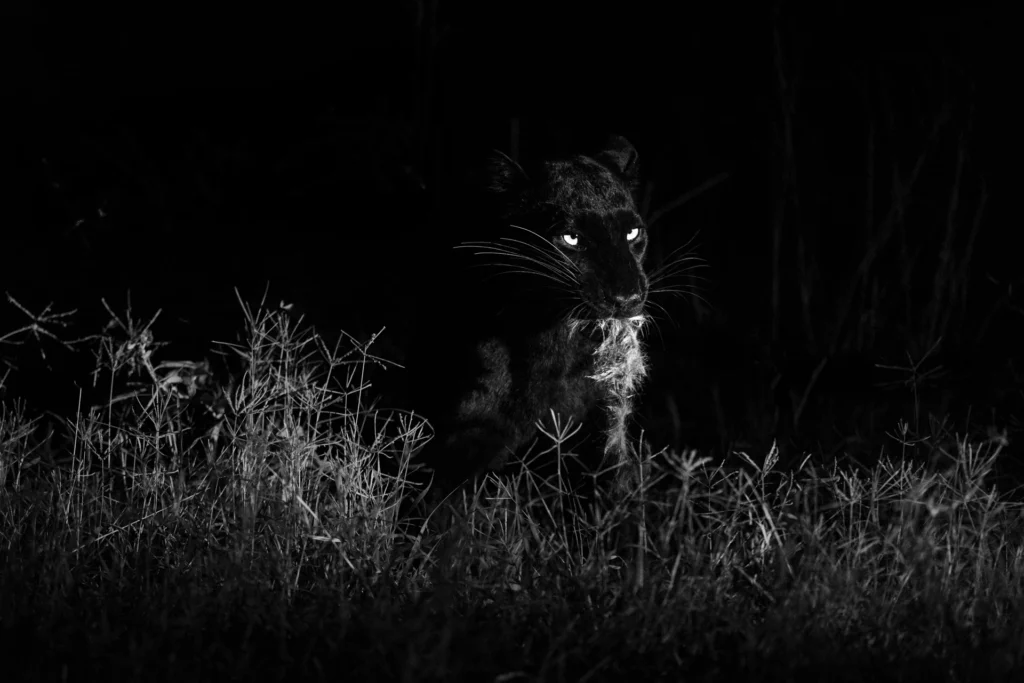
We have been doing this long enough to know when a guest arrives with a single, specific, unwavering objective. They are not here for the Great Migration. Not for Kilimanjaro. Not for the general abundance of East Africa’s wildlife. They have seen images. A black cat on a dark rock in fading light, rosettes barely visible beneath an ink-dark coat. They want that. One sighting. One hour in the field with Giza Mrembo.
We respect that kind of focus. We also tell them the truth about it. She is wild. She has a territory that crosses fence lines and roads and neighbouring farms and does not follow any schedule we have ever tried to predict. She will appear at dusk on the Ewaso Narok River for three consecutive evenings and then vanish into the croton thickets for a week. The guides at Laikipia Wilderness Camp track her movements every day. They read the rocks and the river course and the dik-dik alarm calls and they still cannot guarantee the moment.
That is precisely why people go.
Giza Mrembo means beautiful darkness in Swahili. The name was given to her by the guides and trackers at Laikipia Wilderness Camp, the family-run property on 70,000 acres of central Laikipia where she was born and raised, less than one kilometre from camp. She is a melanistic African leopard, Panthera pardus, with a genetic mutation that produces excess eumelanin and gives her coat its near-black appearance. In the right light, at the right angle, you can still see her rosettes. Ghost patterns beneath the darkness. But in the field at dusk, as she drops off a granite boulder and moves toward the river, she looks exactly like what folklore always said she was. A shadow that hunts.
She became known to the world in 2018 when British wildlife photographer Will Burrard-Lucas deployed camera traps along the Ewaso Narok River and produced the first scientifically documented high-quality photographs of a wild black leopard in Africa in over a century. The images went global overnight. And Laikipia, which had been quietly building a reputation among serious safari travellers for years, became something else entirely. It became the place where the myth was real.
| QUICK ANSWER | Who is Giza Mrembo and where can you see her? |
| Giza Mrembo is a wild melanistic leopardess living in the Ewaso Narok River corridor of Laikipia County, central Kenya. First documented by photographer Will Burrard-Lucas in 2018, she is the most famous black leopard in Africa. Her territory centres on Laikipia Wilderness Camp and she is most reliably seen in the late afternoon and at dusk. In November 2024 she gave birth to two spotted cubs. |
At a Glance
- Subject: Giza Mrembo, melanistic African leopard (Panthera pardus), female
- Location: Ewaso Narok River corridor, Laikipia County, central Kenya
- Territory: Covers Mpala Ranch, Suyian and the area around Laikipia Wilderness Camp
- First documented: 2018, by photographer Will Burrard-Lucas using Camtraptions camera traps
- Status as of 2026: Wild and active; mother of two spotted cubs born November 2024
- Primary camp: Laikipia Wilderness Camp on the Ewaso Narok River
- Best access: Flight from Wilson Airport, Nairobi to Loisaba Airstrip, then road transfer
- Recommended stay: 4 to 7 nights to maximize sighting chances
- Booking operator: Afrikan Accent Adventures, Nairobi-based KATO member safari operator
What Melanism Is and Why It Makes Giza So Rare
Melanism is a recessive genetic mutation that causes an overproduction of eumelanin, the dark pigment responsible for coat colour in mammals. For a leopard to be melanistic, both parents must carry the recessive allele and pass it on. Giza’s mother is a spotted leopard with a standard coat. Her father is believed to also be a melanistic individual, which means both parents carried the gene. The probability of the trait expressing itself in any given cub remains low even with both parents as carriers.
Melanistic leopards are not a separate species. They are African leopards, Panthera pardus, with the same biology, the same prey requirements and the same territorial behaviour as their spotted counterparts. The rosettes do not disappear. They are still there in the coat, visible as ghost patterns when the light catches the fur at the right angle. In photographs taken with camera traps at close range in good light, Giza’s rosettes are clearly distinguishable. In the field at twilight, she reads as completely black.
The condition is more commonly documented in Asian leopards and in jaguars. In African leopards it is exceptionally rare. A 1909 photograph from Ethiopia held by the Smithsonian Institution was for most of the twentieth century the most credible documentation of melanism in an African leopard. The 2018 Laikipia photographs by Burrard-Lucas changed that and prompted a re-examination of historical sighting reports from the Aberdares, Mount Kenya forest and parts of central Africa that had previously been treated as unverified.
Laikipia’s geological character may be part of the explanation for the concentration of melanistic individuals here. The landscape is dominated by volcanic basalt, dark granite outcroppings and phonolite rock formations. The hypothesis, which remains unproven, is that a dark coat may offer some camouflage advantage in this specific terrain that it would not provide in the open savannah of other East African ecosystems. What is documented is that the Laikipia population represents the most significant known concentration of melanistic leopards in Africa. At least ten individuals have been recorded in the greater region.
| Melanism in an African leopard is rare enough that for most of the twentieth century the scientific record held only one credible photographic document, a 1909 image from Ethiopia. Laikipia now has ten confirmed individuals. That concentration is not fully explained and remains one of the more interesting open questions in African mammal genetics. |
Giza’s Life: From Drought Cub to Mother of Two
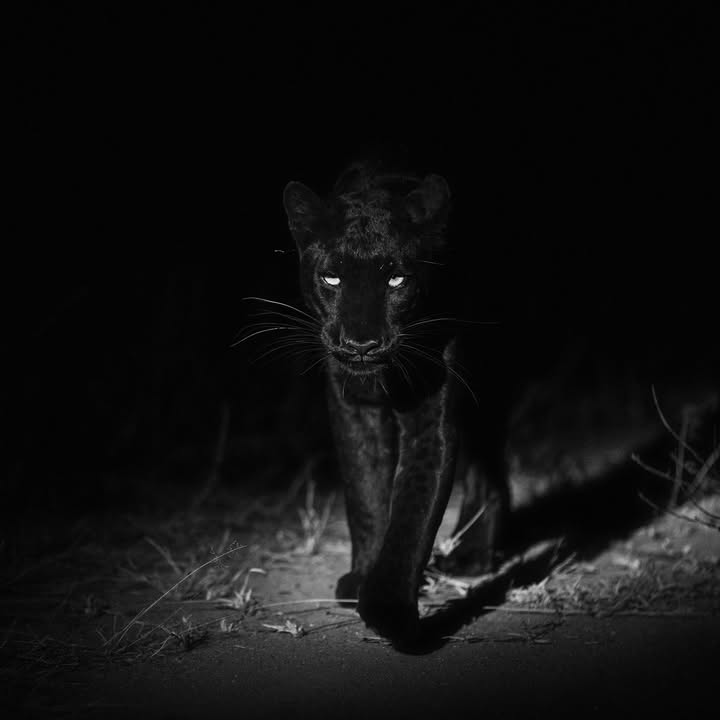
Giza was first observed as a young cub alongside her spotted mother during Kenya’s devastating 2022 drought. The drought conditions that killed livestock across Laikipia County and reduced prey availability across the ecosystem shaped the early months of her life. Food was scarce. She adapted early and adapted fast.
Her hunting strategy diverged from the classic leopard approach almost immediately. Spotted leopards rely on their camouflage to close the distance on prey before a short burst of acceleration. Giza’s dark coat offers no such advantage in the open savannah terrain and acacia woodland of Laikipia. She developed instead an opportunistic, high-movement approach: covering large distances, working the dik-dik population in the croton thickets and ambushing prey in open terrain where speed rather than stealth determined the outcome.
A dominant male leopard in her range, known to guides as Kasiwa, identified her as a reliable hunting resource and began following her, stealing her kills. His size advantage left her no room to contest. She adapted again. Making multiple kills in a single night became her strategy, one to lose to Kasiwa and one to keep. The kink in her tail, visible in every photograph, suggests an injury sustained during her cub period, possibly a fall or a failed hunt. She carried it into adulthood without apparent impairment.
She became habituated to safari vehicles within roughly 18 months of being observed regularly. Her mother’s existing comfort around vehicles accelerated the process. By 2023 she was reliably relaxed around game viewing vehicles and was providing the kind of extended, unhurried sightings that photographers from Europe, North America and Japan were travelling specifically to Laikipia to experience.
In November 2024 Giza gave birth to two cubs. Neither is melanistic. Both carry the standard spotted coat. The mathematics of the recessive gene means that even with Giza as one parent, expression of melanism in the cubs would require the father to also carry the allele. The cubs’ spotted coats confirm the genetic rarity of what Giza herself represents. She is now raising them in the same territory where she was raised, in the same riverine woodland along the Ewaso Narok, teaching them the same landscape she learned from her mother during the drought.
| Giza gave birth to two spotted cubs in November 2024. The cubs’ standard coats are not a disappointment. They are a precise illustration of how rare melanism truly is. Both parents must carry the recessive gene. The odds remain long even when one parent is the cat herself. |
The Landscape: What Laikipia Actually Looks and Feels Like
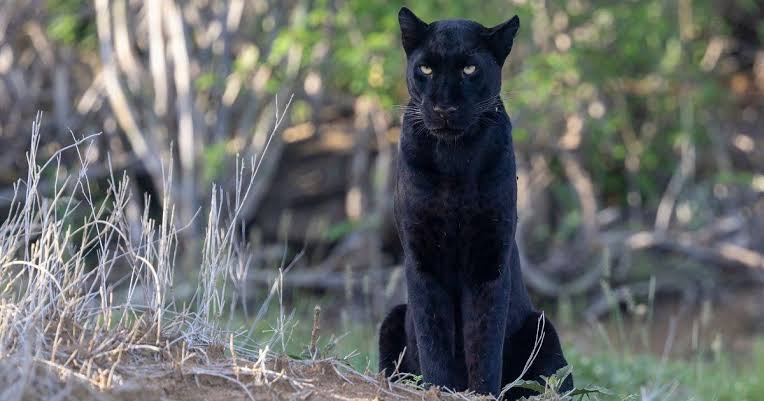
Laikipia County sits on the equator in central Kenya, on the high plateau north and west of Mount Kenya. The county is one of Kenya’s 47 counties and sits at elevations ranging from roughly 1,500 to 2,500 metres above sea level. The landscape is not what first-time visitors to Kenya expect. There is no endless grass plain here. No obvious savannah horizon. Laikipia is rockier, drier, more dramatic in its contrasts: basalt outcroppings rising from thorn scrub, granite kopjes overlooking riverine woodland, escarpments dropping sharply toward the Great Rift Valley in the west.
The Ewaso Narok River is the spine of Giza’s territory. It flows west through central Laikipia, lined with riverine forest and acacia woodland that provide cover, water and prey concentration. The vegetation shifts quickly from the dense croton thickets along the river banks to open grassland on the plateau above and to rocky escarpment country on the valley sides. This compressed diversity of habitat types within a small area is what supports the wildlife density Laikipia is known for.
The county is home to significant populations of Grevy’s zebra, the rarest zebra species in the world, found almost exclusively in northern Kenya and southern Ethiopia. Reticulated giraffe, found only in northern Kenya, Somalia and southern Ethiopia, move through the acacia woodland. African wild dogs have been documented here. Striped hyenas, far rarer than their spotted cousins and one of the most sought-after sightings in East Africa, use the rocky escarpment country. Lions, elephants, cheetahs, buffaloes and an exceptional raptor list including Verreaux’s eagle, martial eagle and African hawk-eagle complete the wildlife picture.
For photographers and serious wildlife travellers, the species list at Laikipia competes with anywhere in East Africa. Giza is the headline. She is not the whole story. Guests who come for only her and nothing else consistently leave surprised by what else they found.
Where to Stay: Laikipia Wilderness Camp and the Three Properties
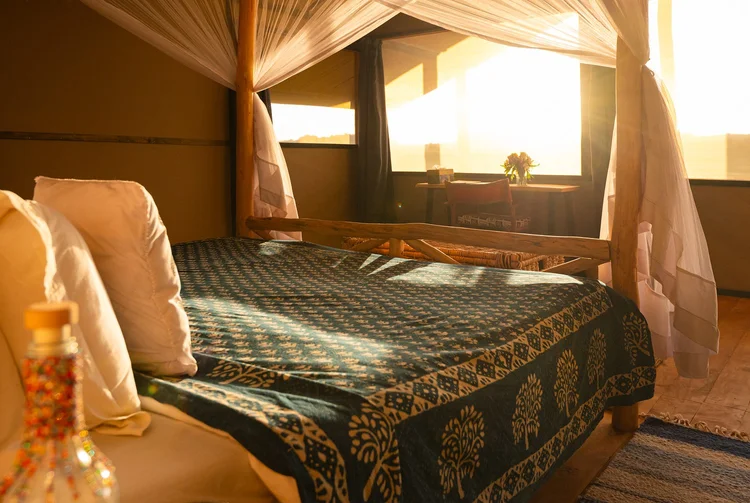
Laikipia Wilderness Camp is the family-run operation on 70,000 acres that sits at the centre of Giza’s territory. It is run by the Heath family and has been for many years. The relationship between the camp, the guides and the land is not assembled for tourism purposes. It is the product of years of living inside this landscape and knowing it in the way that only long-term presence builds.
The camp has three distinct properties along the Ewaso Narok River. Laikipia Wilderness Main Camp sits on a hillside overlooking the river with six spacious en-suite safari tents, four of which are family configurations. The hillside position is operationally significant: guides and trackers use the elevated viewpoint to scan for Giza’s movement across the surrounding terrain, and the lookout deck on the hillside above camp provides a 360-degree view of the landscape including Mount Kenya to the southeast. Sunsets from that deck are worth a separate mention.
Wilderness River Camp sits directly on the riverbank with four thatched cottages and an open-air dining area. It is lower, closer to the water and in immediate contact with the nocturnal activity along the river. Elephants come to drink at the culvert near Room 5. The sound of the river running over rocks carries into every room. For guests who want the full sensory immersion of a riverside position this is the camp. Meals are cooked over a wood fire or open flame, sourced from on-site vegetable and herb gardens.
Palm Camp opened in the second half of 2024 upstream from River Camp. Four en-suite tents elevated on wooden stilts with views across the rolling lawns to the river beyond. It is the newest of the three options and the most recent addition to the Laikipia Wilderness portfolio.
The camp operates a Black Leopard Private Vehicle and a Black Leopard Shared Vehicle system that gives holders priority at sightings. When the radio call comes in that Giza has been located, these vehicles go first. For guests whose primary objective is Giza, this is the booking structure to ask about.
How to See Giza Mrembo: What the Sighting Actually Involves
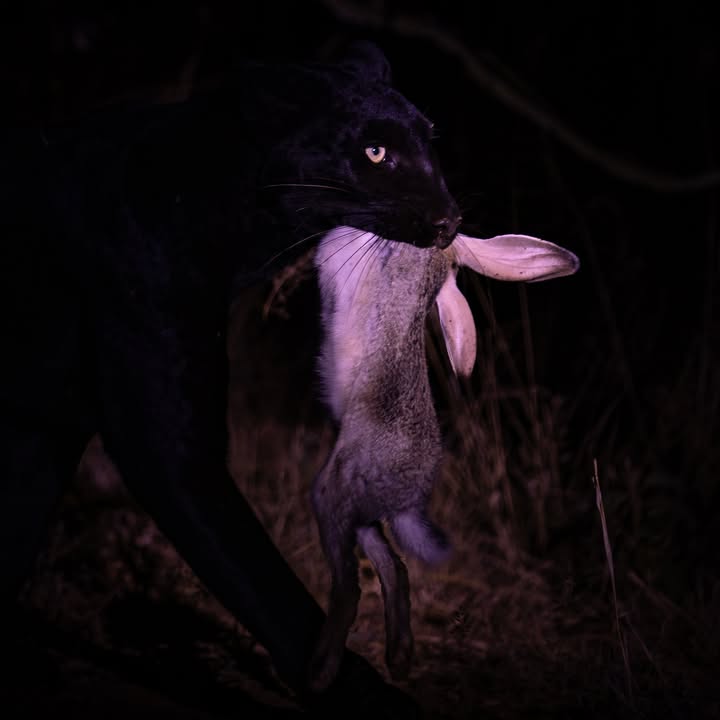
We will be direct about this because guests deserve honesty more than false confidence. Giza is not guaranteed. We have sent guests to Laikipia who spent four nights without seeing her and left on the fifth morning frustrated but unable to explain rationally why they would not go back. We have sent others who found her on their first afternoon drive, sitting on a rock above the river in the last hour of light, and sat with her for forty minutes while she watched the bush below.
The sighting dynamic depends on where she is in her territory. Her range covers parts of Mpala Ranch, Suyian and the land immediately around Laikipia Wilderness Camp. The Laikipia Wilderness section is the northeast corner of her wider territory. She spends significant time in the neighbouring farms across the river and across the road to the east. When she is outside the Laikipia Wilderness area, she is outside the reach of the camp’s guide network. The trackers determine her position each morning by reading spoor, checking known crossing points along the Ewaso Narok and listening for prey alarm calls.
Late afternoon into dusk is the most productive period. She moves earlier than most leopards and her activity increases as the light fails. Some of the most photographed sightings have occurred at or just after sunset, which creates a specific challenge for photographers: low light, a dark subject, a moving target. The photographic community has adapted to this with high-ISO work, fast lenses and the creative use of the conditions rather than trying to fight them. Black-and-white high-key images shot against the reflective surface of the Ewaso Narok River have become a signature Laikipia photographic style for exactly this reason.
The camp’s ethical guidelines around sightings are non-negotiable and worth understanding before you arrive. Vehicles do not intercept her movement. Vehicles do not reposition during a sighting. Artificial spotlighting is used only at the guide’s discretion and is never used when she is with her cubs, who will not be spotlit until they are at least six months old. The number of vehicles at any single sighting is limited. The priority vehicle system exists precisely to manage demand without creating disturbance. These are not inconveniences. They are the reason she remains relaxed and accessible.
| We recommend a minimum of four nights. Seven nights is better. Not because you need seven nights to see her. Because if you spend the first four looking for her and the last three sitting with her, you will not be counting the cost of the extra nights. |
The Rest of the Wildlife: Why Laikipia Works as a Safari Destination Beyond Giza
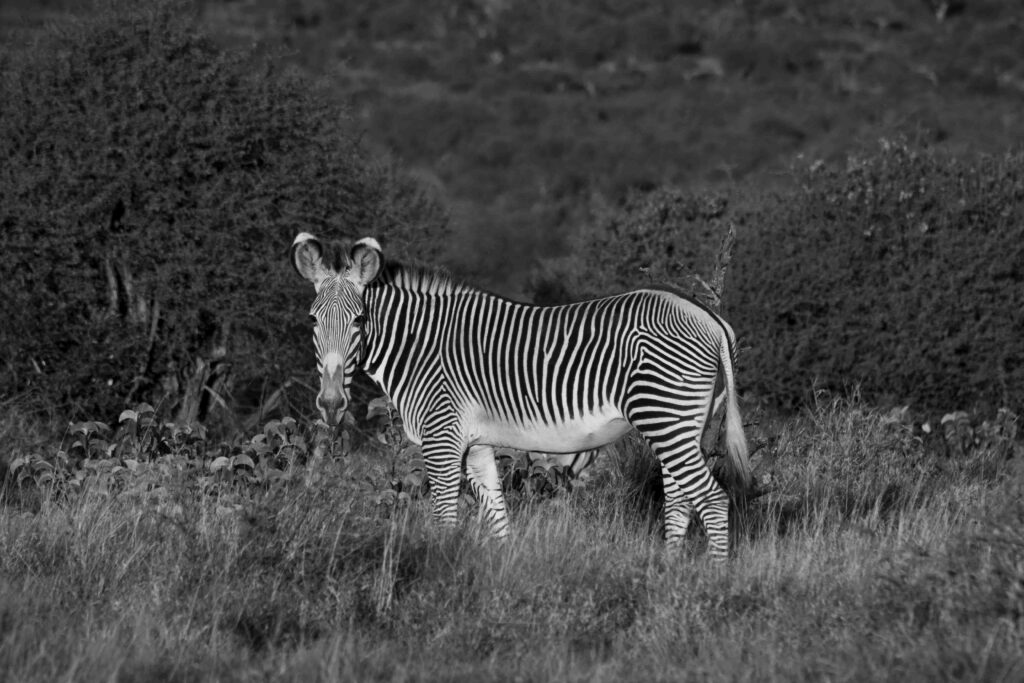
Guests who travel to Laikipia purely for Giza and allow themselves to notice what else is here consistently describe it as the better trip for that openness. The wildlife list in the Ewaso Narok corridor is exceptional by any measure.
Grevy’s zebra are the largest wild equid and the rarest zebra species on earth. Kenya holds the majority of the global population, estimated at fewer than 3,000 individuals. Laikipia is one of the core Grevy’s strongholds. Seeing a herd on the open plateau, the distinctive narrow stripes and rounded ears clear against the dust, is one of the more underrated experiences in East African wildlife watching.
Reticulated giraffe, found nowhere south of the equator, browse through the acacia woodland with the unhurried confidence of an animal with no natural predator from above. Their coat pattern is distinct from the Maasai giraffe of the Mara and Amboseli: large, clearly defined polygons with sharp white borders rather than the irregular brown patches of their southern relatives.
African wild dogs, one of the most endangered carnivores on the continent with a continental population estimated below 6,600 individuals, have been documented in Laikipia. Striped hyenas use the rocky escarpment country. A pride of lions hunts the open plateau. Cheetahs have been seen with cubs. The bird list includes Verreaux’s eagle, martial eagle, vulturine guineafowl, eastern chanting goshawk, secretary bird, crowned crane and a substantial suite of raptors and riverine species.
And occasionally, on the right morning in the right light on a hillside above the river, an elephant bull with exceptional ivory. The kind of animal you think belongs to another era until it is standing in front of you and you understand that the past is not as distant as you assumed.
Photography at Laikipia: What the Light Requires
Laikipia is a specialist photographic destination. Not because it is more difficult than other parks. Because the specific challenge of photographing a black animal in low light conditions calls for preparation that a standard safari lens kit does not automatically include.
The key variables are: aperture, ISO ceiling and shutter speed in the last hour of light. A lens of f/2.8 or faster makes a meaningful difference in the fifteen-minute window around sunset when sightings most often occur. Modern mirrorless systems with strong high-ISO performance produce usable files at ISO 6400 and above, which is where dusk work at Laikipia tends to land. If you are bringing a crop sensor camera with a variable aperture zoom, understand the limitations before you arrive rather than discovering them in the field.
Bush walks and vehicle drives both operate at Laikipia Wilderness. The walks access terrain that vehicles cannot reach and provide scale and ground-level perspective that changes the photographic vocabulary entirely. A Grevy’s zebra at twenty metres on foot is a different image to the same animal at fifty metres from a vehicle. For photographers who want variety in their work, the walk program should be built into the schedule rather than treated as an optional extra.
The ORYX Photo Tours team, led by photographer Daniel Bailey, runs dedicated black leopard photography departures to Laikipia that include pre-trip briefings on light management, composition in low-light environments and Lightroom processing for high-ISO files. For guests whose primary motivation is the photography rather than the wildlife experience more broadly, a structured photography departure with an experienced photo tour leader changes the quality of the output significantly.
How to Get to Laikipia for the Black Leopard Safari
The standard access route is a flight from Wilson Airport in Nairobi to Loisaba Airstrip in central Laikipia. Flight time is approximately 45 to 50 minutes on a scheduled or charter light aircraft. The road transfer from Loisaba Airstrip to Laikipia Wilderness Camp takes roughly one hour depending on conditions, passing across the Loisaba Plateau, down the escarpment and along the Ewaso Narok River.
Luggage restrictions apply. The limit is 20 kg per person in a soft-sided bag including hand luggage. This is a hard limit on light aircraft and it is enforced at check-in at Wilson Airport. Camera equipment adds weight fast. If you are travelling with professional photography gear, plan the bag weights carefully before you arrive at the airstrip.
Laikipia combines logically with several other Kenya destinations. The Masai Mara is a natural pairing: three or four nights in Laikipia followed by three or four nights in the Mara covers two of Kenya’s strongest ecosystems in a single trip without retracing any steps. Samburu National Reserve to the north adds a completely different habitat and species list including the northern specials: Beisa oryx, gerenuk, Somali ostrich, reticulated giraffe and reticulated giraffe. Mount Kenya National Park is close enough to justify an overland transfer for guests interested in the Afromontane environment and its endemic species.
Afrikan Accent Adventures, based in Nairobi and a KATO member operator, builds Laikipia itineraries as part of Kenya circuits and handles all flight bookings, transfers and camp logistics. We know the camps, the access routes and how to sequence the trip so that the time in the field is maximized rather than lost to unnecessary travel days.
Frequently Asked Questions
Who is Giza Mrembo?
Giza Mrembo is a wild melanistic African leopard, Panthera pardus, living in the Ewaso Narok River corridor of Laikipia County in central Kenya. Her name means ‘beautiful darkness’ in Swahili. She was first documented by photographer Will Burrard-Lucas in 2018 and has since become the most famous individual black leopard in the world. In November 2024 she gave birth to two spotted cubs.
What is a black leopard?
A black leopard is an African leopard with melanism, a recessive genetic mutation that causes overproduction of eumelanin and gives the coat a near-black appearance. The rosettes are still present and visible in the right light. Black leopards are the same species as spotted leopards. The term ‘black panther’ is commonly used but scientifically imprecise: there is no species called a black panther. In Africa, black panthers are melanistic leopards.
Where exactly does Giza Mrembo live?
Giza’s territory covers the Ewaso Narok River corridor in southern Laikipia County, including parts of Mpala Ranch, Suyian and the area around Laikipia Wilderness Camp. She was born less than one kilometre from Laikipia Wilderness Camp and has remained in the same general territory since. Her range extends into neighbouring farms across the river and east of the main road, which means she is not always within reach of the camp’s guide network.
How rare are black leopards in Africa?
Extremely rare. A 1909 photograph from Ethiopia held by the Smithsonian Institution was for most of the twentieth century the only credible documentation of melanism in an African leopard. The 2018 Laikipia photographs produced the first high-quality documented images of a wild black leopard in Africa in over a century. Approximately 10 melanistic leopards have since been documented in the greater Laikipia region, representing the most significant known concentration of the trait in Africa.
What are the best camps for seeing Giza Mrembo?
Laikipia Wilderness Camp is the primary base for black leopard sightings. It operates three properties on the Ewaso Narok River: Main Camp on the hillside with six tents, River Camp on the riverbank with four thatched cottages and Palm Camp upstream with four elevated tents, opened in late 2024. The camp operates a Black Leopard Private Vehicle and Shared Vehicle system that gives priority access to sightings. Staying at any of the three properties gives access to this system.
Is seeing Giza Mrembo guaranteed?
No. She is a wild animal with a large territory that extends outside the reach of the guide network. The camp recommends a minimum stay of four nights and states that seven nights significantly improves sighting chances. The guides track her movements daily using spoor, known crossing points and prey alarm calls. Late afternoon into dusk is the most productive period. Patience and an extended stay are the honest prerequisites for a sighting.
What other wildlife can you see in Laikipia?
Laikipia holds Grevy’s zebra, the world’s rarest zebra species; reticulated giraffe found only in northern Kenya and the Horn of Africa; African wild dogs; striped hyenas; lions; cheetahs; elephants; buffaloes and an exceptional bird list including Verreaux’s eagle, vulturine guineafowl, martial eagle and eastern chanting goshawk. The wildlife diversity in Laikipia competes with any ecosystem in Kenya and substantially exceeds what most first-time visitors to the region expect.
When is the best time to visit Laikipia for the black leopard?
Laikipia is a year-round destination for Giza sightings. The dry seasons, July to October and January to February, offer more predictable wildlife movement and clearer conditions for tracking. Giza herself is active year-round. The camp’s experience suggests that animal behaviour and Giza’s own activity patterns do not favour one season strongly over another. The most significant variable is not season but length of stay.
How do I book a Laikipia black leopard safari from Nairobi?
Contact Afrikan Accent Adventures in Nairobi. We are a KATO member operator and we build Laikipia itineraries as part of Kenya circuits. We handle flights from Wilson Airport to Loisaba Airstrip, camp bookings, transfers and the full trip logistics. We can also build a Laikipia and Masai Mara combination, a Laikipia and Samburu circuit or a multi-destination Kenya itinerary that includes Laikipia as one stop.
Go to Laikipia. Stay Long Enough.
We wrote this article because Giza Mrembo represents something that does not come along often in East African wildlife. A genuinely rare animal, in a genuinely wild landscape, accessible to the kind of guest who is willing to go somewhere unfamiliar and stay long enough to earn the sighting.
Laikipia is not the Masai Mara. It does not deliver guaranteed spectacle from the first afternoon. What it delivers, to guests who invest the time, is a different quality of experience. Smaller camps. Fewer vehicles. A landscape that requires reading rather than just driving through. And the possibility, on a late afternoon in the Ewaso Narok corridor, of a black cat on a dark rock dropping into the river and crossing to the other side as the last light goes.
We are Afrikan Accent Adventures, a Nairobi-based, Kenya-run safari operator and KATO member. We know Laikipia the way we know the rest of the country: because we have driven it, stayed in the camps and kept going back. We can build you a Laikipia itinerary that works as a standalone trip or as part of a wider Kenya circuit. We handle the flights from Wilson Airport, the camp bookings, the transfers and the details that make the difference between a trip that functions and a trip that exceeds what you imagined.
Talk to our Safari experts and let us build you the Laikipia trip that gives you the best possible chance of standing in her shadow.
Let's plan your East African safari
Tell us when you'd love to travel and a local specialist will craft a tailor-made route around you.


