


Planning & Tips
Solo Safari in Kenya: What the Single Supplement Really Costs and How to Cut It
We priced eleven safaris for one traveller, from a USD 650 shared tent in the Siana Conservancy to…
Read more →
Africa's Primate Capital - chimpanzee trekking, 13 primate species and ancient rainforest in western Uganda.
The forest is still dark when you leave the lodge. Somewhere ahead, a chimpanzee calls once, then another answers from deeper in the canopy. The guide stops, listens, and points toward a movement in the branches. A few seconds later, the first chimp appears, swinging between the trees above us.
We have walked Kibale’s forest trails many times, and that first encounter never becomes ordinary.
Kibale National Park sits in western Uganda, roughly 300 kilometres west of Kampala and close to the town of Fort Portal. Covering about 795 square kilometres, the park protects one of Africa’s most important remaining tracts of tropical forest and is best known for its extraordinary concentration of primates. The forest rises and falls across rolling terrain, with tall evergreen trees, tangled vines, streams and patches of grassland creating a habitat that feels completely different from Uganda’s savannah parks.
What sets Kibale apart is chimpanzee trekking. More than 1,400 chimpanzees are estimated to live in the wider Kibale ecosystem, making this one of the most reliable places in Africa to encounter wild chimpanzees on foot. But chimpanzees are only part of the story. Kibale is home to 13 recorded primate species, including red colobus, black-and-white colobus, L’Hoest’s monkeys, blue monkeys, red-tailed monkeys and olive baboons.
The forest also supports forest elephants, buffalo, bushbuck, duiker, giant forest hogs and more than 375 recorded bird species. Nearby Bigodi Wetland Sanctuary adds another dimension, combining birdwatching, primate sightings and community-based tourism in a wetland landscape just outside the national park.
For us, Kibale is where a Uganda safari changes character. The open savannah disappears, the vehicle is replaced by walking trails and the experience becomes less about scanning the horizon and more about listening to the forest.
Kibale National Park is a 795-square-kilometre tropical forest protected area in western Uganda, near Fort Portal. It is famous for chimpanzee trekking and is one of Africa’s best destinations for seeing wild chimpanzees. The park protects one of Uganda’s richest primate habitats, with 13 recorded primate species, along with forest elephants, buffalo, giant forest hogs and hundreds of bird species.
Location: Western Uganda, near Fort Portal and approximately 300 kilometres west of Kampala
Size: Approximately 795 square kilometres
Established: 1993 as a national park, following earlier forest reserve protection
Managed by: Uganda Wildlife Authority
Known for: Chimpanzee trekking, primates, tropical forest and birdwatching
Main tourism centre: Kanyanchu Visitor Centre
Nearest major town: Fort Portal
Nearest airport: Kasese Airport for some scheduled and charter connections, with road transfers required
Main attraction: Wild chimpanzee trekking and habituation experiences
Nearby attractions: Bigodi Wetland Sanctuary, Queen Elizabeth National Park, Rwenzori Mountains and crater lakes around Fort Portal
Chimpanzee trekking is the experience around which most Kibale safaris are built. Visitors meet their guides and trackers at Kanyanchu before setting off into the forest, usually in the morning. Once fresh chimpanzee signs are located, the trackers follow calls, nests, feeding remains and other clues to establish where the troop is moving.
Unlike a traditional game drive, chimpanzee trekking is unpredictable by nature. The animals may be high in the canopy, moving quickly through the trees or resting quietly on branches. On some days they remain relatively close to the trail, while on others the walk can involve several kilometres through dense forest.
When the chimpanzees are finally located, the experience can be remarkably intimate. You may hear them before you see them, then suddenly find yourself looking up at a chimpanzee watching the visitors below.
The standard chimpanzee trekking experience normally allows visitors a limited period observing a habituated community once it has been located. The exact experience, group size and regulations are determined by Uganda Wildlife Authority and can change, so we confirm current requirements when arranging permits.
Chimpanzee trekking in Kibale involves walking through tropical forest with trained guides and trackers to locate a habituated chimpanzee community. The trek can take several hours depending on where the chimpanzees are located, and once found, visitors spend regulated time observing their behaviour from a respectful distance.
For travellers who want more time with chimpanzees, Kibale also offers the Chimpanzee Habituation Experience. Rather than following a fully habituated troop for a standard trek, participants accompany researchers, trackers and guides as they spend extended periods with chimpanzees undergoing the habituation process.
The experience begins early and can occupy much of the day. It provides a deeper understanding of how researchers monitor chimpanzee behaviour, social relationships, feeding patterns and movement through the forest.
It is particularly suited to photographers, primate enthusiasts, researchers and repeat visitors who want something beyond the standard chimpanzee trek.
Availability, group sizes and permit conditions can vary, so we recommend confirming the current rules and permits before building a safari around the habituation experience.
Chimpanzees may be the headline attraction, but Kibale’s forest is one of the richest primate habitats in Africa.
The red colobus is one of Kibale’s most sought-after monkeys. It has a distinctive reddish-brown coat and pale face and spends much of its time high in the canopy. Kibale supports important populations of red colobus, although sightings can require patience because these monkeys move quickly through dense vegetation.
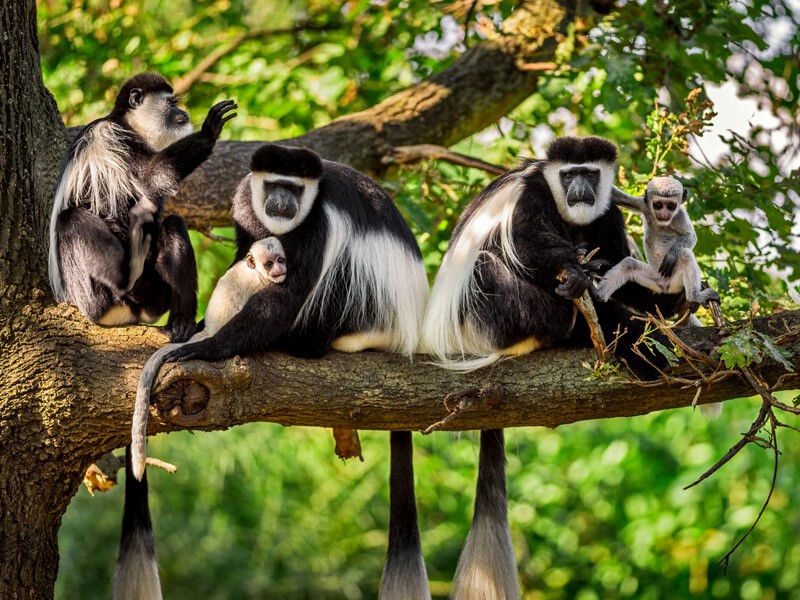
Black-and-white colobus monkeys are among the easier primates to notice in Kibale. Their striking black coats, white mantles and long tails make them highly visible against the green forest canopy. They often travel in groups and can sometimes be seen feeding or resting in trees close to the trails.
The red-tailed monkey has a distinctive pale or white cheek marking and a reddish tail tip. It is relatively widespread through Kibale and is frequently encountered during forest walks.
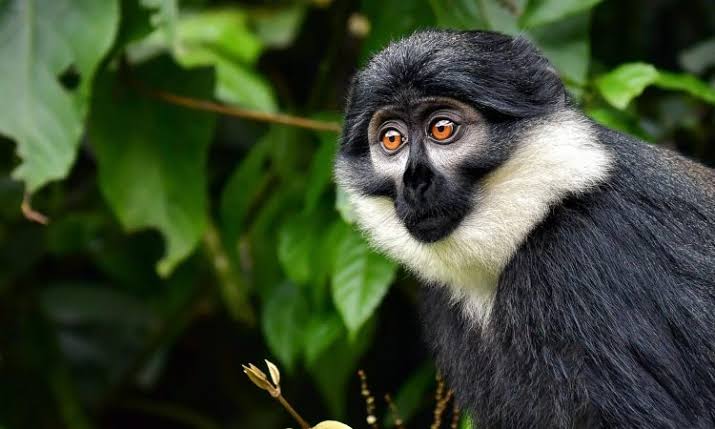
L’Hoest’s monkeys are terrestrial compared with many of Kibale’s other primates and can sometimes be seen moving through the lower forest or along the forest floor. They are recognizable by their darker bodies and pale facial markings.
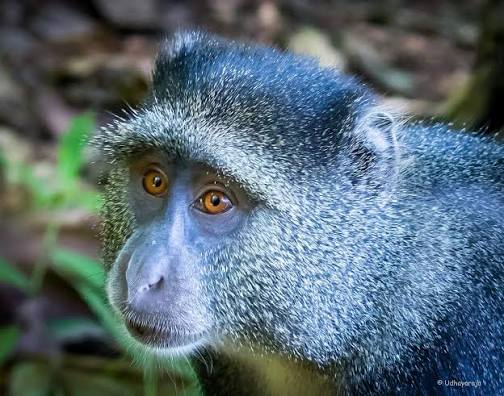
Despite its name, the blue monkey does not appear bright blue. Its colouring is generally greyish or bluish, and it often moves through the middle and upper layers of the forest. Blue monkeys are among the primates visitors may encounter during a standard forest walk.
Olive baboons are more commonly associated with open woodland and forest edges than the deep forest itself. They are social, adaptable animals and are frequently encountered around roads and clearings near Kibale.
Kibale’s wider primate community also includes mangabeys, bushbabies and potto, although some of the smaller nocturnal species are far harder to encounter during daylight walks.
Kibale is primarily a forest and primate destination rather than a Big Five safari park. The wildlife experience is therefore different from destinations such as Murchison Falls, Queen Elizabeth or Kenya’s Masai Mara.
Chimpanzees are the main attraction, while other primates provide almost constant movement in the canopy. Forest elephants occur in the ecosystem, although they are considerably harder to see than savannah elephants. Buffalo, giant forest hogs, bushbuck, duikers and several smaller forest mammals are also present.
Leopards and other forest predators occur but are rarely the main focus of a Kibale visit.
The real strength of Kibale is biodiversity. The combination of dense forest, primates, birds, butterflies, insects and plant life creates an ecosystem where even a short walk can produce something unexpected.
Kibale is best known for chimpanzees and its 13 recorded primate species, including red colobus, black-and-white colobus, red-tailed monkeys, blue monkeys and L’Hoest’s monkeys. The park also supports forest elephants, buffalo, bushbuck, giant forest hogs, duikers and more than 375 bird species.
Do not judge Kibale by the number of large animals you see from a vehicle. This is a forest safari. The experience is about following chimpanzee calls, watching monkeys move through the canopy, identifying bird calls and noticing the smaller details that are easy to miss on a conventional game drive.
Chimpanzee trekking is the principal activity in Kibale. The walk usually begins in the morning from Kanyanchu Visitor Centre, with trackers working ahead of the group to locate the chimpanzee community.
The terrain is generally manageable for travellers of reasonable fitness, but this is still a genuine forest walk. Trails can become muddy after rain, and visitors should expect uneven ground, roots, slopes and dense vegetation.
The habituation experience provides a longer and more immersive encounter with chimpanzees. Visitors accompany researchers and trackers as they observe chimpanzees that are gradually becoming accustomed to human presence.
It is one of the best options in Uganda for travellers who want to understand chimpanzee behaviour rather than simply see the animals.
Bigodi Wetland Sanctuary lies just outside Kibale and is one of the area’s most rewarding community-based experiences.
The wetland supports numerous bird and primate species, and guided walks follow trails through swamp, forest and farmland. Red-tailed monkeys, black-and-white colobus, blue monkeys and other species may be encountered along the way.
The sanctuary is also important because tourism revenue supports local community projects, making the visit more than simply another wildlife excursion.
Kibale is one of Uganda’s strongest forest birding destinations, with more than 375 species recorded in the wider park ecosystem.
The forest is particularly interesting for birders searching for species associated with Central and East African forests. Great blue turacos, African pitas, barbets, hornbills and various forest flycatchers are among the species that can be encountered.
Bigodi Wetland Sanctuary is especially useful for birdwatching because the combination of wetland, woodland and forest-edge habitats increases the range of species available.
Not every forest walk in Kibale has to be about chimpanzees. Guided nature walks provide an opportunity to focus on trees, plants, insects, birds and the ecological relationships that make the forest function.
These walks are particularly worthwhile for travellers who have already completed chimpanzee trekking and want to experience the forest at a slower pace.
Night walks in the Kibale area offer a completely different experience from daytime trekking. As the forest becomes dark, nocturnal species emerge, including bushbabies, potto and other small mammals.
The experience is led by trained guides and uses lights to locate animals without disturbing them. It is an excellent addition for travellers staying several nights around Kibale.
The communities around Kibale have developed several cultural tourism experiences where visitors can learn about local farming, food, traditional knowledge and daily life.
Coffee-growing experiences are particularly interesting in the Fort Portal region, where the volcanic soils and highland climate support coffee production.
The area around Kibale and Fort Portal is part of western Uganda’s important coffee-growing region. A coffee experience can take visitors from the farm through harvesting and processing to roasting and tasting.
It provides a useful contrast to the wildlife-focused activities and gives visitors a closer understanding of the agricultural economy supporting communities around the forest.
Kibale’s photography is fundamentally different from open savannah photography. Instead of long-distance wildlife portraits, photographers work with shafts of light through the canopy, chimpanzees moving between branches, colourful birds and intimate forest scenes.
A longer lens can be useful for primates high in the trees, while a wide-angle lens is valuable for capturing the scale and atmosphere of the forest.
Bigodi deserves its own mention because it has become one of western Uganda’s best examples of community-based tourism.
The sanctuary is managed through the local community, with tourism activities creating employment and supporting community initiatives. Guided walks pass through wetland and forest habitats where visitors may encounter monkeys, birds, butterflies and other wildlife.
The experience is less about finding one particular species and more about understanding how people and wildlife coexist around the edge of Kibale.
For travellers who have already spent time looking for chimpanzees, Bigodi provides a welcome change of pace.
Queen Elizabeth National Park lies south of Kibale and can be combined with it on a western Uganda safari.
The journey between the two destinations takes travellers from dense tropical forest into open savannah and wetland landscapes. Queen Elizabeth adds large mammals, tree-climbing lions in the Ishasha sector, hippos and boat safaris on the Kazinga Channel.
A Kibale and Queen Elizabeth combination works particularly well because the two parks provide very different wildlife experiences.
One morning you can be tracking chimpanzees through dense forest; a day later you can be watching elephants and buffalo from a safari vehicle beside an open channel.
The Rwenzori Mountains rise to the west of Kibale and provide another major attraction in the region.
Known as the Mountains of the Moon, the Rwenzori range contains some of Africa’s highest peaks and supports remarkable vegetation as altitude increases.
Travellers interested in trekking can combine a Kibale chimpanzee experience with a longer mountain adventure, although the two require very different levels of preparation and time.
For most safari itineraries, simply enjoying views of the Rwenzori from the Fort Portal area is the more practical option.
The Fort Portal region is surrounded by volcanic crater lakes, green hills, tea plantations and small farming communities.
A crater-lake excursion provides a scenic counterpoint to chimpanzee trekking, particularly for travellers staying several nights in the region.
The landscape is lush and rolling, with viewpoints overlooking lakes surrounded by forest and farmland.
Kibale is important not only because of its chimpanzees but because it protects one of Uganda’s remaining large blocks of moist tropical forest.
The forest provides habitat for primates, birds and numerous plant species while also supporting surrounding communities through tourism, employment and ecosystem services.
Chimpanzee tourism plays an important role in giving the forest economic value beyond agriculture and timber. Permit revenue, tourism employment and community-based activities all contribute to the wider conservation economy.
The relationship is not without challenges. Forest-edge communities need agricultural land, wildlife needs connected habitat and conservation authorities have to balance tourism with the protection of sensitive species.
That is why responsible tourism matters in Kibale.
Chimpanzee trekking is governed by rules designed to reduce disturbance and protect both visitors and wildlife.
Guests should maintain the distance required by Uganda Wildlife Authority, avoid loud noises, never attempt to feed animals and follow the guide’s instructions throughout the trek.
If you are unwell before a chimpanzee trek, tell your safari operator and guide. Great apes are susceptible to several human respiratory illnesses, so preventing transmission is an important part of responsible primate tourism.
Photography should also be respectful. Avoid using flash around chimpanzees and other wildlife, and never attempt to approach an animal simply to obtain a closer photograph.
Community visits should follow the same principle: engage respectfully, ask before taking photographs and purchase crafts directly from the people producing them whenever possible.
Kibale and Bwindi are both famous for primate experiences, but they offer very different encounters.
Kibale is the stronger choice for chimpanzee trekking and has one of Africa’s highest concentrations of primates. The terrain is generally less mountainous, and chimpanzee trekking is often more accessible for travellers who do not want a very demanding hike.
Bwindi is best known for mountain gorilla trekking. The forest is considerably more mountainous and trekking conditions can be demanding depending on where the gorilla family is located.
Many travellers combine the two destinations on a longer Uganda safari, creating an itinerary that includes both chimpanzees and mountain gorillas.
Kibale is about forest and primates. Queen Elizabeth is about savannah, wetlands and large mammals.
If chimpanzees are your priority, spend more time around Kibale. If you want elephants, buffalo, lions, hippos and a classic game-drive experience, Queen Elizabeth adds that dimension.
The two destinations complement each other extremely well and can easily form the central wildlife section of a western Uganda itinerary.
Most visitors reach Kibale by road from Kampala or Entebbe, travelling west through Uganda’s highlands toward Fort Portal.
The journey takes several hours depending on the starting point, traffic and road conditions. The road trip is part of the experience, with changing landscapes of farmland, tea plantations, rolling hills and forest.
Travellers arriving from Queen Elizabeth National Park can continue north toward Kibale, making the two destinations easy to combine.
Travellers looking to reduce driving time can use scheduled or charter flights to airports serving western Uganda, followed by a road transfer to their lodge.
Kasese is one of the useful aviation points for western Uganda, although the exact flight schedule and routing depend on the operator and season.
Because flights and airstrips can change according to the safari itinerary, we confirm the current routing before booking a fly-in safari.
The road option is generally the better choice for travellers who want to experience Uganda’s landscapes and combine Kibale with Queen Elizabeth, Murchison Falls or other destinations along a longer circuit.
Flying is more attractive when time is limited or when Kibale is part of a multi-region safari where long road transfers would consume too much of the itinerary.
For most travellers visiting Kibale as part of a western Uganda circuit, we prefer the road because the journey connects naturally with Queen Elizabeth and other attractions.
Kibale has a warm, humid tropical climate because of its elevation and extensive forest cover.
Rain can occur throughout the year, which is one reason the forest remains green and dense even when other parts of East Africa are experiencing dry conditions.
The region generally experiences two wetter periods, with heavier rainfall commonly occurring around March to May and September to November, although weather patterns can vary from year to year.
Temperatures are moderated by elevation, and mornings in the forest can feel cool before becoming warmer and more humid later in the day.
Rain is not necessarily a reason to avoid Kibale. Wet conditions can make trails muddy, but they also keep the forest vibrant and can create excellent photographic conditions.
Kibale has a warm, humid tropical climate with rainfall possible throughout the year. The forest remains green year-round, with wetter periods generally occurring around March to May and September to November. Temperatures are moderated by the area’s elevation, although humidity can be high.
A chimpanzee trekking permit is required to participate in the standard chimpanzee trekking experience in Kibale.
Permit prices are set by the Uganda Wildlife Authority and can change, so current rates should always be confirmed for the intended travel dates.
The Chimpanzee Habituation Experience has a different permit structure because it provides a longer period in the forest and a more immersive research-oriented experience.
We recommend securing chimpanzee permits before finalizing accommodation, particularly during busy travel periods. The permit determines the date on which you can trek, so it is one of the first elements we confirm when building a Kibale itinerary.
Kibale is one of those destinations where the permit should drive the itinerary rather than the other way around. Once we know your preferred chimpanzee trekking date, we can build the accommodation and road routing around it.
Kibale can be visited throughout the year, but the best period depends on what you want from the forest.
June to August generally offers a relatively drier period and is popular for trekking and wider Uganda safari circuits.
December to February can also provide good trekking conditions, with generally less rainfall than the wetter months.
March to May is one of the wetter periods. Trails can become muddy, but the forest is exceptionally lush and bird activity can be rewarding.
September to November brings another wetter period, with green vegetation and good opportunities for birdwatching.
Chimpanzees can be tracked throughout the year, so there is no single month when sightings suddenly become impossible.
Kibale is a year-round destination. June to August and December to February are generally popular for relatively drier trekking conditions, while March to May and September to November are wetter and greener. Chimpanzee trekking remains possible throughout the year.
Two nights can work for travellers whose main goal is chimpanzee trekking. It allows arrival, one trekking experience and departure, although the schedule can feel tight.
Three nights is our preferred minimum for a more relaxed first visit. It allows a chimpanzee trek, Bigodi Wetland Sanctuary and time to enjoy the forest without rushing between activities.
Four nights or more makes sense for travellers interested in the Chimpanzee Habituation Experience, night walks, birdwatching, cultural activities and the surrounding crater lakes.
If Kibale is combined with Queen Elizabeth National Park, we generally recommend allocating at least three nights to the wider western Uganda section, with the exact split depending on whether chimpanzees or big-game viewing is the priority.
Two nights is enough for a focused chimpanzee trekking visit. Three nights provides a more comfortable first experience and allows time for Bigodi Wetland Sanctuary. Four or more nights suits travellers interested in chimpanzee habituation, birdwatching, night walks and additional cultural experiences.
Kibale offers one of the closest wildlife encounters available in East Africa: walking through a tropical forest in search of wild chimpanzees.
It is also one of the best destinations in Africa for primate diversity. You are not simply visiting a park to find one species. The forest is alive with monkeys, birds, butterflies and smaller mammals throughout the day.
The landscape itself is another reason to come. After the open plains of a traditional safari, Kibale feels almost like entering another world. Tall trees close overhead, sunlight breaks through the canopy and animal calls come from every direction.
Kibale also works exceptionally well as part of a larger Uganda safari. Combine it with Queen Elizabeth for chimpanzees and big game, Bwindi for mountain gorillas, or the Rwenzori region for mountain scenery and trekking.
For travellers looking for something beyond conventional game drives, Kibale is one of Uganda’s strongest destinations.
The cost of a Kibale safari depends primarily on accommodation, the length of the trip, chimpanzee permit costs, transportation and whether additional parks are included.
As a general planning guide, budget and basic mid-range Kibale safaris can start from roughly USD 250 to 400 per person per day, while comfortable mid-range and upper-mid-range trips may fall around USD 400 to 650 per person per day. Luxury lodges and tailor-made private itineraries can exceed USD 650 per person per day, particularly when chimpanzee permits, private vehicles, premium accommodation and additional destinations are included.
These are planning ranges rather than fixed quotations. Chimpanzee permits are an important part of the overall cost, while combining Kibale with Queen Elizabeth or Bwindi can significantly change the total price.
Kibale safari costs commonly range from approximately USD 250 to 400 per person per day for budget and basic mid-range options, USD 400 to 650 for more comfortable mid-range and upper-mid-range safaris, and USD 650 or more for luxury itineraries. Chimpanzee permits, accommodation and transport are major factors in the final price.
We build Kibale into Uganda itineraries in several ways: as a focused chimpanzee safari, as part of a Kibale and Queen Elizabeth combination, or as one section of a longer Uganda primate safari that continues to Bwindi for mountain gorilla trekking.
For first-time visitors, our most popular approach is to combine Kibale and Queen Elizabeth National Park. The itinerary begins with chimpanzee trekking in the forest before moving into open savannah for classic game viewing.
For travellers whose main objective is primates, we can extend the stay to include chimpanzee habituation, Bigodi Wetland Sanctuary and additional forest activities.
For a complete Uganda wildlife experience, Kibale can also be combined with Bwindi, creating a journey that includes both chimpanzee and mountain gorilla trekking.
Accommodation around Kibale ranges from simple guesthouses and community lodges to comfortable mid-range properties and high-end forest lodges.
The main consideration is location. Properties near Kanyanchu provide convenient access to the chimpanzee trekking meeting point, while lodges farther away may offer more expansive views, larger grounds or a stronger luxury experience.
Forest-facing accommodation can also enhance the experience, particularly when monkeys and birds move through the surrounding vegetation.
We match accommodation to the traveller’s priorities, whether that means keeping costs controlled, staying close to the trekking centre or choosing a more secluded forest experience.
Kibale does not operate like a large savannah reserve with a long list of game-drive gates.
For most tourism activities, Kanyanchu Visitor Centre is the key access and information point. It is the main starting location for chimpanzee trekking and several forest activities.
Other forest areas and access points serve conservation and community purposes, while Bigodi is accessed separately through its community tourism programme.
The correct access point therefore depends on the activity and accommodation rather than simply choosing the nearest park gate.
Kibale’s conservation story is closely connected to the communities living around the forest.
Agriculture is a major source of income in the region, and farmers cultivate crops including bananas, tea, coffee and other food crops.
Tourism provides another economic pathway through lodge employment, guiding, transport, craft sales, community tourism and conservation-related employment.
Bigodi Wetland Sanctuary is one of the clearest examples of this relationship, with local residents directly involved in tourism activities and community development.
For visitors, choosing community-led experiences and buying locally produced crafts or agricultural products can help ensure tourism revenue reaches the people living around the park.
Chimpanzee trekking is an extraordinary privilege, but the experience needs to be managed carefully.
Chimpanzees are closely related to humans and can be vulnerable to human-borne diseases. Visitors should therefore follow all health requirements, maintain the required distance and never enter the forest when experiencing symptoms of illness.
Do not attempt to touch chimpanzees, offer food or imitate their calls to attract their attention.
The objective is observation, not interaction.
The best encounter is often the one where the chimpanzees continue behaving naturally while visitors remain quiet observers.
Kibale presents a completely different photographic challenge from Uganda’s savannah parks.
Light is often filtered through the canopy, backgrounds can be dark and animals may move quickly between branches. A telephoto lens is useful for chimpanzees and monkeys, while a wider lens can capture the scale of the forest.
Photographers should also be prepared for high humidity and occasional rain. Waterproof protection for camera equipment is essential.
The forest’s biggest photographic advantage is atmosphere: mist, shafts of light, enormous trees, tangled vegetation and primates moving overhead can create images that look nothing like conventional safari photography.
From chimpanzee trekking at Kanyanchu to the community trails of Bigodi, Kibale National Park offers a completely different side of East African wildlife.
It is a destination for travellers who want to walk rather than simply drive, listen rather than scan, and spend time watching primates behave naturally in their own forest environment.
We can build Kibale as a standalone chimpanzee safari, combine it with Queen Elizabeth National Park for big-game viewing, or include it in a longer Uganda itinerary incorporating Bwindi and mountain gorilla trekking.
The most important thing is to secure your chimpanzee trekking date early and then build the rest of the itinerary around it.
Kibale is not simply where you go to see chimpanzees. It is where you enter their world for a few hours—and for many travellers, that becomes one of the most memorable experiences of a Uganda safari.
Step into the ancient rainforest of Kibale National Park, where unforgettable encounters with wild chimpanzees await. Explore one of Africa's richest primate habitats through guided forest walks, discover rare monkey species, listen to the sounds of over 375 bird species and experience the remarkable biodiversity that has earned Kibale its reputation as Africa's Primate Capital.
Experience unforgettable encounters with wild chimpanzees in their natural habitat, making Kibale National Park one of the best places in Africa for…
Discover an incredible diversity of 13 primate species, including red colobus monkeys, black-and-white colobus monkeys, L'Hoest's monkeys, grey-cheeked mangabeys and red-tailed monkeys.
– Explore one of East Africa's largest and most pristine tropical rainforests, filled with towering trees, lush vegetation and scenic forest trails.
Exceptional Birdwatching – Spot over 375 bird species, including the rare African Green Broadbill, Great Blue Turaco, African Pitta, Black Bee-eater and…
– Enjoy immersive forest walks led by experienced guides who share fascinating insights into the park's wildlife, plants, insects and conservation efforts.
Discover Kibale's hidden nightlife with guided evening walks offering opportunities to see bush babies, pottos, nocturnal birds and other elusive forest creatures.
Bigodi Wetland Sanctuary – Visit the nearby community-managed wetland, famous for its rich birdlife, diverse primates and outstanding conservation initiatives that directly…
Capture stunning images of chimpanzees, colourful birds, ancient rainforest scenery and unique primates in one of Uganda's most photogenic ecosystems.


From value camps to premium lodges — we match every stay to your style and budget.
Budget accommodation near Kibale National Park offers comfortable rooms, friendly hospitality and convenient access to chimpanzee tracking and guided forest walks. These properties provide excellent value for travellers seeking an authentic rainforest safari experience at an affordable price.
Mid-range lodges combine spacious accommodation, quality dining and tranquil forest surroundings. Guests enjoy easy access to chimpanzee tracking, Bigodi Wetland Sanctuary, birdwatching excursions and nature walks while relaxing in comfortable surroundings with modern amenities.
Luxury accommodation near Kibale National Park offers elegant cottages, personalised service and breathtaking views of crater lakes and tropical rainforest. Guests enjoy gourmet dining, luxurious amenities and seamless access to chimpanzee tracking, birdwatching, Bigodi Wetland Sanctuary and guided forest experiences, making these lodges perfect for luxury safaris, honeymoon escapes and exclusive primate
Every season has its magic — here's what to expect when, so you can travel at your perfect time.
Everything you need to know before you go — and we’ll guide you through every step.
Most international visitors require a valid visa to enter Uganda. Applications can be submitted online through the Uganda e-Visa system before arrival. Visitors from East African Community (EAC) member states benefit from simplified entry arrangements.
The official currency is the Ugandan Shilling (UGX). Most safari lodges, hotels and tour operators accept Visa and Mastercard, while cash is recommended for gratuities, local purchases and community visits.
English and Swahili are Uganda's official languages. English is widely spoken by park rangers, guides, lodge staff and tour operators, making communication easy for international visitors. 🕒 Icon: Clock Label: Time Zone Title: East Africa Time Text:
Kibale National Park operates on East Africa Time (EAT), which is UTC +3 throughout the year with no daylight saving time.
Kibale National Park enjoys a pleasant tropical rainforest climate with daytime temperatures generally ranging between 20°C and 27°C (68°F–81°F). Occasional rainfall is possible throughout the year, so lightweight waterproof clothing is recommended.
A yellow fever vaccination certificate is required for entry into Uganda. Comprehensive travel insurance is highly recommended. Visitors should carry insect repellent, waterproof hiking boots, sunscreen, rain gear and any necessary personal medication.
Wear sturdy hiking boots, long trousers and long-sleeved clothing to protect against vegetation and insects. Carry drinking water, binoculars and a waterproof jacket, as rainforest weather can change quickly.
Mobile phone coverage is available around Fort Portal and most safari lodges. Wi-Fi is offered at many accommodations, though connections may be slower in remote forest locations.
Follow your ranger's instructions during chimpanzee tracking, maintain the required viewing distance, avoid feeding wildlife, keep noise to a minimum and leave no litter behind. Responsible tourism helps conserve Kibale National Park's unique rainforest ecosystem and supports local communities.
Pack lightweight neutral-coloured clothing, waterproof hiking boots, a rain jacket, insect repellent, binoculars, a camera, sunscreen, a reusable water bottle and a small daypack for chimpanzee tracking excursions.
Kibale National Park is located in Western Uganda, near the town of Fort Portal, approximately 320 km (199 miles) from Kampala. The park lies within Kabarole and Kamwenge districts.
Kibale National Park is renowned as Africa's Primate Capital, offering some of the world's best chimpanzee tracking experiences. It is also famous for its ancient tropical rainforest, exceptional biodiversity and remarkable variety of primates.
The park is home to 13 primate species, including chimpanzees, black-and-white colobus monkeys, red colobus monkeys, L'Hoest's monkeys, red-tailed monkeys, blue monkeys, grey-cheeked mangabeys and olive baboons. Visitors may also encounter African forest elephants, bushbucks, bush pigs and more than 375 bird species.
The best time to visit is during the dry seasons from June to September and December to February, when forest trails are drier and chimpanzee tracking conditions are at their best.
For foreign non-residents, a chimpanzee tracking permit costs USD 250 per person. Park entry is included with the tracking permit.
Chimpanzee tracking typically lasts 2–5 hours, depending on the location of the chimpanzee groups. Once located, visitors are allowed one hour to observe them in their natural habitat.
A stay of 2–3 days is ideal to enjoy chimpanzee tracking, guided forest walks, birdwatching, Bigodi Wetland Sanctuary and optional nocturnal forest walks.
Kibale National Park offers a wide range of budget camps, mid-range lodges and luxury safari lodges, catering to backpackers, families, photographers and luxury travellers.
Yes. Kibale National Park is one of Uganda's finest birdwatching destinations, with over 375 recorded bird species, including the rare African Green Broadbill, Great Blue Turaco, African Pitta and numerous forest specialists.
Kibale National Park is commonly combined with Queen Elizabeth National Park, Bwindi Impenetrable National Park, Murchison Falls National Park, Semuliki National Park and Lake Mburo National Park to create a complete Uganda wildlife and primate safari.
We priced eleven safaris for one traveller, from a USD 650 shared tent in the Siana Conservancy to…
Read more →
A 5:00am start, about eight hours inside the park and a late return to your hotel: who the…
Read more →
Kenya swapped the visa for an online eTA in 2024, added compulsory health insurance in October 2026 and…
Read more →Tell us what you’d love to see and a local specialist will design a tailor-made itinerary around you — no obligation, reply within 24 hours.