
Planning & Tips
Solo Safari in Kenya: What the Single Supplement Really Costs and How to Cut It
We priced eleven safaris for one traveller, from a USD 650 shared tent in the Siana Conservancy to…
Read more →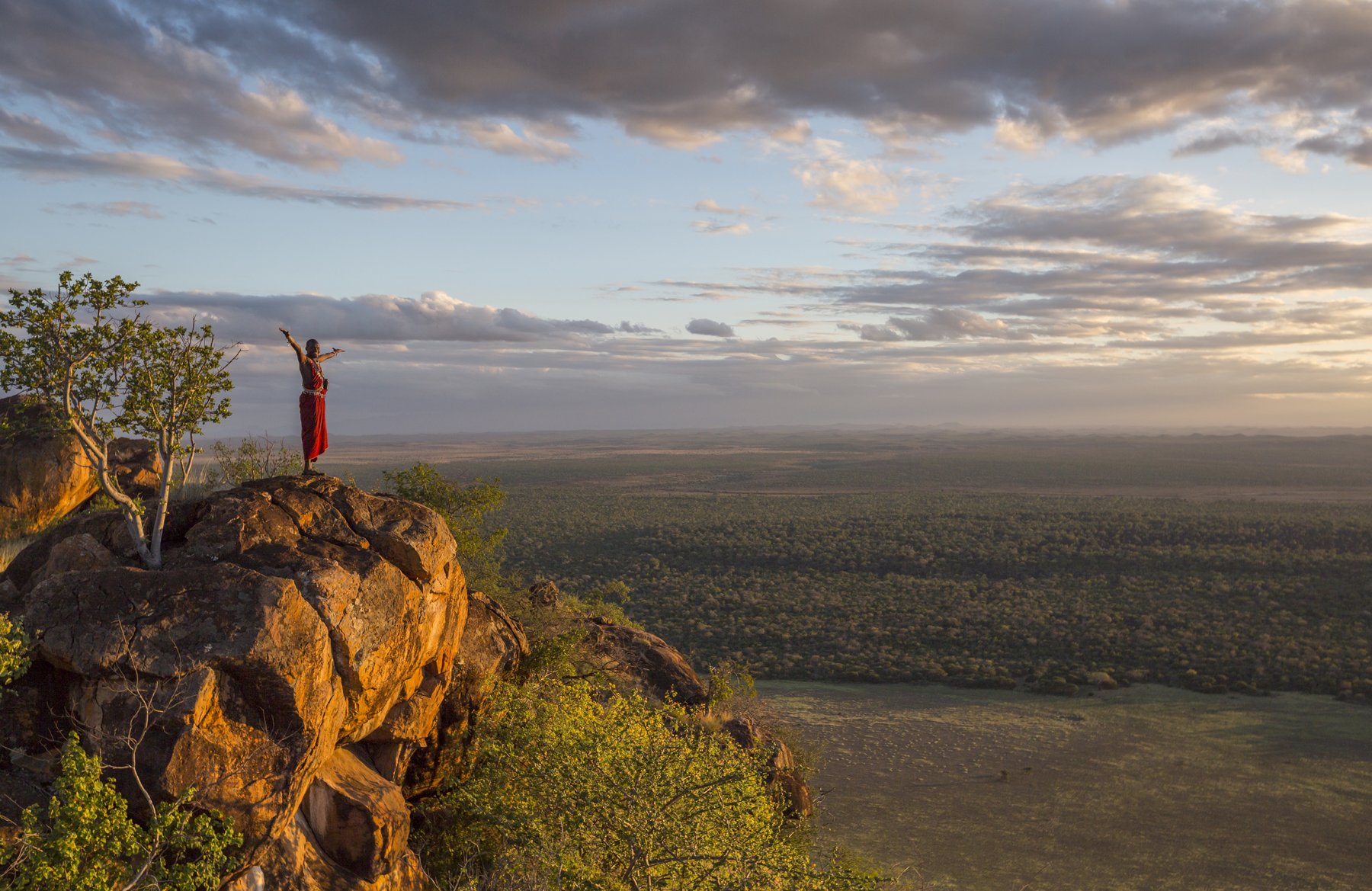
Kenya's Green Hills of Africa - lava tube caves, volcanic hiking and Kilimanjaro views between Amboseli and Tsavo.
The road out of Kibwezi changes almost without warning. The red earth gives way to black volcanic rock, the horizon lifts into rounded green hills and, if the weather is clear, Mount Kilimanjaro appears beyond the plains. There are no crowds here, no long lines of safari vehicles and none of the familiar rhythm of Kenya’s better-known parks. Chyulu Hills National Park feels different from the moment you enter.
Chyulu Hills National Park lies in southeastern Kenya between Amboseli and Tsavo West, protecting the eastern slopes of the Chyulu Hills. The landscape is a striking combination of green rolling hills, montane forest, open grassland, ancient volcanic formations and black lava flows. Beneath the hills lies an extraordinary network of lava tubes and caves, including the famous Leviathan Cave, while the porous volcanic rock acts as a vast natural water-storage system feeding springs and rivers across the surrounding plains.
What sets Chyulu Hills National Park apart is that it is not simply another destination for ticking animals off a checklist. This is a landscape-first safari. Hiking, cave exploration, birdwatching, photography, picnicking and game viewing all make sense here, and the hills provide one of southeastern Kenya’s most dramatic wilderness settings. The park is also an important water catchment, with underground water from the Chyulu Hills contributing to Mzima Springs in Tsavo West and other permanent water sources.
We send guests to Chyulu Hills National Park when they want something quieter and more adventurous than a conventional game-drive safari. It works particularly well as a combination with Tsavo West or Amboseli, and for travellers who would rather spend a morning walking through volcanic hills or exploring a lava tube than sitting in a vehicle all day.
Chyulu Hills National Park is a scenic volcanic park in southeastern Kenya, situated between Amboseli and Tsavo West. It is known for its rolling green hills, montane forests, lava formations, extensive cave systems, wildlife, hiking opportunities and its important role as a water catchment for the surrounding region. The Kenya Wildlife Service describes Chyulu Hills National Park as the “Green Hills of Africa.”
Location: Southeastern Kenya, between Amboseli and Tsavo West
Landscape: Rolling volcanic hills, grassland, montane forest, lava flows and caves
Highest point: Approximately 2,188 metres
Established: 1983
Managed by: Kenya Wildlife Service
Main access: Kithasyo Gate
Distance from Nairobi: Approximately 200 kilometres by the commonly used southern route, depending on the exact starting point and access route
Nearest major town: Kibwezi
Known for: Volcanic scenery, Leviathan Cave, hiking, birdwatching, wildlife and spectacular views
Water importance: Major water catchment feeding Mzima Springs and other surrounding water sources
Public campsites: Kithasyo, Kisula and Satellite
The first thing you notice in Chyulu Hills National Park is the landscape.
Unlike the open grass plains of the Masai Mara or the dry expanses of Tsavo East, Chyulu Hills National Park rises in a series of rounded volcanic ridges covered in grass and patches of forest. Black lava rock appears between the vegetation, while the higher sections of the hills support montane forest and unusual plant species.
The volcanic origins of Chyulu Hills National Park are visible everywhere. Lava flows, volcanic cones, caves and rugged rock formations create a landscape that feels much younger and more dramatic than the surrounding plains. The hills are part of a long volcanic range that stretches across southeastern Kenya.
During wetter periods, the hills become intensely green, contrasting sharply with the drier plains below. When the grass dries, the dark volcanic rock becomes more prominent and the landscape takes on a completely different character.
For photographers, Chyulu Hills National Park is particularly rewarding because the scenery changes constantly with cloud, light and weather.
The cave systems are arguably the most unusual attraction in Chyulu Hills National Park.
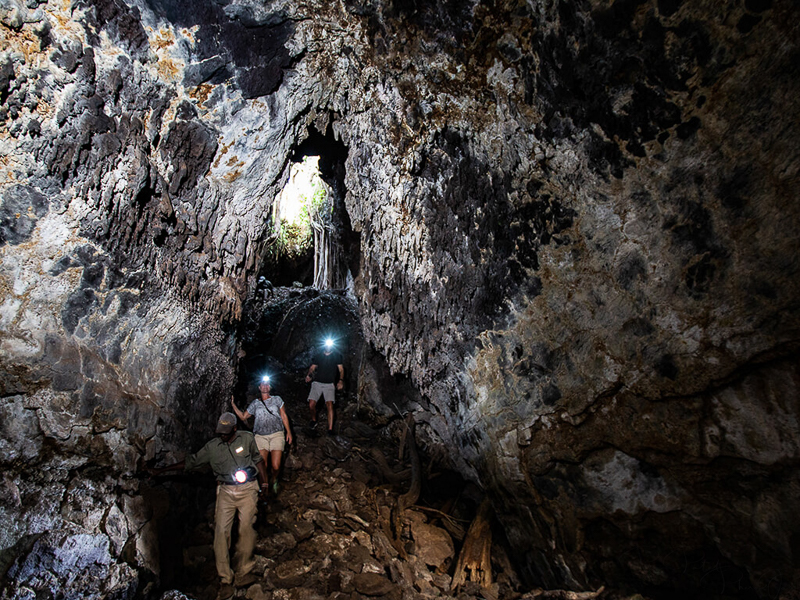
Beneath the hills is an extensive network of lava tubes formed when molten lava flowed through the landscape and the outer surface cooled while lava continued moving underneath. When the remaining lava drained away, it left behind underground tunnels and chambers.
The most famous is Leviathan Cave, also associated with the Kisula cave system. Kenya Wildlife Service identifies Kisula Cave as an approximately 11.5-kilometre lava tube and one of the major geological attractions of Chyulu Hills National Park.
Cave exploration is not simply a sightseeing stop. It is an opportunity to see the volcanic history of Chyulu Hills National Park from underneath the landscape, moving through passages created by ancient eruptions.
Because cave conditions can be difficult and wildlife may also be present, cave exploration should be undertaken with appropriate local guidance and according to current Kenya Wildlife Service access and safety requirements.
Leviathan Cave is a major lava-tube cave system within the Chyulu Hills, associated with the Kisula caves. The mapped cave system extends for roughly 11.5 kilometres and is one of the defining geological attractions of Chyulu Hills National Park.
Chyulu Hills National Park supports a diverse range of wildlife, although wildlife densities are generally lower than in Kenya’s major safari destinations such as the Masai Mara or Amboseli.
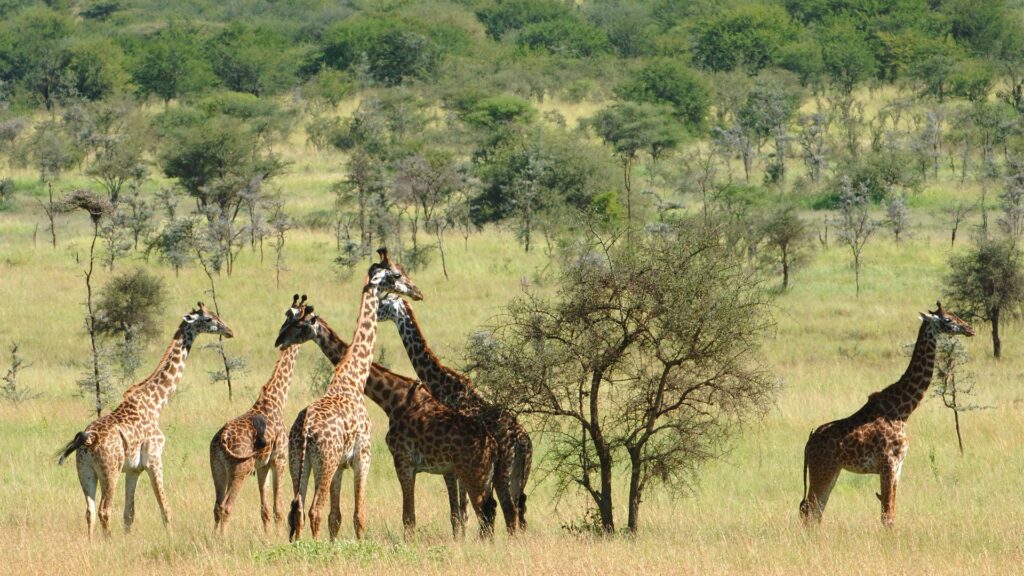
Elephant, buffalo, giraffe, zebra, eland, leopard, bushbuck, mountain reedbuck, steenbok and bushbuck are among the mammals associated with the Chyulu Hills ecosystem. Black rhino are also listed among the wildlife of the park and wider ecosystem.
The combination of open grassland and forest creates different habitats within a relatively compact landscape. Animals move between the grass-covered slopes, forest patches and surrounding plains depending on food, water and season.
Chyulu Hills National Park is therefore better approached as a wilderness and landscape safari than as a destination where every game drive is expected to produce large concentrations of wildlife.
The reward is the setting.
Seeing an elephant moving through green volcanic hills, a giraffe silhouetted against a ridge or a herd of zebra crossing the open grassland feels very different from watching the same animals on a conventional open plain.
Chyulu Hills National Park supports elephant, buffalo, giraffe, zebra, eland, leopard, bushbuck, mountain reedbuck, steenbok, bush pig and black rhino, among other wildlife. The park is more notable for its scenery, hiking and volcanic landscape than for exceptionally high wildlife density.
Birdwatching is one of the quieter strengths of Chyulu Hills National Park.
The dense montane forests in the western sections of the Chyulu Hills provide habitat for forest birds, while grassland and open country support a different collection of species. Kenya Wildlife Service highlights the park’s forest birdlife and notes species including Hartlaub’s turaco, sunbirds, speckled mousebird, white-eared barbet, trumpet hornbill and other forest and woodland species.
The combination of altitude, forest and open grassland makes Chyulu Hills National Park particularly interesting for birders who want habitats that differ from the classic savannah parks.
The park also contains unusual plant life and endemic butterfly species, adding another layer to the biodiversity of the Chyulu Hills ecosystem.
Hiking is one of the best ways to experience Chyulu Hills National Park.
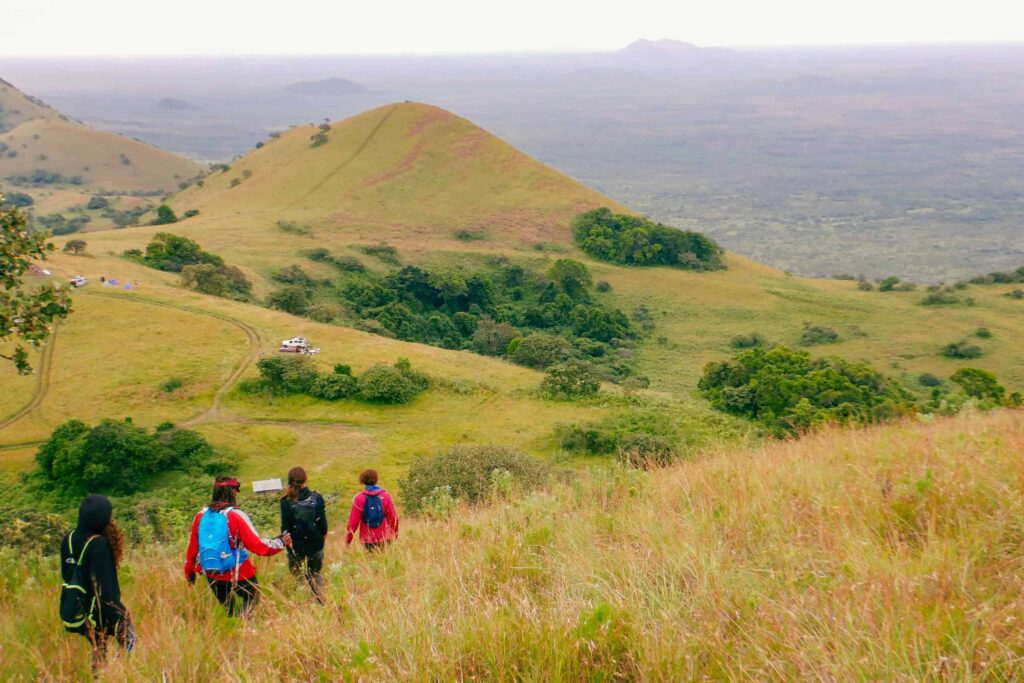
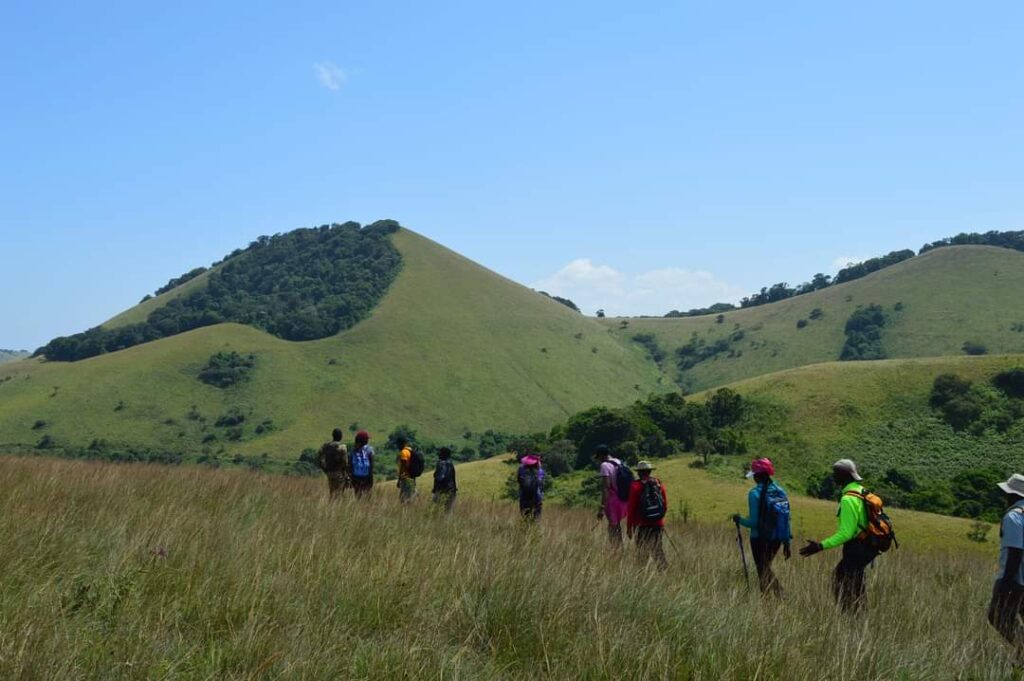
Instead of watching the landscape through a vehicle window, walking allows you to experience the volcanic terrain at ground level. Trails and routes pass through open grassland, forest patches, rocky terrain and rolling hills, with broad views across the surrounding Amboseli and Tsavo plains.
The hills are particularly attractive after rainfall, when fresh vegetation transforms the landscape into the green environment that gave Chyulu Hills National Park its nickname, the Green Hills of Africa.
Walking routes should be arranged with the relevant park authorities or experienced local guides, particularly because Chyulu Hills National Park is a wildlife area and conditions can change quickly.
Cave exploration is the signature adventure in Chyulu Hills National Park.
Visitors can explore sections of the lava-tube systems beneath the hills, seeing volcanic formations that are completely different from anything found on a conventional Kenya safari.
The experience combines geology, adventure and wilderness, making it especially suitable for travellers who want something beyond game drives. Current access, guiding and safety requirements should be confirmed before the excursion.
Game drives remain an important activity in Chyulu Hills National Park, particularly for visitors combining the park with Tsavo West or Amboseli.
The open grasslands and lower slopes provide opportunities to search for zebra, giraffe, buffalo, elephant, eland and other wildlife. Leopard is present but considerably more difficult to find.
Game viewing here is about patience rather than volume. The scenery often becomes as important as the animal sighting itself.
Birdwatching in Chyulu Hills National Park is particularly rewarding in the montane forest.
The changing elevation creates different habitats, while the forest provides opportunities to search for turacos, hornbills, sunbirds and other forest species. The park’s relatively quiet character also makes it possible to spend time listening and observing rather than simply driving between large mammal sightings.
For travellers interested in geology, Chyulu Hills National Park is one of the more unusual destinations in Kenya.
A geological-focused excursion can combine lava tubes, volcanic rock formations, caves, hills, craters and lava flows to explain how the landscape was created.
This is particularly worthwhile for travellers combining Chyulu Hills National Park with Tsavo West, where the volcanic story continues through attractions such as the Shetani Lava Flows.
Chyulu Hills National Park is an excellent destination for a picnic when arranged in designated and safe areas.
The elevated landscape creates wide views across the surrounding plains, and on clear days the horizon can stretch toward Mount Kilimanjaro. Kenya Wildlife Service specifically highlights the park’s scenic landscapes as suitable for hiking safaris and picnicking.
Photography in Chyulu Hills National Park is about more than animals.
The contrast between green hills, black volcanic rock, open blue skies, forest and distant mountains gives photographers an unusually varied setting. Early morning mist can sit over the ridges, while afternoon light creates strong shadows across the volcanic terrain.
For landscape photographers, Chyulu Hills National Park can be more rewarding than parks with greater wildlife density.
One of the great visual rewards of Chyulu Hills National Park is the possibility of seeing Mount Kilimanjaro across the surrounding plains.
The exact visibility depends on weather and cloud conditions, but when the skies clear, the combination of Chyulu’s green volcanic ridges and Kilimanjaro in the distance creates one of southeastern Kenya’s most memorable views.
The importance of Chyulu Hills National Park extends far beyond tourism.
The porous volcanic rock absorbs rainfall and allows water to move underground through the hills. This creates a natural water-storage system that feeds springs and rivers in the surrounding plains.
Mzima Springs in Tsavo West is one of the best-known examples. The Chyulu Hills ecosystem is an important source of water for Mzima Springs and other permanent water sources, while the wider water system supports communities, wildlife and downstream ecosystems.
This makes Chyulu Hills National Park a conservation area with significance far beyond its boundaries.
Protecting the hills means protecting forests, underground water systems and the downstream landscapes that depend on them.
The volcanic character of Chyulu Hills National Park continues into the neighbouring Tsavo West landscape.
The Shetani Lava Flow is a vast black lava formation associated with relatively recent volcanic activity in the region. The name “Shetani” means “devil” in Kiswahili and reflects local stories surrounding the appearance of the black lava landscape.
Although the Shetani Lava Flow is located in Tsavo West rather than inside Chyulu Hills National Park, it makes an excellent addition to an itinerary combining the two destinations.
Together, the Chyulu Hills caves and Tsavo West’s lava landscapes tell a much larger story about the volcanic history of southeastern Kenya.
The wider Chyulu Hills ecosystem extends beyond the national park.
Community lands and conservancies around the western slopes provide additional opportunities for wildlife conservation and tourism, while also creating important corridors between the Chyulu Hills, Amboseli and Tsavo ecosystems.
These surrounding landscapes are particularly important because wildlife does not recognize the boundaries drawn on a park map. Elephants, predators and other large mammals move across different habitats depending on season, food and water availability.
For travellers, this also means that a Chyulu Hills safari can be designed around more than the national park itself, combining the park with community conservation areas and nearby private conservancies.
Amboseli is famous for large elephant herds and its classic Mount Kilimanjaro backdrop.
Chyulu Hills National Park offers a completely different perspective of southeastern Kenya. Instead of open swamps and broad plains, the landscape rises into green volcanic hills, forests, caves and lava formations.
If your priority is photographing elephants with Kilimanjaro, Amboseli is the obvious choice. If you want hiking, caves, volcanic scenery and a quieter wilderness experience, Chyulu Hills National Park is the more unusual destination.
The two work particularly well together.
Tsavo West offers a much larger and more conventional game-viewing experience, with extensive savannah, volcanic landscapes, Mzima Springs and a broader network of safari roads.
Chyulu Hills National Park is smaller and more specialized. Its strongest attractions are hiking, caves, forest, volcanic scenery and the unusual experience of exploring a mountain ecosystem rather than simply driving across plains.
Combining Chyulu Hills National Park with Tsavo West creates a particularly strong southeastern Kenya itinerary because the two destinations complement rather than duplicate each other.
The Masai Mara is the better choice for travellers focused almost entirely on predator sightings, large herds and classic savannah wildlife.
Chyulu Hills National Park is for travellers who want a different kind of Kenya safari.
There are fewer vehicles, fewer large wildlife concentrations and a much stronger emphasis on landscape and adventure. The caves, hiking opportunities, volcanic terrain and forest make Chyulu Hills National Park feel more like an exploration destination than a conventional game-drive circuit.
We often recommend Chyulu Hills National Park after a traveller has already experienced the Masai Mara and wants to see another side of Kenya.
Accommodation around Chyulu Hills National Park ranges from simple public campsites to high-end safari camps in the surrounding ecosystem.
Kenya Wildlife Service lists Kithasyo, Kisula and Satellite as public campsites within the park. The park’s wider accommodation options include private lodges and tented camps such as Finch Hattons Luxury Safari Camp, Kilaguni Serena Safari Lodge, Severin Safari Camp and Ngulia Safari Lodge in the surrounding Tsavo ecosystem.
For a more immersive Chyulu Hills safari, private conservancy properties on the western side of the hills can offer a different style of experience, often combining wildlife viewing with walking, horseback riding and other activities outside the national park.
The right accommodation depends on whether your priority is cave exploration, hiking, wildlife, luxury or combining Chyulu Hills National Park with Tsavo West or Amboseli.
Kithasyo is the principal access point for Chyulu Hills National Park and is located near the park headquarters.
Visitors approaching from Nairobi typically use the Mombasa Road corridor before turning near Kibwezi and continuing toward the park. Kenya Wildlife Service states that the turn from the Nairobi–Mombasa road is near Kibwezi, followed by approximately 9 kilometres on the access road to Kithasyo Gate and park headquarters.
Access arrangements can vary depending on the itinerary and whether the traveller is entering from the Tsavo West side or approaching through surrounding community areas.
We confirm the appropriate gate and route before departure because the best access point depends on the accommodation, activity and direction of travel.
The most straightforward approach from Nairobi is via the Nairobi–Mombasa Road toward Kibwezi.
At Kibwezi, travellers turn toward the Chyulu Hills and continue toward Kithasyo Gate. Kenya Wildlife Service identifies this as the main road approach to the park.
The road journey allows travellers to combine Chyulu Hills National Park with other destinations in southeastern Kenya, including Amboseli and Tsavo West.
A 4×4 safari vehicle is the preferred option for exploring the park and accessing more remote areas, particularly when conditions become wet.
The Standard Gauge Railway provides another option for reaching the Kibwezi area from Nairobi or Mombasa. Kenya Wildlife Service identifies Kibwezi as the relevant rail access point for visitors travelling by train before continuing by road to the park.
Chyulu Hills National Park has two airstrips, Mukururo and Kithasyo, making fly-in access possible for travellers combining the hills with a wider safari itinerary.
For guests with limited time, flying can reduce the amount of road travel and allow more time for hiking, cave exploration and game viewing.
Road travel makes sense if Chyulu Hills National Park is part of a wider southeastern Kenya safari.
It allows you to combine the hills with Amboseli, Tsavo West or other destinations while enjoying the changing scenery along the way.
Flying is more suitable for travellers who want to maximize time at their accommodation and focus on the activities within the Chyulu Hills ecosystem.
For most multi-day Kenya safaris, we normally prefer the road option when the route is logical because Chyulu Hills National Park combines naturally with Amboseli and Tsavo West.
Chyulu Hills National Park has a cooler and wetter environment than the surrounding lowland plains because of its elevation.
The higher hills can be noticeably cooler in the early morning and evening, while lower areas become warmer during the day. Rainfall transforms the landscape dramatically, turning the hills green and increasing the visual contrast between vegetation and volcanic rock.
The wet periods are particularly attractive for landscape photography and hiking, while drier periods can make wildlife easier to locate in open areas.
Because conditions can change quickly in the hills, we recommend carrying a light waterproof layer even when the forecast appears dry.
Chyulu Hills National Park has a cooler, wetter mountain environment than the surrounding southeastern Kenyan plains. Conditions vary with elevation and season, with greener landscapes after rainfall and warmer, drier conditions during the dry periods.
According to the current Kenya Wildlife Service information, Chyulu Hills National Park is classified as a special-interest park. The listed entry fees are KES 500 for East Africa Citizen adults, KES 250 for East Africa Citizen children, KES 675 for Kenya Resident adults, KES 350 for Kenya Resident children, USD 40 for non-resident adults and USD 20 for non-resident children. African citizen rates are listed at USD 20 for adults and USD 10 for children.
Park fees can change, so we confirm the applicable rate before finalizing a safari quotation.
Unlike accommodation costs, which vary considerably depending on the property, Chyulu Hills National Park entry fees are set according to the applicable Kenya Wildlife Service tariff.
The current KWS-listed rate for Chyulu Hills National Park is USD 40 per non-resident adult and USD 20 per non-resident child. Kenya residents and East African citizens pay separate rates in Kenyan shillings, while African citizens have a separate USD tariff.
The best time to visit Chyulu Hills National Park depends on what you want to do.
For hiking and landscape photography, the greener periods can be particularly beautiful. Rain brings fresh grass, clearer vegetation and dramatic cloud formations across the hills.
For game viewing and easier road conditions, drier periods can be more practical because wildlife is easier to locate in open areas and some tracks become easier to navigate.
Birdwatchers may prefer the wetter and greener periods, when vegetation and bird activity increase.
For cave exploration, conditions should always be checked locally because heavy rain can affect access and safety inside and around lava-tube systems.
One night can work for travellers who simply want to experience the scenery and combine Chyulu Hills National Park with Tsavo West or Amboseli.
Two nights is a better introduction. It allows time for a game drive, hiking or cave exploration without turning the visit into a rushed stop.
Three nights works particularly well for travellers who want to combine several experiences, such as hiking, cave exploration, wildlife photography and game viewing.
For most of our clients, two nights is the sweet spot when Chyulu Hills National Park is being included in a wider Kenya safari.
Chyulu Hills National Park offers something that many Kenyan parks cannot.
It gives you mountains without the technical challenge of climbing Mount Kenya or Kilimanjaro. It offers wildlife without the crowds of the Masai Mara. It offers caves without leaving the safari environment. It offers hiking, forests, lava formations and huge landscapes in one destination.
The park is also important ecologically.
Its volcanic hills collect and store rainfall underground, supporting springs and water systems far beyond the park itself. Protecting Chyulu Hills National Park therefore protects both wildlife habitat and one of southeastern Kenya’s important natural water towers.
For travellers who value scenery and adventure as much as wildlife, that combination is difficult to beat.
Chyulu Hills safari prices vary according to accommodation, season, transport and the activities included.
A simple camping-based Chyulu Hills safari can be considerably less expensive than a luxury private-conservancy experience, while high-end properties can command premium rates because of their location, exclusivity and combination of wildlife and adventure activities.
A typical Chyulu Hills safari budget should account for accommodation, meals, safari vehicle and guide, park entry fees, game drives, hiking or cave activities and any additional conservancy or guiding charges.
For travellers combining Chyulu Hills National Park with Amboseli or Tsavo West, the overall price is usually better considered as a complete itinerary rather than as a standalone park cost.
The cost of a Chyulu Hills safari depends primarily on accommodation, transport and activities. Budget camping trips can be relatively affordable, while luxury camps and private conservancy experiences can cost substantially more. Park entry for non-resident adults is currently USD 40 per person, separate from accommodation and other safari costs.
We build Chyulu Hills National Park into several types of safari.
A Chyulu Hills hiking safari focuses on walking through the volcanic hills, forests and open grassland.
A Chyulu Hills cave safari is designed around Leviathan and the wider lava-tube systems.
A Chyulu Hills and Tsavo West safari combines volcanic scenery, cave exploration, Mzima Springs and conventional wildlife viewing.
A Chyulu Hills and Amboseli safari adds Mount Kilimanjaro views and Amboseli’s famous elephant herds.
A longer Chyulu Hills, Amboseli and Tsavo safari creates a complete southeastern Kenya circuit, combining mountains, wetlands, savannah, volcanic landscapes and wildlife.
We tailor the number of nights around whether you are coming primarily for wildlife, hiking, caves, photography or a combination of all four.
For travellers who want to stay close to the park, public campsites provide the simplest option.
Kithasyo, Kisula and Satellite are the three public campsites identified by Kenya Wildlife Service.
For travellers looking for greater comfort, private safari camps and lodges in the wider Chyulu Hills, Tsavo West and Amboseli ecosystems provide luxury tents, full-board accommodation and guided activities.
One of the strongest options for a luxury safari in the wider Chyulu Hills ecosystem is Finch Hattons Luxury Safari Camp, which is particularly well suited to travellers combining Chyulu Hills with Tsavo West.
Responsible tourism is particularly important in Chyulu Hills National Park because the ecosystem serves both wildlife and people.
The hills are a critical water catchment, and protecting the forest and volcanic landscape helps maintain underground water systems feeding surrounding springs and rivers.
Visitors should remain on established roads and trails where required, avoid off-road driving, maintain appropriate distances from wildlife and take all rubbish out of the park. Kenya Wildlife Service also specifies a maximum vehicle speed of 40 km/h and advises visitors to remain inside vehicles except in designated areas.
When visiting surrounding communities, we encourage guests to support locally owned tourism initiatives and to approach cultural encounters respectfully.
The goal is simple: leave the Chyulu Hills ecosystem as wild and intact as you found it.
Chyulu Hills National Park is not a destination I would recommend purely because you want to see the largest possible number of animals. I recommend it because you want to experience Kenya differently. Give yourself time to walk, look at the volcanic landscape, explore the caves and slow down. The hills reward curiosity more than rushing from one sighting to the next.
Kibara Mugo, Safari Writer & East Africa Specialist
From the green volcanic ridges to the underground lava tubes, Chyulu Hills National Park offers one of Kenya’s most distinctive wilderness experiences.
It is a destination for travellers who want more than a conventional game drive: hiking through rolling hills, exploring ancient volcanic caves, photographing unusual landscapes, watching birds in montane forest and searching for wildlife against a backdrop that changes completely from the surrounding plains.
Chyulu Hills National Park also works exceptionally well as part of a larger southeastern Kenya safari. Combine it with Amboseli for Kilimanjaro and elephants, or with Tsavo West for volcanic landscapes, Mzima Springs and classic savannah game viewing.
For a first visit, we generally recommend two nights in or around Chyulu Hills National Park, with enough time for at least one game drive and one dedicated hiking or cave-exploration experience.
Chyulu Hills National Park is not Kenya’s busiest safari destination, and that is precisely the point. It is quieter, more adventurous and more geological than the classic safari circuit.
For travellers looking for the Kenya that exists beyond the usual safari route, Chyulu Hills is worth taking the turn.
Escape to the breathtaking Chyulu Hills National Park, where rolling emerald hills, ancient volcanic landscapes, lush cloud forests, and spectacular views of Mount Kilimanjaro create one of Kenya's most scenic wilderness destinations. Explore hidden lava tubes, encounter elephants, buffaloes, giraffes, and diverse birdlife, and enjoy exclusive safari experiences, horseback riding, guided nature walks, and unforgettable luxury stays in one of Africa's most pristine ecosystems. Callout Icon
Dense vegetation, nightly fog and frequent mists turn the volcanic ridges emerald-green, living up to Hemingway’s moniker. The rolling green cones contrast…
Chyulu is home to an intricate cave system carved by flows. The most famous is Leviathan, an 11–13 km lava tube (one…
The open plains and gentle hills are ideal for riding. Safaris on horseback or mountain bike let guests cover more ground quietly,…
As one of Kenya’s least-visited parks, Chyulu trades crowds for wilderness. Safari vehicles are few, so game drives feel intimate. The night…
Everywhere in Chyulu you see its volcanic origin: thick lava flows, cinder cones, ash fields and volcanic soils. The black lava rock…
Unlike most Kenyan parks, Chyulu offers extensive foot-access through the hills. Well-marked hiking trails climb old lava flows and traverse montane forest.…
Roughly 300 bird species have been sighted. Notables include Hartlaub’s and purple-crested turacos, Narina trogon, African emerald cuckoo, Abbott’s starling, silvery-cheeked hornbill…
On clear mornings, the snow-capped summit of Kilimanjaro rises on the southern horizon. Many lodge verandas and high ridges offer iconic skyline…
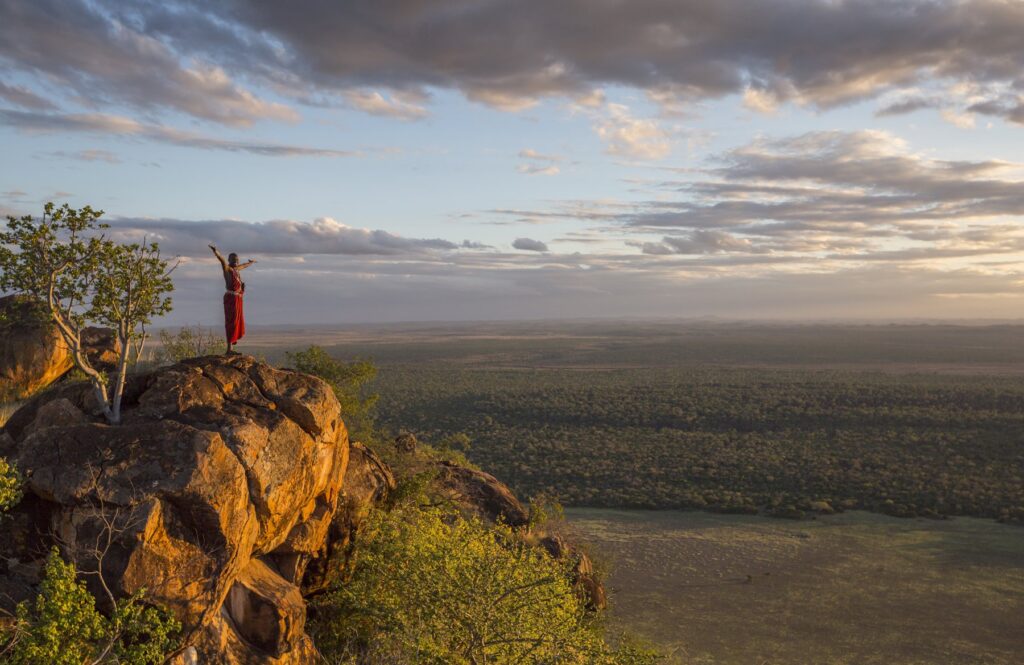
From value camps to premium lodges — we match every stay to your style and budget.
Community-run tents near Kibwezi forest, offering basic rooms and camping. A good option for tight budgets. Also “Kiboko Guest House” in nearby Kibwezi town provides self-catering cottages.
Smaller tented camps such as Sunshine Camp or Sevika Camp (Kuku Ranch) cater to mid-budget travelers, offering simple tents and a genuine out-back atmosphere. Wildlife like elephant often roam near camp.
Set on its own private conservancy bordering Chyulu, this high-end lodge has stylish suites overlooking Kilimanjaro. It features a pool, sunken wildlife hides and excellent cuisine, with strong emphasis on bush walks and horseback riding.
Every season has its magic — here's what to expect when, so you can travel at your perfect time.
Everything you need to know before you go — and we’ll guide you through every step.
Trails range from easy to strenuous. Many walks (like to Mt. Ashnil summit) involve long climbs and loose lava scree. Good fitness and sturdy boots are recommended. Shorter loop trails (e.g. Kichwa Tembo) are moderate. Always hike with a KWS ranger.
Yes. All hikes on park land require a registered guide (armed for security). Guides can also interpret wildlife and plants.
All visitors must pay KWS entry fees and camping fees. Hikes inside the park need a ranger permit. Leviathan Cave requires a special cave permit. Permits are obtained at Kibwezi Gate (cash or mobile payment) or pre-booked via KWS.
Yes. Chyulu is considered safe for tourists. The biggest dangers are natural (rough terrain, sun exposure). Always follow your guide’s instructions. Do not hike alone.
Yes, if arranged with KWS and a guide. The park is open 24 hours. Night drives can reveal hyenas, genets, porcupines and owls.
Afrikan Accent Adventures can arrange everything (accommodation, park permits, guides). You may also book directly with lodges or through international safari operators.
Chyulu is family-friendly if children are supervised. Lodges have child policies; cabins often accommodate kids. For hiking, older kids (10+) do better due to terrain and pace.
Afrikan Accent Adventures offers custom Chyulu packages or combines with Masai Mara, Amboseli, Tsavo, etc. Popular itineraries include 3-day Chyulu hikes, 5-day Amboseli–Chyulu, or extended 7-day “Kenya highlights” safaris.
We priced eleven safaris for one traveller, from a USD 650 shared tent in the Siana Conservancy to…
Read more →
A 5:00am start, about eight hours inside the park and a late return to your hotel: who the…
Read more →
Kenya swapped the visa for an online eTA in 2024, added compulsory health insurance in October 2026 and…
Read more →Tell us what you’d love to see and a local specialist will design a tailor-made itinerary around you — no obligation, reply within 24 hours.