


Planning & Tips
Kenya Safari Tipping Guide: Who to Tip, How Much and What Cash to Carry
The driver-guide’s daily rate, the camp tip box, the dollar-note rule that catches people at the last camp…
Read more →
Uganda's most scenic highland lake - 29 islands, dugout canoes and terraced hills, a short hop from Bwindi gorilla trekking.
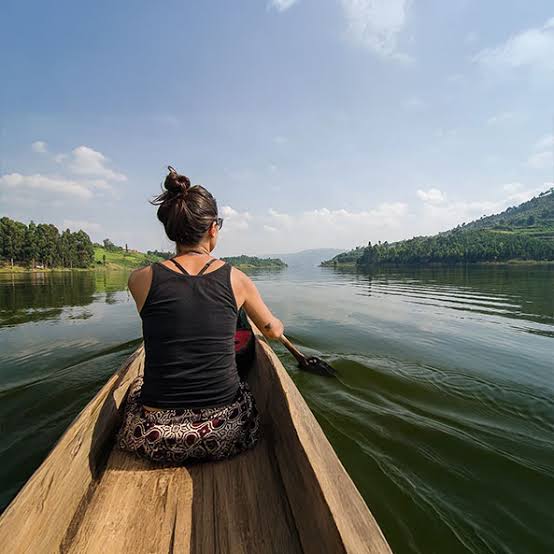
The mist is still sitting low over the water when the first canoe pushes away from the shore. Somewhere beyond the papyrus, a kingfisher drops onto a branch and the hillsides begin to catch the morning light. There are no safari vehicles here, no engines in the distance and no rush to get anywhere. Just a wooden canoe, quiet water and a landscape of steep green terraces falling toward one of Uganda’s most beautiful lakes.
Lake Bunyonyi lies in southwestern Uganda, close to Kabale and within easy reach of the Rwanda border. At roughly 1,950–1,962 metres above sea level, the lake is surrounded by steep cultivated hills and scattered with 29 islands. Its name means “place of many little birds”, a reference to the remarkable birdlife found around its shores and wetlands.
Unlike Uganda’s larger lakes, Bunyonyi feels intimate. The shoreline twists through bays and inlets, small islands break up the view and traditional dugout canoes remain part of everyday life. The lake has become one of southwestern Uganda’s most popular stops for travellers combining gorilla trekking in Bwindi or Mgahinga with a few days of rest, scenery and cultural experiences.
We send guests to Lake Bunyonyi for precisely that reason. After the intensity of a gorilla trek, Bunyonyi slows everything down. You can spend the morning paddling between islands, walk through the terraced hills in the afternoon and watch the sun disappear behind the mountains without needing to do anything more complicated than sit by the water.
Lake Bunyonyi is a scenic freshwater lake in southwestern Uganda, close to Kabale and the Rwanda border. It sits at approximately 1,962 metres above sea level, stretches roughly 25 kilometres in length and 7 kilometres across at its widest points, and is surrounded by steep terraced hills and 29 islands. The lake is famous for canoeing, birdwatching, island excursions, swimming, cultural experiences and its proximity to Bwindi Impenetrable National Park.
Location: Southwestern Uganda, near Kabale and the Rwanda border
Altitude: Approximately 1,950–1,962 metres above sea level
Length: Approximately 25 kilometres
Width: Approximately 7 kilometres
Islands: 29
Known for: Scenic terraced hills, islands, canoeing, birdwatching and cultural experiences
Meaning of Bunyonyi: “Place of many little birds”
Nearest major town: Kabale
Nearest international tourism hub: Kigali, Rwanda
Main access: Road from Kabale, Kampala or Kigali
Nearby safari destination: Bwindi Impenetrable National Park
Popular activities: Canoeing, boat trips, swimming, birdwatching, hiking, island visits and community experiences
Landscape: High-altitude freshwater lake surrounded by cultivated hills and wetlands
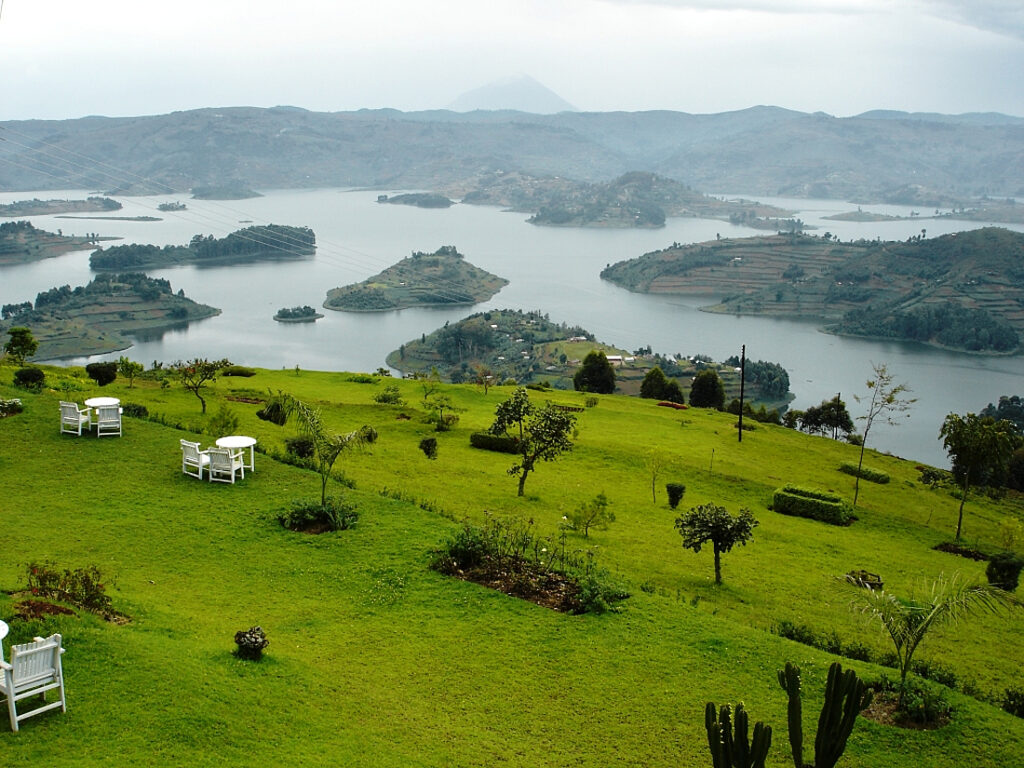
The 29 islands are one of the defining features of Lake Bunyonyi. Some are little more than green outcrops rising from the water, while others support homes, farms, schools and tourism facilities. Travelling between them by canoe gives the lake a completely different character from simply viewing it from the shore.
Bushara Island is among the better-known islands for visitors, while other islands have their own stories and local significance. Bwama Island is associated with the lake’s early medical and missionary history, while Akampene, commonly called Punishment Island, carries one of the lake’s most frequently told historical stories.
A boat or canoe excursion can combine several islands in a single outing, allowing visitors to see cultivated hillsides, fishing communities, birdlife and the changing scenery around the lake.
Lake Bunyonyi has 29 islands scattered across its central and southern sections. The islands vary considerably in size and use, with some supporting communities and tourism facilities while others remain largely undeveloped.
Akampene, better known as Punishment Island, is one of the most talked-about places on Lake Bunyonyi. According to local historical accounts, unmarried women who became pregnant were once taken to the small island and abandoned there as a punishment.
The practice belongs to a difficult chapter of local social history and should be discussed respectfully rather than presented as entertainment. A visit is best approached as an opportunity to understand how social customs changed over time and how communities remember their past.
The island is tiny, and its story is generally included as part of a wider island boat tour rather than as a standalone excursion.
Lake Bunyonyi is not a traditional wildlife safari destination. Its appeal is the combination of water, birds, cultivated hills and local communities rather than large concentrations of mammals.
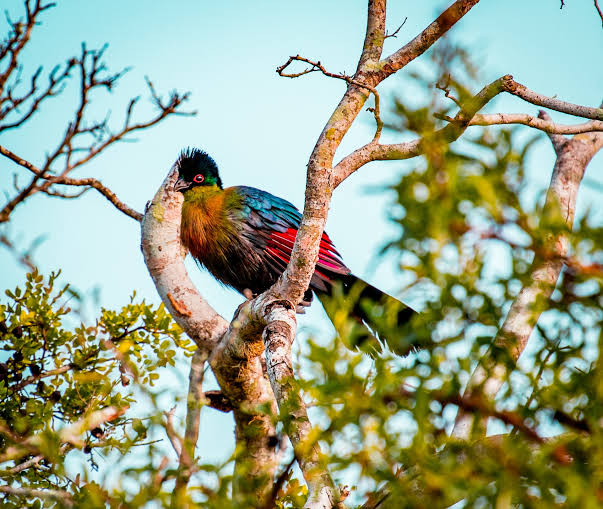
The lake and surrounding wetlands support more than 200 recorded bird species, including herons, egrets, kingfishers, weavers and grey crowned cranes. Early morning is particularly rewarding for birdwatchers, when activity around the shoreline and wetlands is at its highest.
The islands and surrounding hills also provide habitat for smaller wildlife, while the lake itself supports fish and introduced crayfish. Some nearby islands and surrounding areas can also offer sightings of species such as zebra, impala and waterbuck, although these should not be confused with the large-scale wildlife viewing found in Uganda’s national parks.
The real attraction is the birdlife. The name Bunyonyi literally reflects the importance of birds to the landscape.
Lake Bunyonyi is best known for its birdlife rather than big game. More than 200 bird species have been recorded around the lake, including grey crowned cranes, herons, egrets, kingfishers and several migratory species. Smaller wildlife can also be found around some islands and the surrounding countryside.
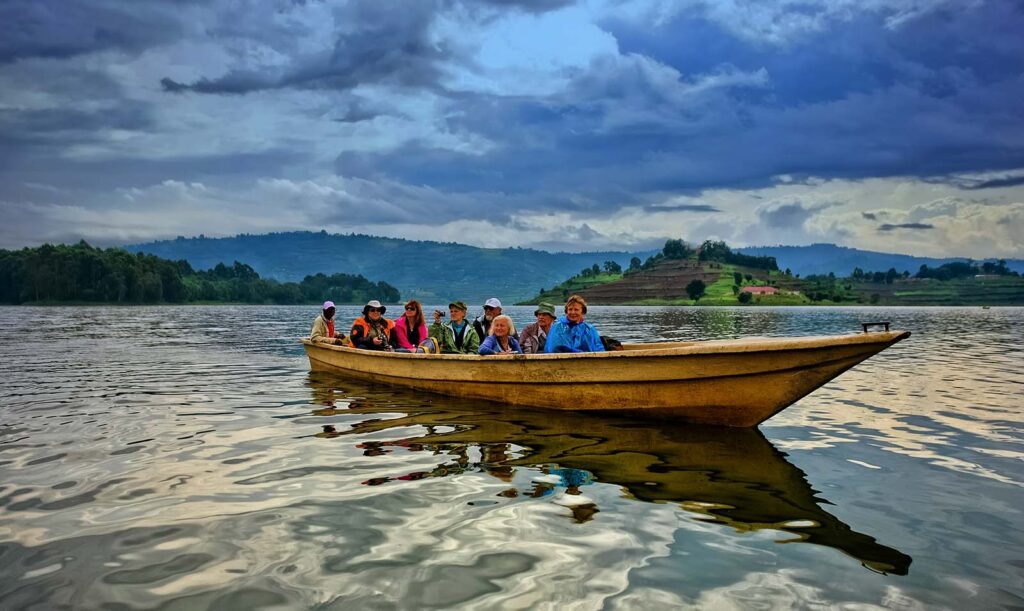
Canoeing is the signature Lake Bunyonyi experience. Traditional dugout canoes allow visitors to move quietly across the water between the islands, often accompanied by a local guide or paddler.
The experience is deliberately slow. There is no need to cover the whole lake. Instead, the canoe follows the shoreline, passes through sheltered channels and stops at selected islands while the guide explains local history and life around the lake.
For photographers, early morning canoe trips are particularly rewarding when mist hangs over the water and the hills are reflected in the lake.
Traditional dugout canoeing is also one of the most environmentally gentle ways to experience Bunyonyi and has become an important part of community tourism around the lake.
Motorboat trips provide a faster alternative to traditional canoeing and are useful when guests want to explore several islands within a shorter period.
A typical island tour can include stops around Bushara, Bwama and Punishment Island, with the guide explaining the history and communities associated with each location. Boat trips can also be arranged for birdwatching, village visits and sunset excursions.
Lake Bunyonyi is unusual among major lakes in the region because it is widely regarded as free from bilharzia, making swimming one of the activities associated with the destination. Nevertheless, swimming should always be undertaken according to the advice of your accommodation or local guide, particularly because conditions can vary between locations.
The cool high-altitude water can be particularly refreshing after a warm afternoon hike.
Birdwatching is one of the easiest ways to understand the name Bunyonyi. More than 200 species have been recorded around the lake, and a guided boat trip can take visitors into quieter wetlands and shoreline areas where birds are easier to observe.
Grey crowned cranes, herons, egrets, kingfishers and weaverbirds are among the species that may be encountered, with the exact sightings depending on season, weather and location.
Island hopping is one of the most enjoyable ways to spend a half or full day at Bunyonyi. Rather than treating the lake simply as scenery, visitors get to experience the communities, landscapes and stories spread across its islands.
Some islands are agricultural, some are home to accommodation facilities and others are largely natural. The contrast makes even a relatively short boat excursion feel varied.
The hills surrounding Lake Bunyonyi are heavily cultivated, creating the dramatic terraces that make the destination so recognizable. Walking trails climb above the lake and provide panoramic views over the islands and surrounding countryside.
These walks are generally more about scenery and community life than strenuous mountain trekking. Guides can take visitors through agricultural areas, villages and viewpoints while explaining how people farm the steep hillsides.
The communities around Lake Bunyonyi are predominantly associated with the Bakiga people, while Batwa communities in the wider region offer additional cultural experiences.
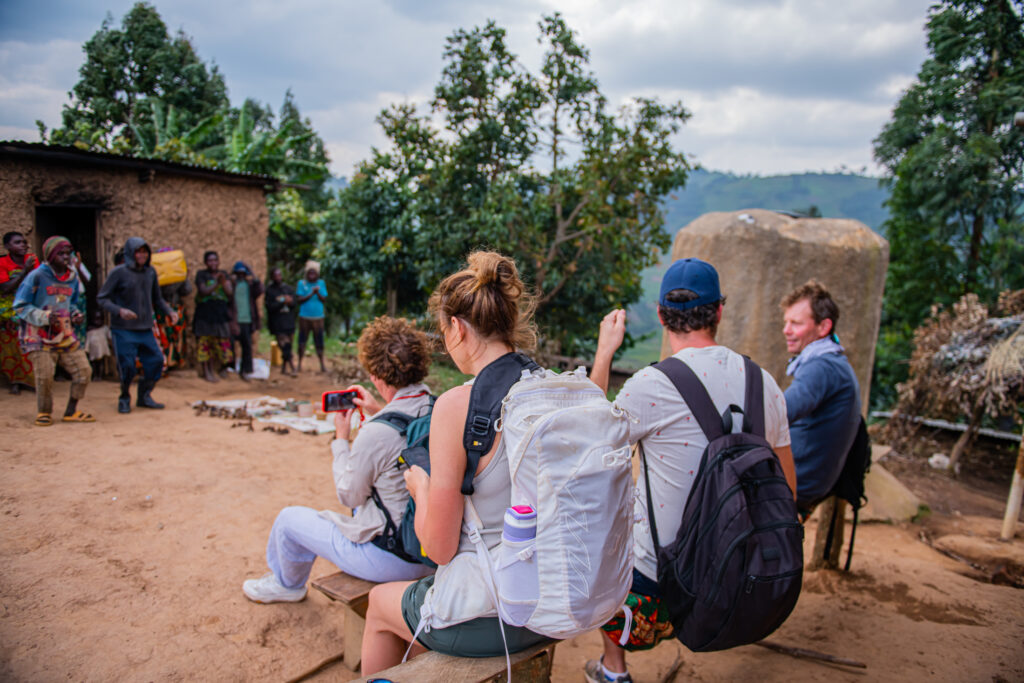
Community visits can include traditional crafts, farming, storytelling, music and conversations about life around the lake. Where Batwa experiences are included, we recommend using community-led visits that allow residents to determine how their history and culture are presented.
A responsible cultural visit should be an exchange rather than a performance. Visitors should ask before taking photographs and support locally owned projects where possible.
The Batwa have a deep historical connection with the forests of southwestern Uganda. Cultural experiences around the Bunyonyi and Bwindi region can provide insight into their history, traditional knowledge and the major changes that followed the creation of protected forests and national parks.
These visits can add an important human dimension to a trip that might otherwise focus entirely on landscapes and wildlife.
The steep terrain around Bunyonyi creates opportunities for cycling and mountain biking for active travellers. Routes pass through villages, farmland and hill country, with frequent viewpoints overlooking the lake.
Because the terrain is hilly, cycling here is better suited to travellers who are comfortable with climbs and uneven rural roads.
Some tourism properties and activity providers around the lake offer zip-lining and other light adventure activities. These are particularly suitable for travellers who want something more active between canoe trips and hikes.
Availability varies by operator, so we confirm the current activity options before including them in an itinerary.
Lake Bunyonyi is one of those destinations where the landscape does much of the work for the photographer. Terraced hills descend toward dark green water, small islands break up the horizon and traditional canoes move slowly between them.
Morning mist, afternoon reflections and sunset over the surrounding hills provide some of the strongest photographic conditions.
The combination of people, agriculture, water and dramatic topography also makes Bunyonyi particularly good for landscape and documentary photography.
The best photographs at Bunyonyi are rarely taken from the main lodge terrace. Take a canoe early in the morning, when the lake is quiet and the hills are still catching the first light. The reflections, mist and slow movement of local boats give you a much stronger sense of the place.
For travellers visiting Uganda primarily for gorilla trekking, Lake Bunyonyi makes an excellent extension before or after the forest experience.
Bwindi Impenetrable National Park is within the broader southwestern Uganda tourism circuit, and Bunyonyi provides a peaceful base for recovering after a demanding trek. Instead of immediately returning to Kampala or moving to another busy destination, travellers can spend a night or two beside the lake, canoe between the islands and explore the surrounding hills.
The contrast is what makes the combination work.
Bwindi is dense, humid and physically demanding. Bunyonyi is open, cool and slow.
For guests who have just spent several hours trekking through rainforest, that change of environment can be exactly what they need.
Yes. Lake Bunyonyi is commonly combined with gorilla trekking in southwestern Uganda, particularly trips involving Bwindi Impenetrable National Park. It works especially well as a relaxing stop before or after trekking, offering canoeing, birdwatching, hiking and cultural experiences in a completely different landscape.
Lake Bunyonyi can also be incorporated into itineraries visiting Mgahinga Gorilla National Park near Kisoro.
Mgahinga is part of the Virunga landscape and offers opportunities for gorilla trekking, golden monkey trekking and volcano hiking. Bunyonyi provides a scenic lakeside base within the same broader southwestern Uganda circuit.
For travellers flying into the region or crossing from Rwanda, the combination can be particularly efficient.
Lake Bunyonyi and Lake Mutanda are both scenic highland lakes in southwestern Uganda, but they offer different experiences.
Bunyonyi is larger in feel, has 29 islands and is particularly associated with canoeing, island visits, community experiences and terraced hills. Lake Mutanda, near Kisoro, has a more dramatic volcanic backdrop, with the Virunga volcanoes dominating the horizon.
If your priority is islands, canoeing and relaxed lakeside time, Bunyonyi is an excellent choice.
If your priority is volcano views and proximity to Mgahinga, Lake Mutanda may be the stronger option.
Many travellers can comfortably include both if their itinerary allows enough time.
Lake Mburo is a wildlife destination; Lake Bunyonyi is primarily a scenic and cultural destination.
Lake Mburo National Park offers zebra, impala, eland, giraffe and other savanna wildlife, while Bunyonyi is more about water, birds, hills and communities.
They therefore complement each other rather than compete. A Uganda itinerary that includes both can provide two very different sides of the country.
The landscape is one of Bunyonyi’s greatest attractions.
The lake sits in Uganda’s southwestern highlands, surrounded by steep hills that have been extensively cultivated. Terraces climb the slopes in layers, with small homes, banana plantations and fields scattered among them.
At approximately 1,962 metres above sea level, the destination has a noticeably cooler climate than Uganda’s lower-lying regions.
The combination of altitude, agriculture, water and islands creates a landscape that looks almost entirely different from the savanna environments of Queen Elizabeth National Park or Murchison Falls.
This is highland Uganda.
Lake Bunyonyi sits at approximately 1,950–1,962 metres above sea level. The surrounding hills rise significantly higher, creating the steep terraced landscape visible from the lake.
Lake Bunyonyi is widely described in tourism literature as one of Africa’s deepest lakes, but its exact maximum depth is disputed.
Some official and local tourism sources cite depths approaching 900 metres, while other references give substantially shallower measurements. Because of this disagreement, we avoid presenting the 900-metre figure as an established scientific measurement.
What is not disputed is that Bunyonyi is a deep high-altitude lake surrounded by steep volcanic and terraced terrain, and its depth contributes to the distinctive character of the lake.
The maximum depth of Lake Bunyonyi is disputed. Local tourism sources sometimes cite depths of up to approximately 900 metres, while other published references give much lower figures. For responsible travel information, it is better to describe Bunyonyi as a notably deep lake rather than state the 900-metre figure as settled scientific fact.
Lake Bunyonyi’s high elevation gives it a cooler climate than many of Uganda’s lower-lying destinations.
Mornings and evenings can be cool, while afternoons are generally comfortable to warm. The surrounding hills and water can also produce mist and changing weather conditions, particularly during rainy periods.
Unlike the hot lowland parks, Bunyonyi is a destination where a light jacket or fleece can be useful in the early morning and evening.
Rainfall can occur throughout the year, with wetter periods generally producing greener hills and more dramatic scenery. The lake remains attractive year-round because most of its main activities, canoeing, boat trips, cultural visits and scenic walks, can be adjusted around the weather.
Lake Bunyonyi has a mild highland climate because it sits at approximately 1,962 metres above sea level. Mornings and evenings can be cool, while afternoons are generally comfortable. Rain can occur throughout the year, so a light waterproof jacket is useful even during otherwise dry periods.
Lake Bunyonyi can be visited throughout the year, but the best period depends on what you want to do.
The drier months are generally better for hiking, canoeing and road travel because trails and access roads are less likely to be affected by heavy rain. Clearer skies can also provide better panoramic views across the lake and surrounding hills.
The wetter periods bring greener vegetation, dramatic cloud formations and lush agricultural landscapes. For photographers, this can actually be an advantage.
If you are combining Bunyonyi with gorilla trekking, the timing of the entire Uganda itinerary matters more than the lake alone. Gorilla trekking takes place throughout the year, so Bunyonyi can be positioned before or after the trek according to your preferred travel dates.
One night gives you a quick introduction to the lake, usually enough for a boat or canoe trip and a relaxed evening overlooking the water.
Two nights is our preferred recommendation for most travellers. It gives you time for an island tour, a canoe experience and either a nature walk or cultural visit without making the stay feel rushed.
Three nights works well for travellers who want to slow down completely, combine Bunyonyi with a cultural experience and spend additional time hiking, birdwatching or simply enjoying their accommodation.
Two nights is generally ideal for a first visit to Lake Bunyonyi. It allows enough time for canoeing or a boat cruise, island visits and a cultural or hiking experience while still leaving time to relax beside the lake.
Lake Bunyonyi offers something very different from Uganda’s traditional safari destinations.
There are no long game drives here and no need to spend hours searching for a particular animal. Instead, the destination is about slowing down and experiencing the landscape.
The 29 islands, terraced hills, traditional canoes, birdlife and surrounding communities create a destination that rewards travellers who are willing to stay for more than a quick photo stop.
Its location is another major advantage. Bunyonyi fits naturally into a southwestern Uganda itinerary that includes Bwindi, Mgahinga and the Rwanda border.
For travellers arriving from Rwanda, the lake can also provide an attractive introduction to Uganda before continuing toward the gorilla forests.
And for travellers finishing a safari or gorilla trek, Bunyonyi offers something increasingly valuable: time to do nothing.
Lake Bunyonyi is generally less expensive than Uganda’s major wildlife and gorilla destinations because the lake itself does not require the high park-entry and trekking fees associated with national parks.
The overall cost depends mainly on accommodation, transport, the number of nights and activities such as private boat trips, canoeing and cultural excursions.
Budget travellers can find simple lakeside accommodation, while mid-range and luxury properties offer private cottages, lake views, restaurants, swimming facilities and organized excursions.
For travellers combining Bunyonyi with gorilla trekking, the gorilla permit and transportation usually form the largest part of the overall trip budget.
We therefore treat Lake Bunyonyi as a flexible component of a Uganda itinerary rather than a fixed-price destination. The same lake can be incorporated into a budget road trip, a comfortable mid-range Uganda safari or a luxury fly-in itinerary.
The cost varies considerably according to accommodation, transport and activities. Simple accommodation can keep costs relatively low, while private lake-view lodges and luxury properties increase the price. Boat trips, canoeing, hiking and cultural visits are generally charged separately or included within selected accommodation packages.
Accommodation around Lake Bunyonyi ranges from simple backpacker-style lodges and community-run properties to comfortable mid-range resorts and luxury lakeside retreats.
The most desirable properties are usually those with direct views over the lake, private terraces and easy access to the water.
Some accommodation is located on the mainland overlooking the lake, while other properties are situated on islands and reached by boat.
Island accommodation can provide a particularly peaceful experience because there is little road traffic and the lake becomes part of everyday life.
For guests combining Bunyonyi with gorilla trekking, we normally recommend choosing accommodation based on the following factors:
Lake Bunyonyi is approximately 440–450 kilometres from Kampala by road, with the journey generally taking much of a day depending on traffic, road conditions and the exact accommodation location.
The route passes through Uganda’s southwestern countryside before reaching Kabale and the highlands around the lake.
For travellers who enjoy road trips, this route offers a useful introduction to rural Uganda, although we recommend allowing plenty of time rather than trying to rush the journey.
Kabale is the main gateway for Lake Bunyonyi. From Kabale, travellers continue toward the lake through the surrounding highlands and terraced countryside.
The final transfer depends on where the accommodation is located. Some properties are reached directly by road, while island properties require a boat transfer from a lakeside landing point.
Lake Bunyonyi is particularly convenient for travellers combining Rwanda and Uganda.
The lake lies relatively close to the Rwanda border, making it possible to include Bunyonyi in an itinerary that begins in Kigali before continuing toward Bwindi or other Ugandan destinations.
For travellers flying into Kigali rather than Kampala, this can be one of the most efficient ways to incorporate southwestern Uganda.
Travellers can fly toward the southwestern Uganda region using scheduled or chartered services depending on the itinerary and current flight schedules, with road transfers continuing toward Kabale and Lake Bunyonyi.
For most travellers, however, the lake is best incorporated into a road itinerary because it is commonly combined with Bwindi, Mgahinga, Queen Elizabeth National Park or Rwanda.
Driving is usually the better choice if Lake Bunyonyi forms part of a broader Uganda road safari. It allows you to experience the countryside and combine several destinations without arranging multiple flights and transfers.
Flying can make sense when time is limited or when Bunyonyi is part of a more extensive fly-in itinerary.
If you are already travelling through Bwindi or Mgahinga by road, we generally recommend driving to Bunyonyi rather than adding an unnecessary flight.
Although Lake Bunyonyi itself is not a volcanic trekking destination, the dramatic Virunga volcanoes are accessible within the broader southwestern Uganda region.
On clear days, travellers moving between Bunyonyi, Kisoro and Mgahinga can enjoy views toward the volcanic peaks.
For active travellers, this opens the possibility of combining lakeside relaxation with volcano hiking, golden monkey trekking or gorilla trekking in Mgahinga.
Kisiizi Falls is another attraction that can be incorporated into a broader southwestern Uganda itinerary.
The waterfall is located away from the immediate lakeshore and is better treated as a day excursion or en-route stop rather than something to squeeze into a short Bunyonyi stay.
It can work particularly well for travellers spending several nights in the region and looking for additional cultural and natural attractions.
Tourism around Bunyonyi is closely connected to the surrounding communities.
Visitors should therefore consider where their money goes. Locally owned accommodation, guides, canoe operators and community projects can ensure that tourism contributes directly to households around the lake.
When visiting villages or cultural projects, ask before taking photographs, follow local guidance and avoid treating people as attractions.
The same principle applies to canoeing. Using local guides and canoe operators supports the people whose knowledge and skills make the experience possible.
Bunyonyi is a place where responsible tourism can be very visible. A boat trip can directly support a local paddler. A community visit can support a local project. Buying locally made crafts can keep tourism income within the community.
Don’t turn Lake Bunyonyi into a checklist of islands. The most rewarding experience is often simply getting into a traditional canoe with a local guide, moving slowly across the water and listening to the stories behind the landscape.
Bunyonyi is particularly well suited to families looking for a quieter stop during a Uganda trip.
Canoeing, boat excursions, birdwatching, swimming and short walks can be adapted to different ages and activity levels.
Families can also choose accommodation with larger cottages or family rooms and use the lake as a base for exploring the surrounding region.
For younger children, we recommend choosing accommodation with easy water access, safe swimming areas and reliable boat arrangements.
For couples, Bunyonyi is one of southwestern Uganda’s strongest relaxation destinations.
Private lake-view accommodation, canoe rides, sunset cruises and quiet walks through the hills create a naturally romantic atmosphere without needing a heavily scheduled itinerary.
It is especially effective after gorilla trekking, when couples can spend the following day doing very little other than enjoying the lake.
Birdwatchers should consider spending at least two nights at Bunyonyi.
The combination of open water, wetlands, cultivated hills, forest patches and islands creates several different habitats within a relatively small area.
A guided early-morning boat trip can be particularly productive, while walking around the accommodation grounds and nearby trails can reveal species that are easily missed from the water.
More than 200 species have been recorded around the lake, making birding one of the destination’s genuine highlights rather than a secondary activity.
Lake Bunyonyi can work exceptionally well as part of a Uganda honeymoon.
A typical combination might include gorilla trekking in Bwindi followed by two or three nights at a private lakeside property. The contrast between the excitement of the forest and the stillness of Bunyonyi creates a natural rhythm for a honeymoon itinerary.
Private canoe rides, lake-view breakfasts, sunset drinks and quiet evenings provide plenty of space for couples to relax without filling every hour with activities.
Bwindi is about the forest.
Bunyonyi is about the lake.
Bwindi offers one of Africa’s most extraordinary wildlife experiences through mountain gorilla trekking, while Bunyonyi provides scenery, water, birds, culture and relaxation.
They are therefore best experienced together rather than treated as competing destinations.
A morning spent trekking through Bwindi followed by a peaceful evening overlooking Bunyonyi is one of the strongest combinations in southwestern Uganda.
Queen Elizabeth National Park offers classic Ugandan wildlife viewing, including elephants, lions, hippos, buffalo and boat safaris along the Kazinga Channel.
Bunyonyi offers almost the opposite experience.
There is less emphasis on large wildlife and more emphasis on scenery, community life, birds and relaxation.
For travellers with enough time, combining the two gives a much broader picture of Uganda.
Lake Bunyonyi is more than a beautiful lake to photograph from a hotel terrace. Its 29 islands, traditional canoes, terraced hills, birdlife and surrounding communities make it a destination worth slowing down for.
We build Bunyonyi into Uganda itineraries in several ways: as a relaxing stop after gorilla trekking, as part of a southwestern Uganda circuit, as an extension from Rwanda, or as a standalone highland escape.
For first-time visitors, two nights usually provides the right balance: enough time for a canoe or boat trip, island exploration and a walk or cultural experience without rushing the lake.
For couples and families, we can build a slower itinerary around lakeside accommodation and private activities. For active travellers, Bunyonyi can be combined with hiking, cycling, volcano experiences and gorilla trekking.
Lake Bunyonyi does not demand that you chase anything.
You arrive, take a canoe, look across the terraces and islands, and let Uganda’s highlands do the rest.
Escape to the tranquil shores of Lake Bunyonyi, where crystal-clear waters, 29 picturesque islands and rolling emerald hills create one of East Africa's most breathtaking landscapes. Whether you're canoeing across the lake, exploring charming island communities, enjoying exceptional birdwatching or relaxing after a gorilla trekking adventure, Lake Bunyonyi offers the perfect blend of nature, culture and serenity for an unforgettable Ugandan getaway..
Discover the lake's 29 unique islands, each with its own fascinating history, cultural significance and breathtaking scenery, including the famous Punishment Island…
Glide across the calm waters in a traditional wooden canoe while taking in spectacular views of the surrounding terraced hills and lush…
Up Paddleboarding – Experience the tranquillity of Lake Bunyonyi from the water through guided kayaking and paddleboarding excursions suitable for all skill…
Enjoy one of Africa's safest lakes for swimming, free from crocodiles, hippopotamuses and bilharzia.
Observe more than 200 bird species, including Grey Crowned Cranes, African Fish Eagles, kingfishers, herons, cormorants and colourful weaver birds
Admire rolling emerald hills, terraced farmlands, mist-covered valleys and panoramic viewpoints that make Lake Bunyonyi one of Uganda's most photogenic destinations.
Explore scenic trails through surrounding villages and hills while enjoying incredible views of the lake and learning about the local environment.
Ride along quiet countryside roads and scenic trails, passing traditional villages, farms and spectacular lake viewpoints.
From value camps to premium lodges — we match every stay to your style and budget.
Budget accommodation around Lake Bunyonyi offers comfortable lakeside rooms, friendly hospitality and easy access to canoeing, birdwatching and island excursions. These properties provide excellent value for travellers seeking a peaceful retreat while enjoying the lake's spectacular scenery and cultural experiences.
Mid-range lodges feature spacious cottages, panoramic lake views, quality dining and convenient access to kayaking, guided nature walks and cultural village visits. They offer an excellent balance of comfort, affordability and unforgettable lakeside experiences.
Luxury accommodation at Lake Bunyonyi combines elegant lakeside cottages, exceptional hospitality and breathtaking panoramic views across the lake's 29 islands. Guests enjoy fine dining, personalised service, private canoe excursions, spa treatments and exclusive experiences in one of East Africa's most tranquil and scenic destinations. These properties are ideal for honeymooners, couples, luxury travellers and those seeking relaxation before or after gorilla trekking.
Every season has its magic — here's what to expect when, so you can travel at your perfect time.
Everything you need to know before you go — and we’ll guide you through every step.
Most international visitors require a valid visa to enter Uganda. Applications can be made online through the Uganda e-Visa portal before arrival. Citizens of East African Community (EAC) member states benefit from simplified entry procedures.
The official currency is the Ugandan Shilling (UGX). Most hotels, lodges and resorts accept Visa and Mastercard, but carrying some cash is advisable for local markets, boat rides, community visits and small purchases.
English and Swahili are Uganda's official languages. Around Lake Bunyonyi, the local community primarily speaks Rukiga, while English is widely spoken in hotels, lodges and by tour guides.
Lake Bunyonyi operates on East Africa Time (EAT), which is UTC +3, with no daylight saving time observed throughout the year.
Owing to its elevation of approximately 1,962 metres (6,437 feet) above sea level, Lake Bunyonyi enjoys a pleasant highland climate with daytime temperatures typically ranging between 18°C and 25°C (64°F–77°F). Evenings can be cool, so a light jacket is recommended.
A yellow fever vaccination certificate is required for entry into Uganda. Comprehensive travel insurance is recommended. While the lake is free from crocodiles, hippopotamuses and bilharzia, visitors should always follow local safety advice during water activities.
Pack lightweight clothing for daytime, a warm sweater or jacket for cool evenings, comfortable walking shoes, swimwear, sunscreen, insect repellent, sunglasses and a hat for outdoor excursions.
Canoeing, kayaking and boat excursions are popular activities on Lake Bunyonyi. Always wear a life jacket during water-based activities and use experienced local guides or licensed operators.
Help preserve the lake's pristine environment by avoiding littering, respecting local communities, supporting locally owned businesses and practising responsible tourism during your visit. Your support contributes to conservation and sustainable community development.
Uganda uses Type G electrical sockets with a 240V, 50Hz power supply. International visitors should carry a universal travel adapter if needed.
Mobile network coverage is generally reliable around Lake Bunyonyi. Most lodges, hotels and resorts provide Wi-Fi, although connection speeds may vary depending on location.
Lake Bunyonyi is located in southwestern Uganda, between Kabale and Kisoro districts, approximately 8 km (5 miles) west of Kabale. It lies close to Bwindi Impenetrable National Park and the Rwanda border.
Lake Bunyonyi is famous for its 29 scenic islands, crystal-clear waters, spectacular terraced hills, rich birdlife and peaceful atmosphere. It is also recognised as one of Africa's deepest freshwater lakes and a popular destination before or after gorilla trekking.
Yes. Lake Bunyonyi is widely regarded as one of Africa's safest lakes for swimming because it is free from crocodiles, hippopotamuses and bilharzia (schistosomiasis).
Lake Bunyonyi is home to 29 islands, each with its own unique history, cultural significance and natural beauty. Popular islands include Punishment Island (Akampene), Bushara Island and Bwama Island.
Visitors can enjoy canoeing, kayaking, stand-up paddleboarding, swimming, birdwatching, island excursions, hiking, cycling, cultural village tours, coffee experiences and lakeside relaxation.
The lake is best known for its birdlife, with more than 200 bird species, including Grey Crowned Cranes, African Fish Eagles, kingfishers, herons, cormorants, weaver birds and egrets. The lake also supports freshwater fish and occasional sightings of Cape Clawless Otters.
The best time to visit is during the dry seasons from June to September and December to February, when conditions are ideal for outdoor activities, photography and island excursions.
A stay of 2–3 days is ideal to enjoy the lake's scenery, island tours, birdwatching, cultural experiences and outdoor activities while relaxing before or after a safari or gorilla trekking adventure
Yes. Lake Bunyonyi is one of the most popular extensions to Bwindi Impenetrable National Park and Mgahinga Gorilla National Park, providing a peaceful place to relax before or after gorilla trekking.
Lake Bunyonyi offers a wide range of budget camps, mid-range lakeside lodges and luxury boutique resorts, making it suitable for backpackers, families, honeymooners and luxury travellers alike.
The driver-guide’s daily rate, the camp tip box, the dollar-note rule that catches people at the last camp…
Read more →
Kenya's US$50,000 travel insurance rule is frozen, not struck down. Here's the cover that actually moves you, treats…
Read more →
Kenya’s parks don’t set a minimum age, but camps, balloon operators and mosquitoes do, and this is how…
Read more →Tell us what you’d love to see and a local specialist will design a tailor-made itinerary around you — no obligation, reply within 24 hours.