

Book-a-Seat Safari Kenya: How It Works and Who It Suits
We built our book-a-seat model to give shared travellers a private safari's comfort without a private safari's price…
Read more →
Kidepo Valley National Park is Uganda's most remote and spectacular wilderness, celebrated for its dramatic savannah landscapes, rugged mountains, abundant wildlife, and authentic cultural experiences. Home to lions, cheetahs, elephants, buffaloes, and over 475 bird species, Kidepo offers an uncrowded safari experience and is widely regarded as one of Africa's last true wilderness destinations.
The road into Kidepo Valley National Park seems to go on forever. The last settlements fall behind, the landscape opens into an enormous sweep of golden grassland and, beyond the road, mountains rise along the horizon. There are no crowded safari convoys here, no chain of lodges stretching across the landscape and very little to suggest that you are anywhere near a major tourist destination. Then a herd of buffalo appears in the Narus Valley, a lion is lying beneath a rocky outcrop and an ostrich crosses the track, and the reason for coming this far north becomes obvious.
Kidepo Valley National Park sits in the remote northeastern corner of Uganda, in the semi-arid Karamoja region close to the borders with South Sudan and Kenya. Covering approximately 1,442 square kilometres and ranging from about 914 to 2,750 metres above sea level, Kidepo Valley National Park is one of East Africa’s great wilderness areas. The park was first gazetted as a game reserve and became a national park in 1962. Today, Kidepo is managed by the Uganda Wildlife Authority and is known for its extraordinary landscapes, large concentrations of wildlife, exceptional birdlife and strong cultural connections with the communities of Karamoja.
What makes Kidepo Valley National Park different from Uganda’s more frequently visited safari destinations is the combination of remoteness, scenery and northern wildlife. Kidepo Valley National Park supports species that are difficult or impossible to see elsewhere in Uganda, including cheetah, ostrich, bat-eared fox, striped hyena, caracal and several northern species of antelope. The park also has substantial populations of elephant, buffalo, lion, leopard, Rothschild’s giraffe and zebra.
The park’s two great valleys, Narus and Kidepo, define the Kidepo Valley National Park safari experience. The Kidepo River is usually dry for much of the year, while the Narus Valley retains water in pools and wetlands that become critically important during the dry season. Wildlife concentrates around these remaining water sources, particularly around Narus, making it the most reliable area for game viewing during dry periods.
We send guests to Kidepo Valley National Park when they want something beyond the conventional Uganda safari. If Bwindi is about gorillas and Kibale is about chimpanzees, Kidepo is about open wilderness, enormous skies, unusual wildlife and the feeling that you have reached the edge of the continent.
Kidepo Valley National Park is a 1,442-square-kilometre protected area in northeastern Uganda’s Karamoja region. Gazetted as a national park in 1962, Kidepo Valley National Park is known for its remote wilderness, dramatic savanna landscapes, large buffalo and elephant herds, lions, cheetahs, Rothschild’s giraffes, ostriches and more than 475 recorded bird species. The park borders South Sudan and lies close to Kenya.
Location: Karamoja region, northeastern Uganda, near the borders with South Sudan and Kenya
Size: 1,442 square kilometres
Established: 1962 as a national park, after previously being gazetted as a game reserve
Managed by: Uganda Wildlife Authority
Altitude: Approximately 914 to 2,750 metres above sea level
Distance from Kampala: Approximately 700 kilometres
Known for: Remote wilderness, Narus Valley, Kidepo Valley, lions, elephants, buffalo, cheetahs, Rothschild’s giraffes, ostriches and exceptional birdlife
Main tourism area: Apoka and the Narus Valley
Main rivers: Kidepo River and Narus River, both seasonal
Nearest international airport for safari connections: Entebbe International Airport, followed by a scheduled or chartered light-aircraft flight
Border region: South Sudan to the northwest and Kenya to the east
Kidepo Valley National Park is one of Uganda’s most rewarding destinations for wildlife enthusiasts because its isolation has helped preserve a distinctive northern savanna ecosystem. The Uganda Wildlife Authority records more than 77 mammal species and approximately 476 bird species in the park, while the official park brochure records 86 mammal species and more than 475 bird species.
The wildlife of Kidepo Valley National Park includes elephant, buffalo, lion, leopard, cheetah, spotted hyena, jackals, zebra, hartebeest, eland, oribi, reedbuck and several other antelope species. The park is particularly important because it provides refuge for several species that are rare or absent from other Ugandan national parks.
During the dry season, the Narus Valley becomes the centre of the Kidepo Valley National Park wildlife experience. Buffalo gather around the remaining water and wetland areas, elephants move through the valley, giraffes browse on the slopes and lions often use rocky areas and vegetation for shade. The concentration of wildlife can make a morning or afternoon game drive in Narus exceptionally productive.
The Kidepo Valley itself offers a different experience. Wildlife can be more dispersed across its broad plains, but the scenery becomes the attraction. The dry riverbed, enormous valley floor and distant mountains create some of the most dramatic landscapes on a Kidepo Valley National Park safari. Ostriches and secretary birds are among the species frequently associated with the open plains.
Kidepo Valley National Park is home to elephant, buffalo, lion, leopard, cheetah, spotted hyena, zebra, Rothschild’s giraffe, eland, hartebeest, oribi, reedbuck and many other species. It is also one of Uganda’s most important places for ostrich and northern dry-country wildlife, including species such as bat-eared fox, striped hyena and caracal.
Kidepo Valley National Park is one of the few places in Uganda where visitors have a realistic opportunity to see cheetah. The species is associated with the park’s open grasslands, where the combination of visibility and prey makes the landscape suitable for this fast-moving predator. A cheetah sighting in Kidepo is very different from the more common lion and buffalo encounters, and finding one often becomes one of the highlights of a Kidepo Valley National Park safari.
Rothschild’s giraffe is another important species in Kidepo Valley National Park. The population suffered a severe decline during periods of insecurity and poaching, reaching only three known individuals in the 1990s. Conservation monitoring and translocation efforts subsequently helped rebuild the population. In 2018, 14 additional giraffes were translocated to Kidepo, and ongoing monitoring continues to track the population.
The sight of a Rothschild’s giraffe moving across the golden plains with the mountains behind it is one of the defining wildlife images of Kidepo Valley National Park.
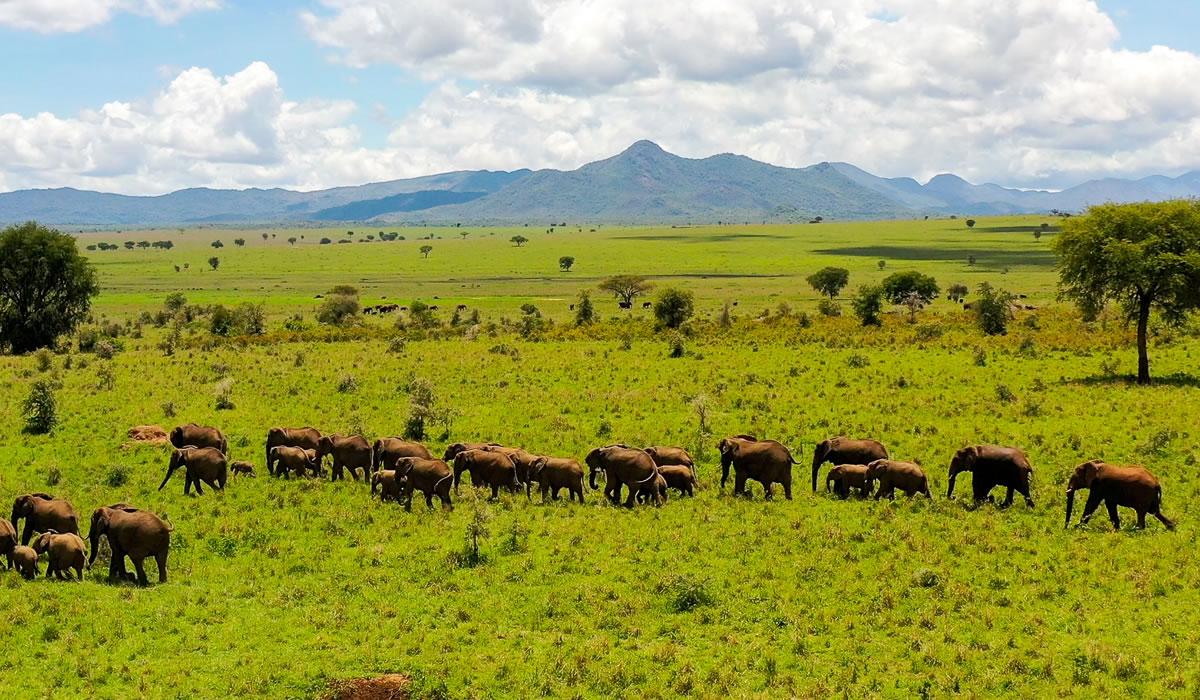
Elephants are an important part of the Kidepo Valley National Park ecosystem. During dry periods, elephant movements are strongly influenced by the availability of water in the Narus Valley and other remaining water sources. Large elephant groups can sometimes be encountered around the valley, particularly when the surrounding plains become increasingly dry.
Buffalo are among the most impressive animals to see in Kidepo Valley National Park. During the dry season, large numbers gather around the Narus Valley wetlands and water sources. The sheer scale of a buffalo congregation against the open Kidepo landscape is one of the reasons the park has such a strong reputation among experienced safari travellers.
Lions are resident in Kidepo Valley National Park and are frequently associated with the Narus Valley. The rocky outcrops and scattered vegetation provide shade during the hottest parts of the day, while the concentration of buffalo, zebra and antelope creates a strong prey base.
Lion sightings in Kidepo can feel particularly wild because vehicle density is generally much lower than in some of East Africa’s more famous safari destinations.
Leopard and spotted hyena are also present in Kidepo Valley National Park, although sightings are less predictable than those of some of the more visible herbivores. Black-backed jackals and side-striped jackals are also recorded in the park, while striped hyena and caracal contribute to the distinctive northern predator community.
Kidepo Valley National Park is one of the best places in Uganda to see ostrich in the wild and is particularly significant for birders looking for large terrestrial birds. Ostriches are frequently associated with the park’s open plains, particularly around the Kidepo Valley.
Birdwatching in Kidepo Valley National Park is exceptional. More than 475 species have been recorded, making the park one of Uganda’s richest birding destinations. The park’s northern location means its birdlife includes numerous dry-country species associated with northern Uganda and neighbouring Kenya.
Birding highlights include ostrich, secretary bird, kori bustard, Abyssinian roller, Abyssinian ground hornbill, red-throated bee-eater, Karamoja apalis, Clapperton’s francolin and several species of raptor. The park has also recorded 56 raptor species, making Kidepo Valley National Park particularly attractive to specialist birdwatchers.
The best birding strategy is to combine game drives with slower exploration around the Narus Valley, Apoka and the open plains. Early morning provides cooler temperatures and strong bird activity, while the changing light later in the day creates excellent photographic conditions.
Kidepo Valley National Park has more than 475 recorded bird species, including ostrich, secretary bird, kori bustard, Abyssinian roller, Abyssinian ground hornbill, red-throated bee-eater and numerous raptors. The park is particularly valuable for birders interested in dry-country species.
Game drives are the main activity in Kidepo Valley National Park. Morning game drives are particularly rewarding because temperatures are cooler and predators may still be active. Afternoon drives allow visitors to remain in the park as temperatures fall and wildlife begins moving more actively.
The Narus Valley is usually the first area we recommend because it is the park’s most reliable wildlife-viewing zone, particularly during dry periods. Game drives can also explore the Kakine, Katurum and Nagusokopire areas, giving visitors access to different landscapes and viewpoints.
The Narus Valley is the heart of the Kidepo Valley National Park safari experience. Unlike the broad Kidepo Valley, Narus retains water for longer and therefore attracts wildlife for much of the year.
A Narus Valley game drive can produce sightings of buffalo, elephant, giraffe, zebra, antelope and predators, while the surrounding hills and rocky outcrops provide an impressive backdrop. During the dry season, the concentration of wildlife around the remaining water makes Narus particularly productive.
The Kidepo Valley drive is less about ticking off animal species and more about experiencing the scale of the wilderness. The route takes visitors across a huge semi-arid valley where the seasonal Kidepo River creates a broad sandy channel.
The journey from Apoka towards the Kidepo River provides spectacular views of the surrounding mountains and the border landscapes. At the riverbed, visitors can walk along the dry sand with a ranger guide, depending on current conditions and UWA arrangements. Kananorok Hot Springs can also be visited as part of this excursion.
Kananorok Hot Springs lie beyond the Kidepo River in the northern section of the park near the South Sudan border. The small hot pools are more about the journey and remote landscape than a conventional attraction.
A ranger guide is required for the Kidepo Valley excursion, and access conditions should be confirmed before departure because the area is remote and close to an international border.
Nature walks provide a completely different perspective on Kidepo Valley National Park. Short walks around Apoka can reveal smaller wildlife and vegetation that is easy to miss from a vehicle, while longer walking routes can explore the grasslands around Kakine and the Narus Valley.
Walking activities require a ranger guide. Depending on the route and conditions, visitors may encounter zebra, hartebeest, reedbuck, giraffe and other wildlife, while learning to read tracks, vegetation and animal signs.
The Rionomoe Trail offers a longer walking experience in the southern part of the Narus Valley. It is suited to travellers who want to slow down and experience Kidepo Valley National Park on foot rather than spending the entire safari inside a vehicle.
As with other walking experiences in Kidepo Valley National Park, ranger accompaniment is required and routes should be confirmed locally according to wildlife movements and current park conditions.
The Morungule Mountains rise dramatically from the surrounding plains and offer opportunities for guided mountain walks. Hiking in this part of Kidepo Valley National Park combines physical activity with panoramic views over the surrounding wilderness.
A ranger guide is required, and the difficulty of the hike should be discussed before departure, particularly during hotter months.
Birdwatching is one of the strongest reasons to spend additional time in Kidepo Valley National Park. Experienced ranger guides can help visitors locate and identify the park’s northern species, while the different habitats around Apoka, Narus and Kidepo provide opportunities for a varied bird list.
Kidepo Valley National Park has several viewpoints where the scale of the landscape becomes apparent. Viewpoints around Apoka, Nagusokopire and Kakine provide wide panoramas over the valleys and mountains, including views towards the Morungule range and mountains in neighbouring South Sudan.
A Kidepo Valley National Park safari can also include cultural experiences with communities around the park. Community walks around areas such as Kawalakol, Lorukul and Karenga provide opportunities to learn about local life, pastoral traditions and the relationship between communities and the surrounding wildlife landscape.
The Karamojong are especially closely associated with the region. Their pastoral culture, livestock traditions, distinctive manyatta homesteads, music, dance and beadwork add an important human dimension to the Kidepo Valley National Park experience.
The Karamojong have lived with the challenges of Karamoja’s dry environment for generations. A responsible cultural visit should focus on conversation, learning and community benefit rather than turning local people into a photographic attraction.
We encourage guests to ask permission before taking photographs, purchase crafts directly from community members where appropriate and use local guides whenever possible.
The Ik are a small community living in the mountains near the Uganda-Kenya border. Cultural visits can provide insight into their history, food, traditions and relationship with the surrounding environment.
Because the Ik community is small and culturally distinct, visits should always be arranged through appropriate local channels and approached respectfully.
Kidepo Valley National Park rewards travellers who resist the temptation to rush. We recommend building enough time into the itinerary to combine a Narus Valley game drive with the Kidepo Valley excursion and at least one cultural or walking experience. The park is not somewhere you visit simply to collect a list of animals; the landscape is a major part of what makes Kidepo special.
Kibara Mugo, Safari Writer & East Africa Specialist
Kidepo Valley National Park has several access points serving different approaches into the park. The most appropriate gate depends on whether you are arriving by road from the south, through Karamoja, or approaching from the Gulu and Kitgum side.
Lokumoit Gate: One of the main access points for visitors approaching Kidepo from the western and southern road network.
Nataba Gate: Used by routes approaching through the Karamoja region.
Katurum Gate: Provides access to parts of the park and is associated with routes around the Narus Valley.
Gate access can vary according to the route, road conditions and current park management arrangements, so we confirm the appropriate entry point before every Kidepo Valley National Park safari.
For most travellers, flying is the easiest way to reach Kidepo Valley National Park. Scheduled and chartered light aircraft services connect Kidepo with other Ugandan safari destinations and the wider tourism network.
The Uganda Wildlife Authority specifically recommends scheduled or chartered flights as the best way to reach Kidepo Valley National Park. Flying eliminates most of the long road journey and allows visitors to spend more of their time on safari.
Flights generally use airstrips serving the park and surrounding safari lodges, with road transfers arranged from the airstrip to accommodation.
Kidepo Valley National Park can also be reached by road for travellers who want to experience northern Uganda as part of the journey. The most direct route through Gulu to Lokumoit Gate takes approximately 10 hours according to Uganda Wildlife Authority information, although actual travel time depends heavily on road conditions, stops and weather.
The journey can be broken up with an overnight stop around Ziwa Rhino Sanctuary, Gulu or Kitgum. Other routes pass through the wider Karamoja region and can be combined with destinations such as Moroto.
A road safari to Kidepo Valley National Park is therefore best treated as part of a wider northern Uganda adventure rather than simply as a transfer from Kampala.
Flying is the better option for travellers with limited time or for those who want to combine Kidepo Valley National Park with other safari destinations efficiently. It saves significant travel time and places you much closer to the wilderness.
Driving makes sense for travellers who enjoy road travel, want to explore northern Uganda or are building a longer itinerary through Gulu, Kitgum, Karamoja and Kidepo.
The road journey is part of the experience, but it requires more time. For a short Kidepo Valley National Park safari, we generally recommend flying.
If Kidepo Valley National Park is the main reason for your Uganda trip, fly whenever your budget allows. If you have a week or more and want to understand northern Uganda rather than simply reach Kidepo, the road journey can become an attraction in its own right.
Nicholas Wangithi, Director & Founder
Kidepo Valley National Park has a semi-arid climate that is noticeably hotter and drier than Uganda’s western forest destinations. Temperatures are generally high during the day, while mornings and evenings can feel considerably cooler, particularly at higher elevations.
Rainfall is seasonal and can transform the landscape quickly. The valleys may become green after rains, while the seasonal rivers can briefly carry significant amounts of water before returning to sandy riverbeds.
The dry season is particularly important for wildlife viewing because water becomes concentrated around the remaining pools, especially in the Narus Valley. The Kidepo Valley itself can become extremely dry, which is precisely what creates the stark landscapes that define the northern section of the park.
Kidepo Valley National Park has a hot, semi-arid climate with seasonal rainfall. The landscape becomes greener after the rains, while the dry season creates concentrated wildlife viewing around remaining water sources in the Narus Valley. Conditions can be hot during the middle of the day, so early morning and late afternoon are usually the most comfortable times for activities.
Uganda Wildlife Authority currently lists Kidepo Valley National Park entry fees at USD 40 for foreign non-residents, USD 30 for foreign residents and UGX 20,000 for East African citizens on its park information page. However, UWA’s tariff system is subject to periodic updates, and travellers should confirm the applicable rate for their travel dates before finalizing a safari budget.
Entry fees are separate from accommodation, transport, guiding, activities and other safari costs unless specifically included in a package.
At Afrikan Accent Adventures, we normally build applicable park fees into the safari quotation so guests have a clear understanding of the total cost before travelling.
The Uganda Wildlife Authority’s current park information lists the Kidepo Valley National Park entrance fee as USD 40 for foreign non-residents, USD 30 for foreign residents and UGX 20,000 for East African citizens. Rates can change with new UWA tariff periods, so we confirm the applicable rate when preparing a safari quotation.
The dry season is generally the best period for a classic Kidepo Valley National Park wildlife safari. As water becomes scarce, animals concentrate around the Narus Valley and remaining pools, making wildlife easier to locate.
The dry months are also excellent for photography because the golden grass, dusty tracks, dramatic skies and low evening light create the visual character for which Kidepo Valley National Park is famous.
The wetter months bring a completely different experience. Grasslands become greener, migratory and resident birdlife can become particularly rewarding and the landscape loses some of its dry-season harshness. For birdwatchers and photographers interested in green-season landscapes, this can be an excellent time to visit.
The dry season is generally the strongest period for concentrated wildlife viewing, particularly around the Narus Valley. The wetter periods are attractive for birdwatching, greener scenery and quieter safari conditions. The best month ultimately depends on whether wildlife density, photography, birding or lower visitor numbers is the priority.
Two nights can provide a good introduction to Kidepo Valley National Park, particularly if you fly in and focus on morning and afternoon game drives around Narus.
Three nights is our preferred minimum for a first Kidepo Valley National Park safari. It gives enough time for several game drives, a Kidepo Valley excursion and either a cultural visit, nature walk or birding experience.
Four nights or more is ideal for travellers who want to slow down. It allows time for Narus Valley, Kidepo Valley, mountain hiking, cultural experiences and additional game drives without making every day feel rushed.
Three nights is our recommended minimum for a first Kidepo Valley National Park safari. It gives travellers enough time to experience the Narus Valley, explore the Kidepo Valley and add a cultural, walking or birding activity. Four or more nights is better for a slower and more comprehensive northern Uganda experience.
Kidepo Valley National Park offers something that is increasingly difficult to find in Africa: genuine space.
The park is enormous, the landscapes are dramatic and the wildlife is often encountered without the concentration of vehicles found in more heavily visited safari destinations. A Kidepo Valley National Park game drive can involve minutes of empty road followed by an extraordinary encounter with buffalo, elephant, lion, giraffe or cheetah.
The wildlife list is also different. Kidepo Valley National Park offers species that add something genuinely new to a Uganda itinerary, particularly cheetah, ostrich, Rothschild’s giraffe, bat-eared fox, striped hyena and caracal.
Then there is the landscape. The dry Kidepo River, Narus Valley, Morungule Mountains, rocky outcrops and huge open plains make Kidepo Valley National Park one of the most visually dramatic safari destinations in East Africa.
Finally, there is the cultural dimension. A safari in Kidepo Valley National Park can include interactions with communities whose pastoral traditions have developed around one of the most challenging environments in the region.
Kidepo Valley National Park safaris vary significantly in price depending on whether you travel by road or air, the accommodation selected, the season and the length of the safari.
A road-based Kidepo Valley National Park safari can be more economical when transport costs are shared across several travellers and the itinerary includes other northern Uganda destinations. Flying is more expensive but significantly reduces travel time.
Accommodation ranges from campsites and simpler properties to luxury safari lodges. The cost of a Kidepo Valley National Park safari should therefore be considered as a combination of accommodation, transport, meals, park entry fees, guide services and activities rather than a single fixed rate.
For current pricing, we recommend quoting according to the exact travel dates and accommodation level because Kidepo’s remote location means transport and accommodation availability can have a significant effect on the final price.
Kidepo Valley National Park safari prices vary according to accommodation, season, number of travellers and whether the safari is road-based or fly-in. Flying generally costs more but saves substantial travel time, while road safaris can offer better value when combined with a wider northern Uganda itinerary.
We build Kidepo Valley National Park safaris around the type of experience each traveller wants.
A 3-day Kidepo Valley National Park safari is designed for travellers who want a concentrated introduction to the park, usually with flights, game drives and a focus on the Narus Valley.
A 4-day Kidepo Valley National Park safari gives more flexibility, allowing time for the Kidepo Valley drive, additional game viewing and a cultural experience.
A 5-day Kidepo Valley National Park safari is ideal for travellers who want a slower itinerary with several game drives, birdwatching, walking or mountain hiking and cultural interaction.
Longer northern Uganda itineraries can combine Kidepo Valley National Park with Gulu, Ziwa Rhino Sanctuary, Murchison Falls or the Karamoja region, creating a much broader journey through northern Uganda.
Accommodation around Kidepo Valley National Park ranges from luxury safari lodges and tented camps to more basic campsites.
Apoka Safari Lodge is one of the best-known luxury accommodation options in the park, offering an upscale base close to the main wildlife areas.
Mid-range accommodation is available around the park’s edges, including properties in the Nga Moru and Kidepo Savanna Lodge area.
For travellers looking for a more basic and immersive experience, campsites including Kakine and Nagusokopire provide a closer connection to the wilderness. The Uganda Wildlife Authority has also developed tourism infrastructure and continues to pursue additional investment in accommodation within Kidepo Valley National Park.
Accommodation availability should be checked early because Kidepo Valley National Park is remote and has fewer properties than Uganda’s more established safari destinations.
Murchison Falls National Park is easier to access from Kampala and offers the dramatic Murchison Falls, Nile boat cruises and large savanna landscapes.
Kidepo Valley National Park is significantly more remote and offers a more isolated wilderness experience. Its northern wildlife, dramatic valleys and proximity to Karamoja make it feel very different from Murchison Falls.
For travellers with enough time, the two parks complement one another rather than compete.
Queen Elizabeth National Park offers a broader range of ecosystems, including savanna, wetlands, forests and the Kazinga Channel. It is also easier to combine with Bwindi and Kibale.
Kidepo Valley National Park is drier, more remote and more focused on open wilderness and northern species.
If your priority is variety of landscapes and primates, Queen Elizabeth is an obvious choice. If your priority is solitude, dramatic scenery and unusual savanna wildlife, Kidepo Valley National Park is difficult to beat.
The Masai Mara is famous for exceptional predator density, huge herds and the annual wildebeest migration. Kidepo Valley National Park offers a completely different atmosphere.
There is no Great Migration in Kidepo, but there are vast open landscapes, northern species, ostrich, cheetah, Rothschild’s giraffe and an extraordinary sense of wilderness.
Travellers who have already experienced the Masai Mara often find Kidepo Valley National Park particularly rewarding because it does not attempt to reproduce the Mara experience. It offers something entirely different.
Kidepo Valley National Park is an important conservation landscape, but its long-term future depends on more than the boundaries of the national park.
The wider Kidepo-Turkana landscape connects protected areas and community lands across northern Uganda and Kenya. Recent conservation initiatives have focused on improving ecological connectivity, strengthening community involvement and reducing human-wildlife conflict.
Uganda Wildlife Authority also shares a portion of park fees with communities around protected areas. The official Kidepo park brochure states that 20 percent of park fees are shared with communities in parishes bordering the park to increase local benefits from ecotourism and build support for conservation.
For visitors, responsible tourism means staying on designated routes, following ranger instructions, maintaining appropriate distances from wildlife and treating cultural encounters as genuine exchanges rather than staged performances.
Kidepo Valley National Park entered a new chapter in 2026 with the return of southern white rhinos after more than four decades without rhinos in the landscape.
In March 2026, Uganda Wildlife Authority began reintroducing rhinos to Kidepo Valley National Park, with eight southern white rhinos planned for the programme. The animals were initially placed in a secure sanctuary within the park for close monitoring by rangers and veterinary teams.
The last rhino in Kidepo was killed in Narus Valley in 1983 during a period of insecurity and intense poaching. The current reintroduction is therefore more than a tourism development; it represents an important restoration project for the Kidepo ecosystem.
Visitors should not assume that rhino sightings are part of the standard Kidepo Valley National Park safari yet. The reintroduced animals are being closely monitored as the sanctuary and wider conservation programme develop.
The return of rhinos makes Kidepo Valley National Park particularly interesting from a conservation perspective. Guests visiting now are seeing a landscape in the middle of an important restoration story, not simply a finished wildlife destination.
Hellen Asiko, Director & Guest Experience Curator
Kidepo Valley National Park is not the easiest safari destination in Uganda to reach, and that is precisely why it remains so special.
The long journey, remote location and limited visitor numbers have helped preserve a wilderness experience that is increasingly difficult to find elsewhere. The Narus Valley provides exceptional dry-season game viewing, while the Kidepo Valley delivers scale, silence and some of the most dramatic scenery in Uganda.
Add cheetah, ostrich, Rothschild’s giraffe, elephant, buffalo, lion, leopard and more than 475 bird species, and the wildlife credentials of Kidepo Valley National Park are undeniable. Add the Karamojong and Ik cultural experiences, the Morungule Mountains and the emerging rhino restoration programme, and the destination becomes much more than a conventional game-viewing park.
We build Kidepo Valley National Park safaris as standalone fly-in journeys, longer road adventures through northern Uganda or as part of a wider Uganda itinerary combining Kidepo with Murchison Falls, Queen Elizabeth, Kibale or Bwindi.
Speak to Afrikan Accent Adventures about building a Kidepo Valley National Park itinerary around your travel dates, preferred accommodation and budget.
Kidepo Valley National Park is a destination for travellers willing to go farther. Once you reach the open valleys of Karamoja and see the mountains stretching beyond the savanna, the distance starts to feel less like a challenge and more like the point.
We built our book-a-seat model to give shared travellers a private safari's comfort without a private safari's price…
Read more →Inside the Masai Mara career of a Kenya Utalii College graduate who tracks big cats for a living…
Read more →A dozen private conservancies and conservation areas border the Masai Mara National Reserve, and no two of them…
Read more →
Tell us what you’d love to see and a local specialist will design a tailor-made itinerary around you — no obligation, reply within 24 hours.