

Planning & Tips
Wifi, Electricity and Charging on Safari: What Kenya’s Camps Actually Offer
From a generator that switches off at ten to a Land Cruiser fitted with its own charging console,…
Read more →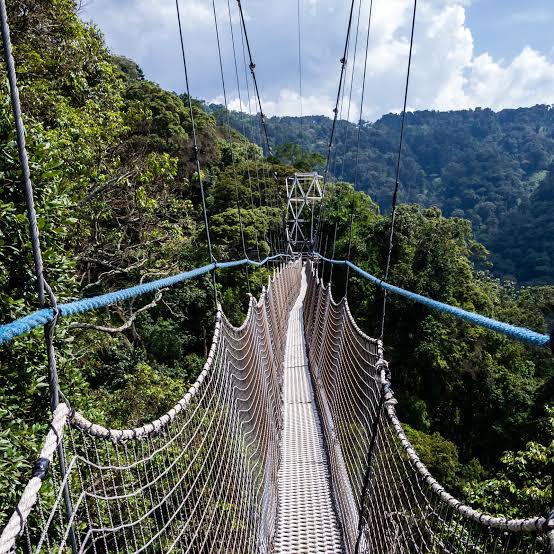
Nyungwe Forest National Park is a spectacular montane rainforest in Rwanda, famous for chimpanzee trekking, colobus monkeys, exceptional birdlife, hiking trails and the breathtaking Nyungwe Canopy Walkway.
Dawn in Nyungwe does not arrive all at once. The forest is still dark when the vehicle leaves the lodge, mist hanging low between the ridges and the first birds beginning to call somewhere beyond the road. Then, as the light reaches the canopy, the forest starts moving. A chimpanzee calls from somewhere ahead. Colobus monkeys shift through the treetops. Water drips from leaves that have probably been wet since the previous afternoon. There is no open savannah here, no horizon filled with elephants or giraffes. Nyungwe asks you to slow down and look into the forest.
Nyungwe Forest National Park lies in south-western Rwanda along the Congo-Nile Divide and protects approximately 1,019 square kilometres of ancient montane rainforest, bamboo forest, wetlands, peat bogs, grasslands and high-altitude habitats. The forest rises from around 1,480 metres to almost 2,950 metres above sea level and forms part of the Albertine Rift, one of Africa’s most biologically important regions. In 2023, Nyungwe National Park was inscribed on the UNESCO World Heritage List because of its exceptional biodiversity and importance for threatened and endemic species.
What sets Nyungwe apart from Rwanda’s other national parks is its concentration of primates and forest species. Chimpanzee trekking is the headline experience, but it is only part of the story. Nyungwe National Park is home to 13 recorded primate species, including eastern chimpanzees, Ruwenzori black-and-white colobus, L’Hoest’s monkeys, owl-faced monkeys, blue monkeys and vervet monkeys. A single observed Ruwenzori colobus community has numbered around 600 individuals, one of the largest primate groups ever recorded.
Then there are the birds. More than 300 bird species have been recorded in Nyungwe, including numerous Albertine Rift endemics. Orchids, butterflies, amphibians and rare forest plants make the park as important to botanists and birders as it is to primate enthusiasts. UNESCO records 1,468 species of vascular plants and 317 bird species for the World Heritage property, including globally threatened and endemic species.
For travellers arriving from Kigali, Nyungwe feels like entering another Rwanda. The cultivated hills gradually give way to tea estates, mist-covered ridges and dense forest. By the time you reach the park, the landscape has become darker, wetter and dramatically more mountainous.
If Volcanoes National Park is Rwanda’s destination for mountain gorillas, Nyungwe Forest National Park is the country’s great destination for chimpanzee trekking, forest hiking, canopy experiences and specialist birdwatching.
Nyungwe Forest National Park is a 1,019-square-kilometre montane rainforest protected area in south-western Rwanda. It is one of Africa’s most important forest biodiversity sites and is known for chimpanzee trekking, 13 primate species, exceptional birdlife, hiking trails, the Nyungwe Canopy Walkway and its 2023 UNESCO World Heritage status.
Location: South-western Rwanda, along the Congo-Nile Divide
Size: Approximately 1,019 square kilometres
Elevation: Approximately 1,480 to 2,950 metres above sea level
Established as a protected forest: 1933
National park status: 2005
UNESCO World Heritage Site: Inscribed in 2023
Managed by: Nyungwe Management Company under the African Parks partnership with the Government of Rwanda
Known for: Chimpanzee trekking, Ruwenzori black-and-white colobus, forest hiking, birdwatching and the Canopy Walkway
Primate species: 13 recorded species
Birdlife: More than 300 species recorded, including numerous Albertine Rift endemics
Main visitor areas: Uwinka, Gisakura, Gisovu and the surrounding forest trails
Nearest major city: Kigali, approximately 200 kilometres away by road depending on the route and destination within Nyungwe
Neighbouring landscape: Lake Kivu to the north-west and Burundi’s Kibira National Park along the southern border
Nyungwe’s importance extends beyond tourism. The forest is a major water catchment and feeds both the Congo and Nile drainage systems, making its conservation important far beyond Rwanda’s borders.
If there is one reason visitors choose Nyungwe National Park over other destinations in Rwanda, it is the primates.
The forest supports one of Africa’s richest montane rainforest primate communities, with chimpanzees and several monkey species sharing the same ecosystem. UNESCO notes that roughly one-fifth of Africa’s mainland primate species occur within the Nyungwe World Heritage property.
Chimpanzee trekking is the signature wildlife experience in Nyungwe Forest National Park.
The eastern chimpanzee lives in extended communities that move through the forest in search of fruit, leaves and other food. They can cover considerable distances during the day, which means chimpanzee trekking in Nyungwe is a genuine tracking experience rather than a guaranteed roadside sighting.
The morning begins early. Official visitor information notes that chimpanzee tracking starts around 5:30 a.m., and the trek can last from about an hour to several hours depending on where the chimpanzees are located. Once the group is found, visitors are allowed a maximum of one hour with the chimpanzees.
Often, you hear the chimpanzees before you see them.
Their calls travel surprisingly far through the forest, bouncing between ridges and trees. Your guide may stop, listen and change direction based on those calls before leading you deeper into the forest.
That uncertainty is part of what makes chimpanzee trekking in Nyungwe different from a conventional game drive.
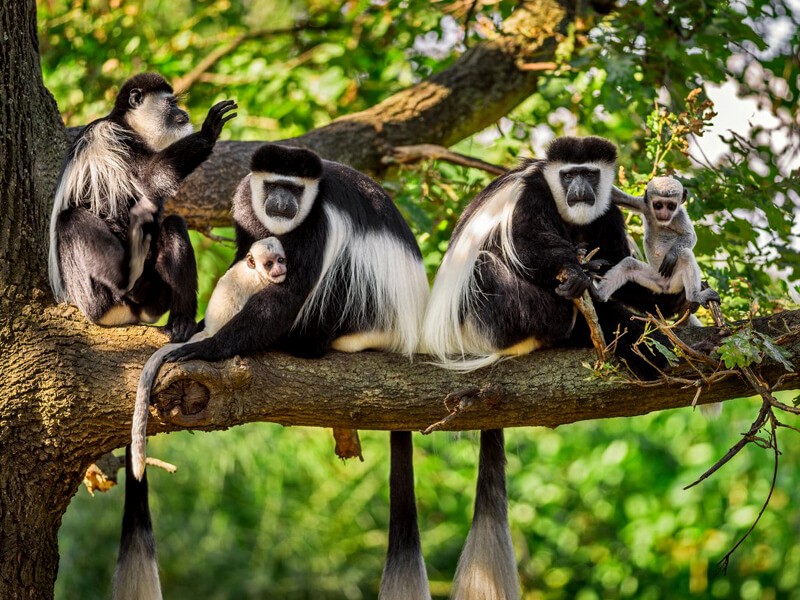
Nyungwe is particularly famous for its Ruwenzori black-and-white colobus monkeys.
These striking primates move through the canopy in large groups, their black bodies and long white hair contrasting sharply against the green forest. One observed community has reached approximately 600 individuals, making the species one of the park’s most spectacular wildlife attractions.
Unlike chimpanzee tracking, where the objective is usually to follow one community, colobus viewing can sometimes become a prolonged observation of an entire troop moving through the canopy.
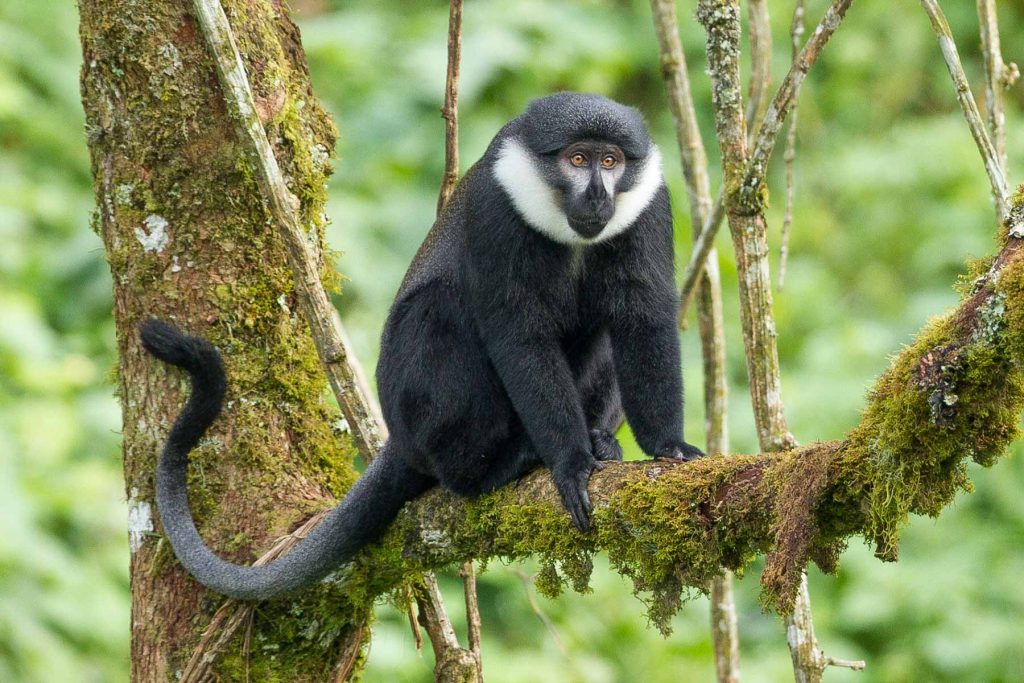
L’Hoest’s monkey is another important Nyungwe primate. It is associated with forest habitats and can be encountered along several hiking and primate-viewing routes.
Its darker coat and pale facial markings make it distinctive, although seeing one requires patience. Nyungwe’s dense vegetation means that many wildlife encounters happen in layers, with an animal appearing briefly before disappearing behind leaves.
Nyungwe National Park is also home to blue monkeys, owl-faced monkeys, vervet monkeys, Dent’s mona monkeys and other forest primates. No single trail guarantees a particular species, which is why specialist primate walks and longer stays can be worthwhile.
For wildlife enthusiasts, this is one of the biggest strengths of Nyungwe National Park: the experience is not built around one animal.
It is about the entire forest community.
Nyungwe National Park supports approximately 85 known mammal species, including eastern chimpanzees, Ruwenzori black-and-white colobus, L’Hoest’s monkeys, blue monkeys, owl-faced monkeys, duikers and several small carnivores. The park also has 13 recorded primate species and more than 300 bird species.
Nyungwe is not a traditional Big Five safari destination. There are no open savannah plains where large herds of zebra and wildebeest gather, and you should not visit Nyungwe expecting the type of wildlife viewing associated with Akagera National Park.
Instead, Nyungwe National Park rewards travellers who enjoy smaller, rarer and more specialised wildlife.
The forest contains approximately 85 known mammal species, including duikers, bushbuck, serval cats, African civets and other small carnivores. The mammal community also includes species associated with the Albertine Rift and montane forests.
The most sought-after sightings remain chimpanzees and colobus monkeys, but the forest is equally fascinating for those who enjoy amphibians, butterflies and plants.
Nyungwe has at least 1,100 recorded plant species according to African Parks, while UNESCO records 1,468 vascular plant species for the World Heritage property. A significant proportion are endemic to the Albertine Rift.
The forest floor is another world entirely. Mushrooms grow on fallen branches, vines climb enormous trunks, frogs hide beside streams and butterflies move through gaps in the canopy.
A good Nyungwe guide does not simply search for chimpanzees. They interpret the entire ecosystem.
Nyungwe National Park is one of Rwanda’s most important birdwatching destinations and one of the best places in the country to look for Albertine Rift endemics.
More than 300 bird species have been recorded, with UNESCO documenting 317 species and African Parks currently citing 345 species. Among them are approximately 30 Albertine Rift endemic species according to African Parks.
Birdwatchers can look for species associated with montane forest, bamboo, wetlands and open high-altitude habitats.
The forest is particularly rewarding early in the morning when bird activity is highest and the calls of different species echo through the valleys.
Nyungwe is also home to the Grauer’s swamp-warbler, whose population in the Kamiranzovu swamp is considered particularly important for conservation.
For serious birders, a dedicated guide and several days in Nyungwe can produce a completely different experience from a standard one-day visit.
Nyungwe is one of those destinations where slowing down improves the experience. A guest who spends three hours looking for chimpanzees and another two hours listening for forest birds may see less individual wildlife than someone driving through Akagera, but the encounters can be far more intimate.
Kibara Mugo, Safari Writer & East Africa Specialist
Chimpanzee trekking is the main reason most international visitors come to Nyungwe National Park.
The trek begins early in the morning, usually around 5:30 a.m., because chimpanzee communities are already moving through the forest by sunrise. Rangers and trackers monitor their movements and help guides locate the group before visitors enter the forest.
The terrain can be steep, muddy and physically demanding, particularly after rainfall. Once the chimpanzees are located, visitors spend up to one hour observing them before returning through the forest.
A reasonable level of fitness is useful, but the difficulty varies according to where the chimpanzees have moved that morning.
If chimpanzee trekking is the main purpose of your Nyungwe safari, we recommend allowing at least two nights in the area rather than trying to combine the trek with a rushed transfer.
The Nyungwe Canopy Walkway is one of the most recognisable experiences in Nyungwe National Park.
The suspension bridge stretches approximately 160 metres and hangs around 70 metres above the forest floor, giving visitors an elevated view across the rainforest canopy.
The Canopy Walkway is accessed through the Igishigishigi Trail or can be incorporated into longer hikes such as the Imbaraga and Umuyove trails.
Walking out over the bridge is only part of the experience. The trail leading to it passes through dense montane forest where butterflies, orchids, birds and primates may appear along the way.
For visitors who are not particularly interested in long hikes, the Canopy Walkway offers one of the easiest ways to experience Nyungwe’s forest from above.
Nyungwe National Park has an extensive network of hiking trails ranging from relatively easy walks to demanding full-day treks.
The trails reveal different sides of the forest, and choosing the right one depends on your interests and fitness level.
The Igishigishigi Trail is approximately 2.1 kilometres and is one of the more accessible routes in Nyungwe. It is particularly popular because it leads toward the Canopy Walkway and passes through impressive forest scenery and wildflowers.
The Umoyove, also known as the Mahogany Trail, passes beneath some of the forest’s taller trees and leads toward a waterfall.
It is particularly attractive for visitors who want to combine forest scenery, plant life and wildlife observation without committing to the longest hikes in Nyungwe.
The Imbaraga Trail is better suited to experienced hikers and covers close to 10 kilometres.
The trail passes through rugged forest terrain and offers several waterfalls, making it one of the more rewarding options for travellers who want a physically active Nyungwe experience.
Mount Bigugu is the highest peak within Nyungwe National Park.
The Bigugu Trail is a demanding hike but rewards hikers with high-altitude vegetation and expansive views when weather conditions are clear. From elevated viewpoints, Lake Kivu and the surrounding landscape may be visible.
Kamiranzovu is Nyungwe’s largest wetland and one of the forest’s most distinctive landscapes.
The swamp covers roughly 1,300 hectares at an elevation of around 1,950 metres and contains extensive peat deposits.
Walking through Kamiranzovu offers a completely different perspective from the dense rainforest. The wetland is also important for birdlife and ecological research.
The Isumo Trail combines tea-country scenery, rainforest and a large waterfall.
It is a good option for visitors who want a physical hike without making chimpanzee tracking the central activity of the day.
Rukuzi is particularly interesting for primate enthusiasts and provides opportunities for chimpanzee sightings as well as views toward Banda village.
The Irebero Trail follows some of the higher ridges of Nyungwe and offers views across the forest and, in favourable weather, toward Lake Kivu.
Birdwatching in Nyungwe can be arranged as a dedicated activity or combined with hiking.
The best approach is to start early, carry binoculars and allow enough time to stop frequently. The forest is not a destination where rushing from one viewpoint to another works particularly well.
A specialist birding guide can identify calls that an ordinary safari guide may simply hear as background forest noise.
Chimpanzees are not the only primates worth tracking in Nyungwe.
Dedicated primate excursions can focus on colobus monkeys, L’Hoest’s monkeys, blue monkeys and other species. Since different primates use different sections of the forest and different elevations, specialist tracking can add another dimension to a longer Nyungwe stay.
Nyungwe’s tourism offering has expanded beyond traditional hiking and wildlife tracking.
In 2025, the park introduced the Nyungwe Canopy Zipline, a 1,935-metre aerial experience described by African Parks as one of the longest in Africa. It begins near the Uwinka Visitor Centre and crosses the forest canopy in three sections.
For travellers looking for adventure alongside chimpanzee trekking and hiking, the zipline provides a very different way to experience the forest.
The Gisakura Rope Course was also introduced as part of Nyungwe’s newer tourism experiences.
It complements the traditional forest activities with a more active adventure component and can be incorporated into itineraries for families, couples and younger travellers depending on current operating conditions.
Tea estates surround sections of Nyungwe National Park and provide an interesting transition between cultivated Rwanda and the protected rainforest.
A tea plantation visit can be combined with a Nyungwe itinerary, giving travellers the opportunity to see how tea is cultivated in the cool highland environment before entering the forest.
Nyungwe contains several waterfalls accessible through hiking trails.
Waterfall walks are particularly rewarding after rain, when streams are full and the forest feels at its most dramatic.
The combination of steep terrain, mist, dense vegetation and flowing water is one of the reasons Nyungwe National Park feels so different from Rwanda’s savannah landscapes.
Nyungwe is a challenging but rewarding photography destination.
The dense forest means light levels can be low, especially beneath the canopy, while mist and rain can appear quickly. Fast lenses, weather protection and patience are more useful here than long telephoto lenses designed for open plains.
The Canopy Walkway provides a particularly strong photographic perspective, while chimpanzees and colobus monkeys offer opportunities for wildlife photography when conditions allow.
Do not pack for Nyungwe as if you are going on a conventional savannah safari. Waterproof hiking shoes, a lightweight rain jacket, insect protection and a small daypack are much more useful here than heavy safari clothing.
Nicholas Wangithi, Director & Founder
Nyungwe National Park became a UNESCO World Heritage Site in 2023.
The designation recognises the exceptional biological diversity of the forest and its importance to threatened and endemic species. The World Heritage property covers approximately 101,963 hectares and includes Nyungwe Natural Forest, Cyamudongo Natural Forest and Gisakura Natural Forest.
The park forms part of the Albertine Rift, a region with unusually high levels of endemism.
This means that some of the plants, birds, amphibians and mammals found in Nyungwe occur nowhere else, or almost nowhere else, on Earth.
For visitors, the UNESCO designation is more than a badge. It helps explain why Nyungwe feels so biologically dense despite being relatively compact compared with many African safari destinations.
One of the most fascinating features of Nyungwe National Park is its position along the Congo-Nile Divide.
Water flowing from the forest eventually feeds two of Africa’s major drainage systems. The Rukarara River begins within Nyungwe and eventually contributes to the Nile system, while other drainage flows toward the Congo Basin.
The forest therefore functions as both a biodiversity refuge and a major water catchment.
This is one reason conservation of Nyungwe matters far beyond the park boundary.
Kamiranzovu is one of the ecological highlights of Nyungwe National Park.
The vast high-altitude wetland sits within the forest and contains extensive peat deposits. Its vegetation, water and open marsh areas create a habitat very different from the surrounding rainforest.
The swamp is also significant for bird conservation, with UNESCO identifying it as an important habitat for Grauer’s swamp-warbler.
A visit to Kamiranzovu is therefore not simply a scenic walk. It is a chance to understand one of the ecological systems that makes Nyungwe such an important protected area.
Nyungwe has been protected as a forest reserve since 1933 and became a national park in 2005. Since 2020, African Parks has worked with the Government of Rwanda under a long-term management partnership focused on conservation, community development and sustainable tourism.
The conservation challenges are significant.
Nyungwe is surrounded by densely populated agricultural areas, creating pressure on the forest from human activity, illegal resource extraction and other threats. Conservation therefore depends not only on protecting the forest itself but also on creating economic opportunities for communities living around it.
African Parks reports that more than 1,600 local people are involved in sustainable economic activities through community cooperatives, benefiting more than 6,800 household members.
Tourism forms an important part of this model.
Responsible tourism in Nyungwe means following the forest’s rules and respecting its ecological sensitivity.
Visitors should remain on designated trails, follow the instructions of guides and rangers, avoid disturbing wildlife and carry out all waste.
Chimpanzee trekking requires particular care because visitors are entering the habitat of wild primates that are susceptible to human-borne diseases.
Keeping a respectful distance, avoiding loud behaviour and following the guide’s instructions are essential.
Tourism revenue also contributes to community development. UNESCO notes that Rwanda’s Tourism Revenue Sharing Programme allocates 10% of total park revenues to projects benefiting communities around protected areas, with an additional special guarantee fund supporting compensation for wildlife-related damage.
The idea is simple: the forest must have value for the people living around it if long-term conservation is going to succeed.
Nyungwe is not organised around a single gate in the way many savannah parks are.
The main visitor and operational areas include Uwinka, Gisakura and Gisovu, with different trails and activities accessed from different parts of the forest.
Uwinka is one of the main tourism hubs in Nyungwe and is particularly important for the Canopy Walkway and several hiking routes.
The Canopy Walkway is accessed through the Igishigishigi Trail from the Uwinka area.
Gisakura lies on the western side of Nyungwe and is an important base for accommodation, forest activities and access to trails.
It is also close to tea-growing areas, making it convenient for travellers who want to combine forest experiences with tea tourism.
Gisovu provides access to another section of the Nyungwe ecosystem and is useful for travellers exploring the park over several days rather than simply visiting for one activity.
The most common way to reach Nyungwe National Park is by road from Kigali.
The journey takes several hours and passes through Rwanda’s famous rolling hills, agricultural landscapes, tea plantations and eventually the dense rainforest of Nyungwe.
Rather than viewing the drive simply as a transfer, we recommend treating it as part of the safari experience.
The scenery changes dramatically as you move from central Rwanda toward the highlands of the south-west.
Travellers with limited time can consider flying into western Rwanda and arranging a road transfer toward Nyungwe, depending on current flight schedules and the exact itinerary.
For most visitors, however, the road journey remains the practical option because Nyungwe is usually combined with other destinations such as Kigali, Lake Kivu and Volcanoes National Park.
Nyungwe is roughly 200 kilometres from Kigali, although the actual travel time depends heavily on the route, road conditions and the specific lodge or park area being visited.
A road journey can take most of the day, which is why we normally recommend building Nyungwe into a multi-day Rwanda itinerary rather than attempting it as a quick overnight excursion.
Road travel makes more sense if you want to experience Rwanda’s countryside and combine Nyungwe with destinations such as Lake Kivu, cultural attractions or other national parks.
Flying or using a faster transfer arrangement makes more sense when time is limited and chimpanzee trekking is the primary purpose of the trip.
For first-time visitors to Rwanda, we generally prefer a road itinerary because the journey itself adds context to the destination.
The biggest mistake we see with Nyungwe is allowing only one night. If chimpanzee trekking is your priority, build at least two nights into the itinerary so that you have enough time for the trek, Canopy Walkway or another forest activity without turning the entire visit into a rushed transfer.
Hellen Asiko, Director & Guest Experience Curator
Nyungwe has a cool, wet montane rainforest climate.
It is significantly cooler and wetter than Rwanda’s lower-lying savannah areas because of its elevation and dense forest cover.
Rain can occur at almost any time, and visitors should be prepared for muddy trails even during periods that are generally considered drier.
The forest’s rainfall and mist are part of what create its extraordinary biodiversity.
For hiking, the most important consideration is therefore not simply whether it is the dry season but whether you are prepared for changing mountain weather.
Temperatures are generally comfortable for hiking compared with the heat experienced in many lowland safari destinations, although early mornings at higher elevations can feel cold.
Nyungwe National Park has a cool, humid montane rainforest climate with frequent rainfall and mist. Weather can change quickly, particularly on the higher trails, so visitors should carry waterproof footwear and a lightweight rain jacket throughout the year.
Nyungwe National Park has separate costs for park entry and individual activities.
Published Rwanda tourism pricing has listed chimpanzee trekking at USD 150 per person, park entry at USD 150 per person, and the Canopy Walkway at USD 40 per person for international visitors.
The Canopy Walkway’s currently published Visit Rwanda rates list USD 40 for international visitors, USD 20 for foreign residents in Rwanda/EAC, and USD 5 for Rwandan/EAC citizens.
Because activity prices and eligibility categories can change, we confirm the applicable rates when preparing a safari quotation rather than relying on an old published tariff.
For clients booking a complete safari through Afrikan Accent Adventures, we can package park fees, permits, accommodation, transfers, guiding and selected activities into one itinerary.
Published Rwanda tourism pricing lists international chimpanzee trekking at USD 150 per person, park entry at USD 150 per person and the Canopy Walkway at USD 40 per person. Current rates should be confirmed when booking because tourism tariffs can change.
Nyungwe National Park can be visited throughout the year.
The forest remains green and biologically active in every season, but weather conditions affect hiking, road travel and visibility.
The drier periods can make some trails easier to navigate, while wetter months produce especially lush vegetation, flowing waterfalls and excellent conditions for photographers who enjoy misty rainforest landscapes.
Chimpanzee trekking is possible throughout the year, but sightings are never guaranteed because chimpanzees move through a large forest environment.
Birdwatchers may prefer periods when migratory species add to the resident Albertine Rift birdlife.
For travellers whose priority is chimpanzee trekking, we recommend choosing the travel dates around the wider Rwanda itinerary rather than trying to identify one “perfect” month.
Two nights is the minimum we recommend for a first visit.
This allows time for chimpanzee trekking and one additional experience such as the Canopy Walkway or a short forest hike.
Three nights is our preferred option for travellers who want to experience Nyungwe properly.
You can combine chimpanzee trekking with the Canopy Walkway, birdwatching, a forest hike or another activity without making every hour of the itinerary feel scheduled.
Four nights or more is ideal for serious birders, hikers and repeat visitors.
It allows time for longer trails such as Bigugu, Imbaraga or Kamiranzovu, specialist primate viewing and a slower pace.
Two nights is enough for a first introduction focused on chimpanzee trekking and the Canopy Walkway. Three nights is better for combining several forest experiences, while four or more nights is ideal for hikers, birders and specialist wildlife travellers.
Nyungwe National Park offers a completely different safari experience from the savannah parks of East Africa.
There are no endless grass plains here.
Instead, there are ancient trees, mist-covered ridges, chimpanzee calls, enormous colobus troops, orchids, waterfalls, high-altitude wetlands and narrow trails disappearing into the forest.
The park also adds depth to a Rwanda itinerary.
A traveller can visit Volcanoes National Park for mountain gorillas, Akagera National Park for savannah wildlife and then continue to Nyungwe National Park for chimpanzees and rainforest.
Few countries in Africa allow such dramatically different wildlife experiences within one relatively compact itinerary.
The UNESCO World Heritage status adds another reason to visit. Nyungwe is not simply a scenic forest; it is one of the most biologically significant protected areas in the Albertine Rift.
Nyungwe safari prices vary according to accommodation, number of travellers, season, activities and transport arrangements.
As a planning guide, a short Nyungwe experience can range from several hundred dollars per person for simpler accommodation and shared arrangements to well over USD 1,000 per person for premium private itineraries with luxury accommodation, private transport and multiple activities.
Published 2026 Rwanda tourism packages currently show a two-day Nyungwe chimpanzee trekking experience from approximately USD 987 per person, while a four-day Nyungwe Forest and Lake Kivu experience is advertised from approximately USD 1,560 per person. These are package examples rather than universal Nyungwe safari rates, and the final price depends on the itinerary and accommodation selected.
Accommodation is usually the largest variable.
A simple guesthouse or campsite produces a very different budget from a luxury forest lodge, while private vehicles and specialist guides add to the overall cost.
Nyungwe safari costs vary considerably, but current Rwanda package examples show two-day chimpanzee experiences from around USD 987 per person and four-day Nyungwe-Lake Kivu experiences from around USD 1,560 per person. Your final cost depends on accommodation, transport, permits, park fees and activities.
We build Nyungwe National Park into Rwanda itineraries in several different ways.
A Nyungwe Chimpanzee Safari focuses on chimpanzee trekking, forest walks and the Canopy Walkway.
A Nyungwe and Lake Kivu Safari combines the rainforest with the lake’s beaches, islands and relaxed lakeside atmosphere.
A Rwanda Primates Safari combines Nyungwe chimpanzee trekking with mountain gorilla or golden monkey experiences in Volcanoes National Park.
A Rwanda National Parks Safari can combine Akagera National Park, Nyungwe National Park and Volcanoes National Park, creating a complete journey through Rwanda’s savannah, rainforest and volcanic ecosystems.
African Parks describes Nyungwe, Akagera and Volcanoes as part of Rwanda’s national three-park tourism route.
For travellers who want something slower, we can build a dedicated Nyungwe itinerary around chimpanzee trekking, hiking, birdwatching and forest photography.
Accommodation around Nyungwe ranges from luxury forest lodges to campsites and simpler guest accommodation.
One of the best-known luxury properties is One&Only Nyungwe House, positioned on the edge of the forest near tea country.
For travellers seeking a more conservation-focused experience, Munazi Eco Lodge was introduced as a new park tourism property in 2025. African Parks describes the lodge as a community-rooted development offering forest access and wildlife experiences.
Camping is also becoming increasingly important in Nyungwe.
African Parks reports that new self-catering campsites have been developed along long-distance trails, including the 100-kilometre Nshili-Gisovu Trail and the Cyinzobe Trail.
We match accommodation to the traveller rather than simply recommending the most expensive property.
A couple looking for privacy may prefer a luxury forest lodge, while a hiker may value proximity to trails and a traveller focused on chimpanzees may prefer the most practical location for early morning access.
Volcanoes National Park is Rwanda’s destination for mountain gorilla trekking and golden monkey experiences.
Nyungwe National Park is Rwanda’s destination for chimpanzees, colobus monkeys, rainforest hiking and forest biodiversity.
The two parks therefore complement each other rather than compete.
A traveller interested in primates can visit both and experience two completely different ecosystems.
Gorillas live in the high volcanic forests of the Virunga Mountains.
Chimpanzees live in the dense montane rainforest of Nyungwe.
Doing both is one of the strongest wildlife combinations Rwanda offers.
Akagera National Park is a classic East African savannah destination, with open plains, wetlands, elephants, lions, giraffes, zebras and other large mammals.
Nyungwe is almost the opposite.
It is mountainous, wet, densely forested and focused on primates, birds and smaller forest species.
If you have time for only one park, the choice depends on what you want.
Choose Akagera for traditional game drives and large mammals.
Choose Nyungwe for chimpanzees, rainforest and hiking.
For a complete Rwanda safari, however, we recommend experiencing both.
The Masai Mara is built around open grasslands, large herbivore populations and high predator densities.
Nyungwe is a forest ecosystem where visibility is limited and wildlife encounters are more intimate.
A Mara safari may involve watching lions hunt from a vehicle across an open plain.
A Nyungwe experience may involve standing quietly beneath a canopy listening to chimpanzees calling from somewhere above.
Neither replaces the other.
They represent two completely different interpretations of an African safari.
Nyungwe National Park is an important example of conservation-led tourism in Rwanda.
The park’s management partnership with African Parks focuses on protecting biodiversity while developing tourism and community benefits around the forest.
Community cooperatives support sustainable livelihoods around the park, while tourism revenue contributes to national and community programmes.
The goal is to make the forest economically valuable without turning it into a resource that is consumed.
For visitors, responsible tourism means following trails, respecting wildlife distances, avoiding litter and listening to the guide.
It also means understanding that chimpanzee trekking is not simply entertainment.
You are entering the habitat of intelligent wild animals and should behave accordingly.
Nyungwe is one of the places where responsible tourism is most visible. Every time a visitor pays for a guide, books a permitted activity or chooses accommodation connected to the conservation economy, they are contributing to a system that gives the forest value beyond timber, mining or agricultural expansion.
Hellen Asiko, Director & Guest Experience Curator
From the first chimpanzee call before sunrise to the final steps across the Canopy Walkway, Nyungwe National Park is a destination built around discovery.
It is Rwanda’s great rainforest experience.
Chimpanzee trekking brings you into the forest.
The colobus monkeys keep you looking upward.
The birds keep you listening.
The hiking trails reveal waterfalls, wetlands and mountain ridges.
The Canopy Walkway changes your perspective completely.
And the UNESCO World Heritage designation reminds you that what you are walking through is not simply beautiful, but globally important.
We build Nyungwe safaris as standalone forest journeys, as part of a Rwanda primate safari with Volcanoes National Park, or as a longer itinerary combining Kigali, Akagera, Lake Kivu and Nyungwe.
For travellers who want more than a conventional game drive, Nyungwe offers something genuinely different.
You do not come here to watch the wilderness from a distance.
You come into the forest.
And once the canopy closes behind you, the forest takes over.
Home to 13 primate species, including wild chimpanzees, and over 320 bird species, Nyungwe Forest National Park is one of Africa's oldest rainforests. Trek through ancient forest trails, cross the spectacular Canopy Walkway, and discover one of Rwanda's richest biodiversity hotspots in an unforgettable wilderness adventure.
Track habituated chimpanzees through one of Africa's oldest rainforests with experienced park guides.
Walk across a 160-metre suspended bridge, 70 metres above the forest floor, for breathtaking views of the rainforest canopy.
Discover 13 primate species, including L'Hoest's monkeys, Ruwenzori colobus monkeys, grey-cheeked mangabeys, and blue monkeys.
Spot over 320 bird species, including numerous Albertine Rift endemics, making the park a paradise for bird enthusiasts..
Visit hidden waterfalls and crystal-clear streams surrounded by lush tropical vegetation
Explore more than 130 km of well-maintained trails leading through ancient rainforest, waterfalls, ridges, and tea plantations
Engage with local communities through traditional dance performances, handicrafts, and cultural village visits.
Visit nearby tea estates to learn about Rwanda's renowned tea industry while enjoying spectacular views over rolling hills.

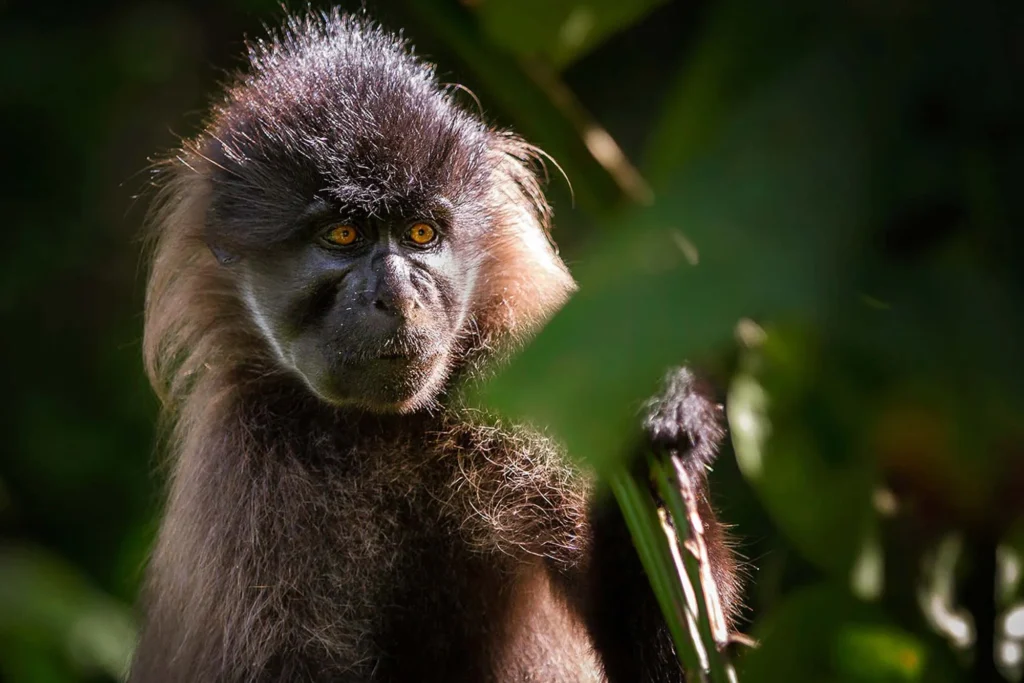
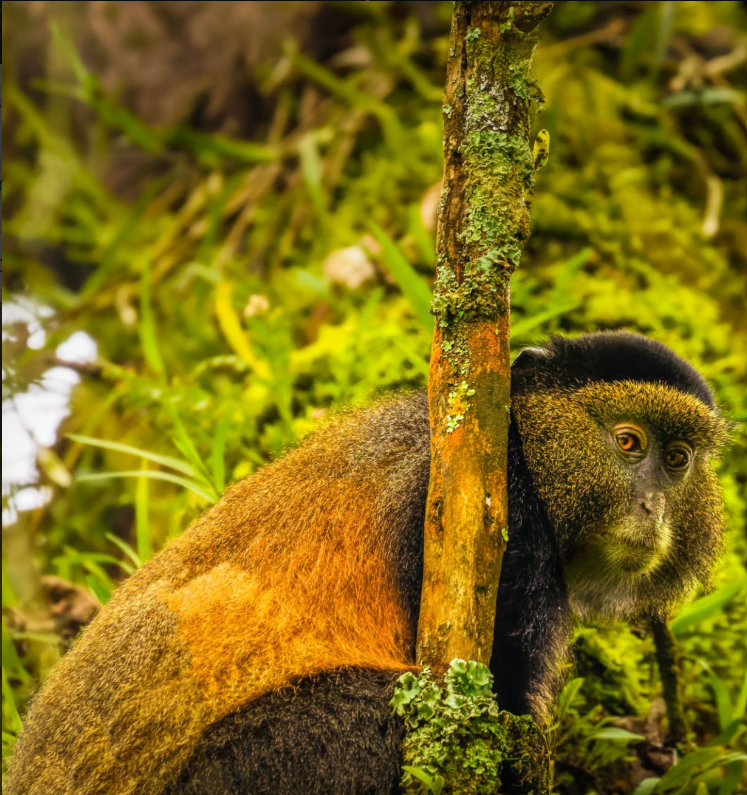
From value camps to premium lodges — we match every stay to your style and budget.
Budget accommodation around Nyungwe Forest National Park provides clean, comfortable rooms with essential amenities, making it ideal for backpackers, solo travellers, and budget-conscious adventurers seeking affordable access to the rain forest.
Mid-range lodges combine comfort, warm Rwandan hospitality, and excellent access to chimpanzee trekking, canopy walks, and hiking trails, making them ideal for couples, families, and nature enthusiasts.
World-class lodges and exclusive camps in private conservancies. Night drives, bush walks, spa, and personalized service — the ultimate safari experience.
Every season has its magic — here's what to expect when, so you can travel at your perfect time.
Everything you need to know before you go — and we’ll guide you through every step.
Most international visitors can obtain a Visa on Arrival or apply online before travelling to Rwanda. Citizens of East African Community (EAC) member states can enter using a valid national ID or passport
The official currency is the Rwandan Franc (RWF). Major hotels, lodges, and tour operators accept Visa and Mastercard, while cash is useful for tips, souvenirs, and purchases in local communities.
The official languages are Kinyarwanda, English, French, and Swahili. English is widely spoken by park guides, rangers, and hospitality staff..
Central Africa Time (CAT) – UTC +2
Nyungwe Forest National Park has a cool montane rainforest climate due to its high elevation. Temperatures typically range between 10°C and 22°C (50°F–72°F), with mist and occasional rainfall throughout the year.
through a country with a risk of yellow fever transmission. Good physical fitness is recommended for chimpanzee trekking and longer forest hikes.
Chimpanzee trekking is one of the park's signature experiences. Treks are led by experienced rangers and can last 2–5 hours, depending on the location of the chimpanzee troops. Visitors must be at least 15 years old to participate.
The park is best explored on guided excursions. Most visitors travel by 4x4 vehicle from Kigali, while guided nature walks, chimpanzee treks, and birdwatching tours are organised from the park's visitor centres.
Mobile phone coverage is available around the park and nearby towns, although reception may be limited in remote forest areas. Most lodges provide Wi-Fi in public guest areas.
Pack waterproof hiking boots, long trousers, a waterproof jacket, warm layers, gardening gloves for gripping vegetation, insect repellent, sunscreen, a reusable water bottle, binoculars, and a camera without flash for wildlife photography.
Nyungwe Forest National Park is renowned for chimpanzee trekking, the Canopy Walkway, rich biodiversity, and one of Africa's oldest montane rainforests. It is also home to 13 primate species and over 320 bird species.
The park is located in Western Province, southwestern Rwanda, approximately 225 km (140 miles) from Kigali
The best time to visit is during the dry seasons (June–September and December–February), when hiking trails are drier and wildlife viewing conditions are at their best.
Park entry for international non-residents starts from USD 100 per adult per day. Activities such as chimpanzee trekking and the Canopy Walkway require additional permits or fees.
A chimpanzee trekking permit costs USD 150 per non-resident adult, in addition to the park entry fee.
Chimpanzee trekking is considered moderately challenging. Visitors should be prepared for hikes lasting 2–5 hours over uneven, sometimes steep and muddy terrain.
No. The minimum age for chimpanzee trekking is 15 years.
Visitors may encounter chimpanzees, L'Hoest's monkeys, Ruwenzori colobus monkeys, grey-cheeked mangabeys, blue monkeys, bushbuck, black-fronted duikers, and over 320 bird species, including many Albertine Rift endemics.
A stay of 2–3 days is recommended to enjoy chimpanzee trekking, the Canopy Walkway, hiking trails, birdwatching, and cultural experiences.
Yes. Nyungwe is commonly combined with Kigali, Lake Kivu, Volcanoes National Park, and Akagera National Park to create a diverse Rwanda itinerary featuring gorilla trekking, Big Five safaris, rainforest adventures, and lakeside relaxation.
From a generator that switches off at ten to a Land Cruiser fitted with its own charging console,…
Read more →
A working checklist from a Nairobi ground operator on licensing, red flags and the questions that separate real…
Read more →
Both parks hold the same herds and the same rivers, but the border between them changes your budget,…
Read more →Tell us what you’d love to see and a local specialist will design a tailor-made itinerary around you — no obligation, reply within 24 hours.