When to See the Great Migration: A Month-by-Month Guide
The wildebeest migration is a year-round journey, not a single event. Here's where the herds are in every month — so you can plan around the moment you most want to witness.
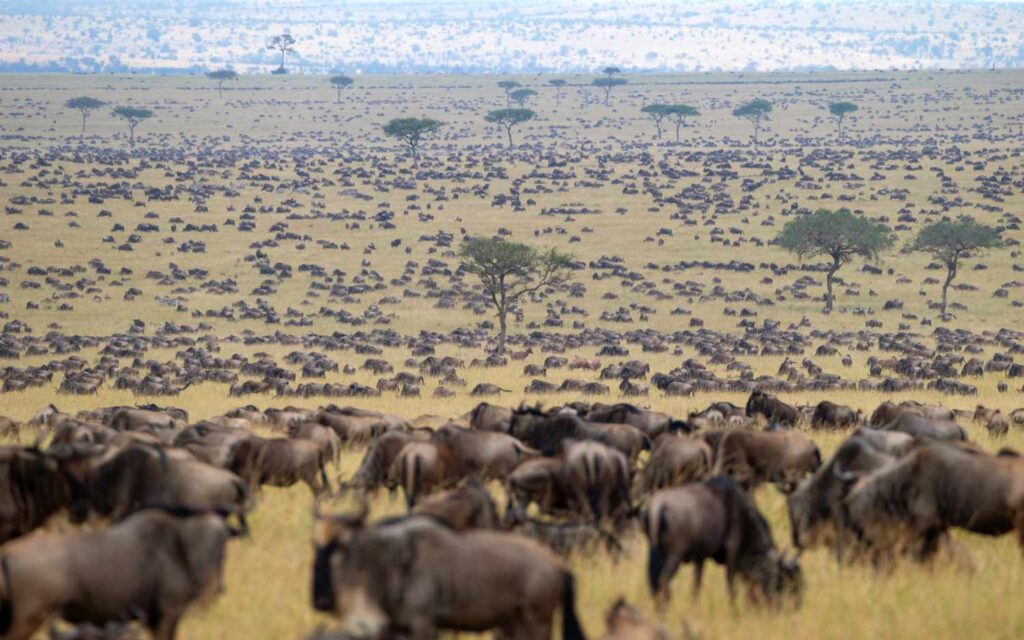
Ask ten travellers when the Great Migration “happens” and you’ll get ten different answers — usually August, usually the Masai Mara. But the truth is more wonderful: over 1.5 million wildebeest, plus hundreds of thousands of zebra and gazelle, are always on the move, tracing a great clockwise loop across the Serengeti–Mara ecosystem.
Knowing where they are in a given month is the single biggest factor in planning a migration safari. Here’s how the year breaks down.
December to March — Calving on the southern plains
As the short rains green the southern Serengeti and the Ndutu plains, the herds gather to give birth. In a roughly three-week window around late January to February, almost half a million calves are born — sometimes 8,000 in a single day. It is a season of new life and, inevitably, of predators.

April to June — The rut and the long march north
As the plains dry, the herds begin their long trek north and west, and the breeding season — the rut — gets under way. Columns of wildebeest stretch for kilometres. This transitional period rewards travellers who want the spectacle of sheer numbers without the peak-season crowds.
July to October — The river crossings
This is the chapter most people picture: the herds reach the Mara River and must cross crocodile-infested waters to continue north. There is no fixed schedule — crossings depend on rain, grass and the herd’s collective nerve — which is exactly why an expert local guide is priceless.
You can wait hours at the river’s edge and then, in a heartbeat, the bank dissolves into thunder and dust. There is nothing else like it on earth.
— Joseph M., Lead Safari Guide
🗝 Key takeaways
- Jan–Feb: calving & big cats on the southern Serengeti — great value.
- Apr–Jun: the rut & the long march — huge numbers, fewer crowds.
- Jul–Oct: the Mara River crossings — the iconic spectacle, peak season.
The single most useful thing you can do is travel with people who read the herds for a living. Tell us when you’d love to travel and we’ll build the route around the moment you most want to see. Start with a free, no-obligation plan →
Let's plan your East African safari
Tell us when you'd love to travel and a local specialist will craft a tailor-made route around you.